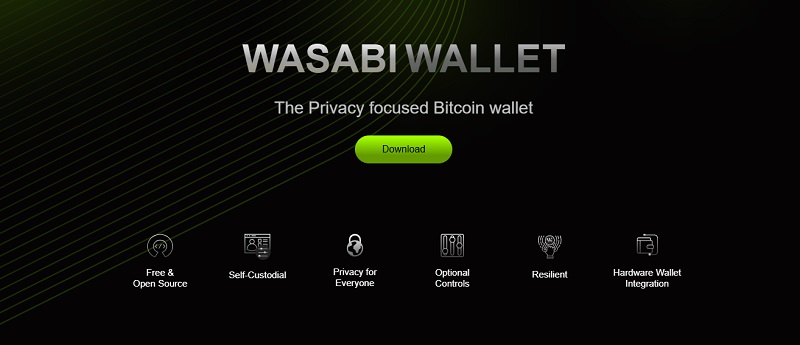
The service Wasabi Wallet is a desktop software solution for storing Bitcoin, focused on self-custody, transaction privacy, and complete control over individual unspent transaction outputs (UTXOs). The project was unveiled by Ádám Ficsor in 2018, with version 1.0 launching later that year. Built exclusively for the Bitcoin network on Windows, Linux, and macOS, the non-custodial WasabiWallet is free and open-source under the MIT license.
Key features include coin control, default Tor routing, hardware device integration, and CoinJoin privacy protocols. Users should note that zkSNACKs permanently discontinued its proprietary CoinJoin coordinator service in 2024, separating the core application software from legacy infrastructure.
Wasabi Wallet Supported Cryptocurrency
The Wasabi Wallet operates with Bitcoin (BTC) as its sole asset.
The software architecture focuses entirely on the UTXO model and Bitcoin privacy standards. Native support extends across all primary address types:
Legacy (1...)
P2SH (3...)
Native SegWit (bc1q...)
Taproot (bc1p...)
Service Asset Coverage
| Asset / Network | Support Status | Notes |
|---|
| Bitcoin (BTC) | Supported | Primary and exclusive asset |
| Bitcoin Mainnet | Supported | Core production network |
| Bitcoin Testnet | Supported | For development and testing |
| Altcoins / Tokens | Not Supported | Purely a single-asset solution |
Core Functions Available in Wasabi Wallet
The WasabiWallet concentrates on essential blockchain mechanics rather than copying traditional exchange interfaces.
Key features include:
Address generation for receiving BTC
On-chain outgoing transactions
Isolated multi-wallet creation
Granular UTXO management (coin control)
Transaction labeling and pre-send privacy scoring
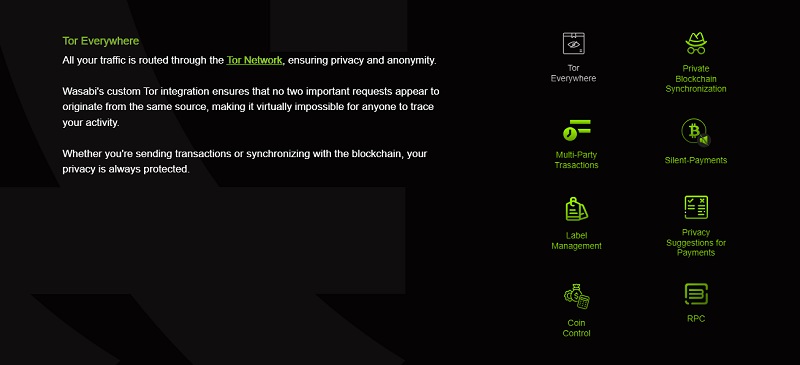
Default Tor traffic routing
Hardware wallet connectivity via HWI (Trezor, ColdCard, Ledger, Jade, BitBox02)
Full Node integration and seed phrase recovery (BIP-39 / SLIP-39)
Granular coin control allows users to select specific outputs based on history and privacy scores, with built-in alerts preventing address reuse or public change creation.
How to Start Using Wasabi Wallet
No accounts or KYC verification are required. Users download the desktop installer from the official website wasabiwallet.io — verifying PGP signatures to guard against counterfeit binaries — and create or import a vault locally.
Backup options include 12-word BIP-39 mnemonics or SLIP-39 multi-share schemes paired with a mandatory user passphrase.
Consequently, the concept of a Wasabi Wallet personal account is fundamentally different from a profile on a centralized platform. There is no remote profile or server-side database. A Wasabi Wallet personal account refers strictly to a locally encrypted file stored on your drive; losing the seed phrase or passphrase permanently locks access to the underlying funds.
Wasabi Wallet Deposits and Bitcoin Withdrawals
Fiat on-ramps (USD, EUR) are not natively integrated. To fund the client, users generate a fresh receiving address and transfer BTC from an external venue.
Sending funds follows standard on-chain steps:
The process of withdrawing money from Wasabi Wallet is simply an on-chain Bitcoin transfer. There are no intermediary reviews or administrative holds. Successful execution when withdrawing money from the platform requires only confirmed UTXOs, an adequate fee balance, and the correct decryption passphrase.
Deposit and Withdrawal Model
| Operation | Execution Mechanism | Associated Costs / Requirements |
|---|
| Receive BTC | Generate fresh receiving address | Sender pays network fee |
| Send BTC | Local signing and P2P broadcast | Bitcoin mining fee |
| Recover Funds | Import seed phrase and passphrase | No service fee |
| Unstick Payment | Fee bumping via RBF / CPFP | Additional network fee |
Wasabi Wallet Fees and Transaction Costs
The Wasabi Wallet software itself charges no service fees. Transacting incurs only standard Bitcoin network miner fees, calculated via real-time estimates (mempool.space, blockstream.info) with full manual adjustment available.
Regarding CoinJoin, client version 2.2.0.0 and later participates strictly in rounds where users pay only for consumed blockspace, with zero coordinator fees. This follows the 2024 shutdown of the zkSNACKs coordinator. Older reviews referencing mandatory zkSNACKs service charges no longer apply.
Privacy and CoinJoin Functions of Wasabi Wallet
Privacy is central to the application. Traffic is anonymized through Tor by default, while WabiSabi CoinJoin protocols combine inputs and outputs from multiple participants into single collaborative transactions to obscure transaction history.
Because Bitcoin remains a public ledger, final privacy relies heavily on post-mix coin handling and counterparty hygiene. Built-in pre-send analysis flags risks, such as combining private outputs with labeled public coins.
Security and Backup Architecture of Wasabi Wallet
Private keys remain client-side at all times. Restoring access requires both the recovery mnemonic and the passphrase.
Users can also back up the encrypted local vault file (wallet.json) to preserve custom labels and transaction graph history. Because the WasabiWallet is entirely non-custodial, there is no centralized support team capable of resetting lost credentials.
Technical Platform and Device Compatibility of Wasabi Wallet
The Wasabi Wallet is strictly a desktop application, supporting:
Windows 10/11,
macOS 14+,
Ubuntu,
Fedora,
Debian.
No official mobile versions exist. Fake apps periodically surface on mobile app stores, which community advisories confirm are scams. Development is maintained publicly on GitHub.
Software Technical Parameters
| Parameter | Specifications |
|---|
| Project | Wasabi Wallet |
| Inception | 2018 |
| Supported Asset | Bitcoin (BTC) |
| Custodial Model | Non-Custodial |
| License | Open Source (MIT) |
| Platforms | Windows, Linux, macOS |
| Mobile Support | None (Desktop Only) |
| Privacy Mechanics | Tor, CoinJoin (WabiSabi), UTXO Control |
| Hardware Devices | Trezor, ColdCard, Ledger, Jade, BitBox02 |
| Domain Created | April 26, 2018 |
| Infrastructure | Cloudflare (San Jose, CA, USA) |
Background and Domain Information of Wasabi Wallet
Originating from the 2015 Hidden Wallet project, Wasabi launched its 1.0 release in October 2018, backed by corporate developer zkSNACKs Ltd. Following zkSNACKs' coordinator shutdown in 2024, the project operates as pure open-source software.
DomainTools data:
Domain created on: April 26, 2018
Updated on April 27, 2026,
IP location: San Jose, California, USA, and Cloudflare as the infrastructure provider.
Organization: Domains By Proxy, LLC.
The domain wasabiwallet.io therefore roughly corresponds to the project's publicly documented launch period. However, domain ownership information alone does not establish the identity of the current legal operator because privacy-proxy services can conceal the underlying registrant.
Client Feedback and Wasabi Wallet Reviews
An unclaimed Trustpilot entry for wasabiwallet.io holds a ~2.4/5 rating, though Trustpilot notes the small sample size (six entries, mostly from 2020–2021) makes the score unrepresentative.
Current user sentiment across technical forums is mixed:
Positive Wasabi Wallet reviews: Experienced users praise its granular UTXO control, interface alerts, and native hardware integration.
Negative Feedback: Criticisms center on node sync delays or misattributed fund losses, which community investigations routinely link to phishing scams or fake software downloads.
Security Disclosures: In July 2024, developers patched an exploit targeting build pipelines and free coordinators. Recent WasabiWallet reviews continue to urge strict caution regarding fake mobile applications.
Contacts and Customer Support for Wasabi Wallet
Support is structured around open-source developer channels rather than traditional call centers. Inquiries are handled via:
Risk Assessment and Expert Conclusion for WasabiWallet
| Evaluation Criteria | Status |
|---|
| Operating History | Established (Since 2018) |
| Custody Model | Non-Custodial |
| Asset Support | Bitcoin Only |
| Source Transparency | High (Open Source) |
| Privacy Mechanics | Advanced |
| Fee Structure | Network Fees Only |
| Mobile Access | None |
| Risk Profile | Medium Risk |
Final Verdict on Wasabi Wallet
WasabiWallet is a Medium Risk privacy tool. The risk classification is tied to the inherent responsibilities of self-custody and UTXO management rather than counterparty or solvency concerns.
Suitable For: Advanced Bitcoin users, privacy-conscious holders, hardware wallet owners, and users requiring granular UTXO management via open-source software.
Less Suitable For: Beginners needing simple mobile access, multi-asset investors (ETH/USDT), or users requiring 24/7 live customer assistance.
Recommendation: Always download binaries directly from wasabiwallet.io and verify PGP signatures prior to setup.


