BitMart Wind-Down 2026: Why Crypto Offboarding Face Friction
- What Triggered Market Scrutiny?
- Why Is the Service Sunsetting?
- Structural Exit Timeline
- Official Stance on Capital Redemptions
- Why Users Face Processing Delays
- Is This a Blockchain Bottleneck?
- Outbound Asset Processing Stages
- The Unpublished Audit Report
- On-Chain Data Signals
- Does BitMart Face a Liquidity Deficit?
- What "Orderly Wind-Down" Implies
- Potential Operational Outcomes
- Lessons From Past Market Events
- Recommended Steps for Account Holders
- Guarding Against "Recovery" Scams
- Australian Licence Protections Explained
- Key Unanswered Questions
- Fact Check: Confirmed Realities vs. Claims
- Conclusion
- FAQ
- Sources
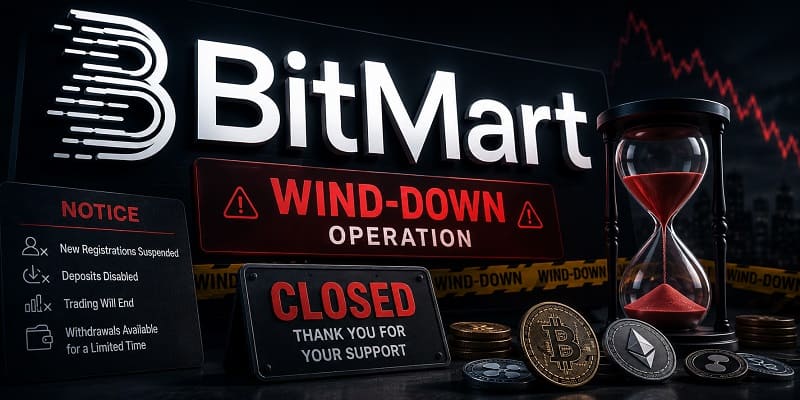
The planned cessation of operations at BitMart has expanded beyond a standard service transition. On July 26, 2026, leadership announced a structured exit plan. New client registrations and inbound asset flows were suspended immediately, spot/futures trading halts on August 26, and full technical systems power down on January 31, 2027.
The central friction centers on public feedback. Community threads around August 1 outlined profile restrictions, pending disbursement tickets, unreceived multi-factor security codes, and delayed desk responses. One account holder reported a submission from July 27 remaining stuck days later, while another noted $8,000 locked inside the portal. Though unconfirmed, similar complaints continue to surface.
What Triggered Market Scrutiny?
Industry analysts and media outlets quickly flagged the development. Sheldon Xia, founder of the business, publicly refuted claims of capital misuse, stating that internal teams were actively performing balance sheet checks, consolidating treasury reserves, and maintaining system stability.
Concurrently, an OpenGradient executive claimed market-making capital was trapped on the CEX, raising open questions regarding overall liquidity. These assertions remain unverified, and no regulatory body or independent auditor has confirmed financial distress.
This leaves depositors with a key question: are processing delays caused by strict security filters during a phased exit, or do they indicate balance sheet illiquidity?
Why Is the Service Sunsetting?
Management has not linked the departure to insolvency, cyber incidents, or regulatory enforcement. Initial notices cited internal reviews of market conditions, corporate strategy, and long-term viability, describing the event as an "orderly cessation of operations."
The sudden move caught observers off guard given the exchange's recent expansion efforts. On June 25, the organization disclosed obtaining an Australian Financial Services Licence (AFSL), highlighting service coverage for over 13 million registered profiles across 180 jurisdictions.
Official ASIC updates from June 25 confirm local regulatory frameworks were undergoing transitional adjustments, extending no-action positions for qualifying digital asset entities through September 30, 2026.
While no evidence links Australian regulatory adjustments to the global exit, the operational shift remains notable.
Structural Exit Timeline
| Date | Event | Impact |
|---|---|---|
| May 23, 2026 | Balance sheet audit roadmap announced | Solvency metrics enter public view |
| June 25 | Australian licensing approval disclosed | Business projects global growth |
| July 24 | Automated market maker (AMM) suite retired | Service offerings begin shrinking |
| July 25 | Margin trading capabilities paused | Further operational contraction |
| July 26 | Formal sunset notice published | Onboardings and inbound deposits blocked |
| July 27 onward | Off-chain asset movements encounter lag | Client access friction escalates |
| August 1 | Community forums report persistent processing delays | Public scrutiny deepens |
| August 8 | Leadership refutes asset misuse allegations | Executives address client concerns |
| August 10 | Claims of locked market-maker capital surface | Venue liquidity comes into question |
| August 26 | Order book execution permanently stops | Core interface transitions to read-only |
| January 31, 2027 | Final technical shutdown | Full platform power-down |
Official Stance on Capital Redemptions
Official updates maintain that disbursement infrastructure remains functional. Guidance advises account holders to complete identity verification and submit off-platform transfer submission before 05:00 UTC on August 26, 2026.
However, policy terms grant compliance teams broad authority to place requests into extended manual queues.
Potential verification checks cover:
- KYC and profile validation
- Device fingerprinting and IP verification
- Destination address risk screening
- Source-of-funds verification
- Historical trading activity
- Travel Rule compliance matching
- Global sanctions registry screening
- Destination wallet ownership proof
The provider explicitly notes that logging an instruction does not guarantee immediate blockchain dispatch. Queues build up from volume spikes, manual document checks, or risk controls.
Also Read: AscendEX Shutdown: What Happens to Customer Funds When an Exchange Leaves the EU?
Why Users Face Processing Delays
Community forums present a contrasting picture. Discussions in early August reported immediate submission rejections or transfers lingering in "created" status. Others cited delivery issues with 2FA authorization codes needed to approve outgoing transfers.
Subreddit discussions dedicated to the hub noted small-value orders processed periodically, whereas larger capital instructions stalled in queues.
- Request Submission: The user logs an outbound order.
- Security Evaluation: Account security and device profiles are checked.
- Compliance Review: The entry undergoes AML and sanctions screening.
- Liquidity Staging: Approved transfers move to hot-wallet queues.
- On-Chain Broadcast: The transaction is dispatched to the public ledger.
When smaller transactions clear while larger amounts stall, internal risk thresholds and reserve management — rather than public network congestion — are driving delays.
Is This a Blockchain Bottleneck?
Public ledger performance is rarely the primary bottleneck. While blockchains occasionally face gas spikes or block congestion, internal systems dictate when a payload is released to the network.
Company guidance points to internal risk workflows, account checks, and compliance filters as primary causes. Consequently, an unfulfilled instruction sits inside internal database queues long before reaching an on-chain mempool.
Outbound Asset Processing Stages
| Workflow Phase | Procedure | Delay Source |
|---|---|---|
| Request Logging | Outbound ticket registered | Internal database buffer |
| Security Audit | Device profile and IP checked | Manual inspection hold |
| Compliance Review | AML and source-of-funds scan | Document submission required |
| Vault Staging | Token assignment from reserves | Hot-wallet rebalancing lag |
| Chain Dispatch | TXID created and broadcast | Mempool or fee spike congestion |
| Block Settlement | Distributed ledger validation | Standard protocol latency |
If an instruction lacks a valid TXID, processing delay rests entirely within internal exchange infrastructure rather than on the public blockchain.
The Unpublished Audit Report
Questions surrounding reserve backing resurfaced during the exit. On May 23, management acknowledged requests for asset auditing, stating preparations were underway to publish verifiable proof once security protocols were met.
No complete audit appeared before payout concerns intensified. While an unpublished audit does not confirm a treasury deficit, reserve snapshots help verify whether liabilities are fully backed by accessible wallets. Without third-party attestations, clients lack verified proof of complete asset backing.
On-Chain Data Signals
Analytics firms noted shifts across identified exchange wallet addresses. Reports highlighted balance drops in tracked wallets as redemption requests rose following the exit announcement.
Interpreting on-chain metrics requires context:
- Centralized hubs distribute assets across hot wallets, cold vaults, third-party custodians, and institutional liquidity pools.
- A balance drop in visible public addresses does not automatically equate to total capital depletion.
- Visible reserves do not show off-balance-sheet liabilities or debt obligations.

Does BitMart Face a Liquidity Deficit?
No verified evidence proves the venue is insolvent. However, several factors explain the ongoing scrutiny:
- Outbound transfer delays started immediately after the wind-down notice.
- The promised Proof-of-Reserves framework was not published prior to closure.
- Market participants publicly claimed institutional funds were inaccessible.
- Executive updates confirmed capital consolidation without publishing audited figures.
These factors warrant careful risk management, though they do not constitute a formal finding of insolvency.
What "Orderly Wind-Down" Implies
An orderly wind-down indicates an intent to sunset operations methodically rather than halting infrastructure abruptly. Management confirmed login access and historical record exports will remain available past the primary trading deadline.
However, a structured timeline does not guarantee every pending request clears smoothly before systems power down. Instructions submitted after August 26 will move to secondary processing queues with different operational rules.
Potential Operational Outcomes
| Scenario | Root Cause | Client Impact |
|---|---|---|
| Queue Backlog | Compliance review congestion | Fulfilled after extended wait times |
| Wallet Maintenance | Single-token node/vault upgrade | Temporary pause on specific assets |
| Account Restriction | AML or identity verification hold | Document submission mandatory |
| Liquidity Bottleneck | Capital conversion or custodian friction | Extended turnaround for large amounts |
| Insolvency | Corporate restructuring or liquidation | Claims filing under court oversight |
Lessons From Past Market Events
The situation draws comparisons to previous platform failures like Celsius, Voyager, and FTX in 2022, where withdrawal pauses served as early indicators of balance sheet distress.
Key differences exist:
- The venue has not filed for legal insolvency.
- Leadership explicitly denies capital misuse.
- The business is executing a scheduled exit rather than abruptly severing comms.
The core principle remains: displayed account balances on an internal interface do not equal self-custody until assets clear the blockchain into a private wallet.
Also Read: Legitimacy of WhiteBIT Exchange: Account Closures, Frozen Funds and User Complaints
Recommended Steps for Account Holders
Clients should manage balances actively ahead of final deadlines:
- Submit outbound transfer requests well before the August 26 trading halt.
- Export complete account ledgers, deposit histories, and trade logs.
- Save screenshots showing account balances, pending tickets, and error codes.
- Ensure KYC information is fully updated to avoid identity flags.
Guarding Against "Recovery" Scams
Phishing and recovery fraud spike during platform exits. Scammers frequently target users posting about pending transfers on public forums.
Official representatives will never:
- Demand upfront fees to "expedite" or "unfreeze" capital.
- Reach out via private messaging apps (Telegram, WhatsApp, WeChat) asking for payment.
- Request account passwords, 2FA codes, seed phrases, or private keys.
Avoid third-party "asset recovery services" offering intervention for an upfront fee.

Australian Licence Protections Explained
An Australian Financial Services Licence (AFSL) does not extend universal coverage to global clients. Regulatory frameworks apply strictly to specific corporate entities, defined asset classes, and regional customer bases.
Global users are typically onboarded under offshore operating entities rather than regulated regional branches. Consult official ASIC registers to verify which specific services and regions fall under local protections.
Key Unanswered Questions
- Total Reserve Holdings: What is the current valuation of client assets held in secure custody?
- Liability Coverage Ratio: What is the exact ratio of liquid assets to total liabilities?
- Pending Queue Volume: How many redemption orders remain pending across the system?
- Turnaround Expectations: What is the standard timeframe for manual compliance reviews?
- Audit Releases: Will an audited Proof-of-Reserves report be published before final shutdown?
Fact Check: Confirmed Realities vs. Claims
| Confirmed Realities | Unsubstantiated Claims |
|---|---|
| Phased wind-down announced July 26, 2026 | Platform insolvency or total illiquidity |
| New onboardings and inbound deposits blocked | Allegations of missing client capital |
| Order book trading ends August 26 | Universal failure of all outbound transfers |
| Final technical power-down set for January 31, 2027 | Exact financial value of pending queues |
| Manual compliance filters actively applied | Release date for Proof-of-Reserves audit |
Conclusion
The platform closure does not currently represent a confirmed insolvency case. Management maintains that exit protocols are moving forward orderly, asset misuse allegations have been denied, and processing systems remain online.
Nevertheless, ongoing payout friction, missing multi-factor codes, and unverified claims require careful attention. Account holders should document transaction details, log outbound requests promptly, avoid secondary recovery offers, and rely exclusively on verified updates.
FAQ
Is BitMart shutting down in 2026?
Yes. The venue announced an orderly cessation of operations on July 26, 2026. Order book trading stops on August 26, with final platform shutdown scheduled for January 31, 2027.
Are transfers currently disabled?
Official notices state disbursement services remain active, subject to compliance checks. Numerous users report processing delays, pending tickets, and verification issues.
Why is my redemption request pending?
Orders may be held for manual security checks, KYC updates, sanctions screening, or AML audits. High processing volumes can also extend turnaround times.
Does a pending request mean the exchange is insolvent?
Not necessarily. Delays often stem from operational backlogs or risk filters. While solvency questions exist publicly, no official finding of insolvency has been issued.
When does trading officially stop?
All trading features terminate at 01:00 UTC on August 26, 2026.
When should I submit my transfer request?
Account holders are advised to log requests before 05:00 UTC on August 26, 2026. Instructions submitted after this threshold move to secondary handling queues.
Has a Proof of Reserves report been published?
While audit preparations were announced in May 2026, a comprehensive third-party report was not released prior to the wind-down notice.
What should I do if my transfer remains stuck?
Document the transaction ID, timestamp, requested amount, destination wallet, and any system error messages. Retain support tickets and avoid third-party recovery schemes.
Sources
- BitMart — Important Notice Regarding the Orderly Cessation of Operations
- Statement on Recent Risk Controls and Asset Transparency
- Australian Financial Services Licence Announcement
- ASIC — Extension of No-Action Position for Digital Asset Businesses
- CryptoSlate — BitMart Shutdown and Withdrawal Delays
- Crypto.news — BitMart Faces Insolvency Claim Over Frozen Withdrawals
- ForkLog — BitMart Founder Denies Misappropriating User Funds
- AUSTRAC — Public Virtual Asset Service Provider Register
Get professional help with your case.