Overview: the digital wallet Guarda is a multi-platform non-custodial crypto service launched in 2017 and associated with Guardarian OÜ. It supports dozens of blockchains and hundreds of thousands of tokens, positioning itself as an all-in-one solution for storage, staking, and crypto exchange operations.
Unlike custodial services, Guarda crypto wallet does not store private keys on its servers, meaning users retain full control — but also full responsibility for access recovery.

What Is Guarda Wallet
The Guarda crypto wallet operates as a non-custodial infrastructure, meaning private keys are generated and stored locally on the user’s device rather than on centralized servers.
The product ecosystem includes:
Web wallet
Desktop applications (Windows, macOS, Linux)
Mobile apps (iOS, Android)
Browser extension
The service is often used as a hybrid solution between hot storage and hardware platforms due to Ledger integration.
Core Parameters
| Parameter | Data |
|---|
| Project name | Guarda wallet |
| Launch year | 2017 |
| Developer | GuardaCo Ltd |
| Related entity | Guardarian OÜ |
| Supported blockchains | 70+ |
| Supported assets | 400,000+ tokens |
| Wallet type | Non-custodial |
| Platforms | Web / Desktop / Mobile / Extension |
| Domain created | 2001-12-27 |
| Hosting | Cloudflare (USA) |
Supported Cryptocurrencies on Guarda Wallet
Guarda crypto wallet supports a wide range of assets across major ecosystems:
The breadth of support exceeds many software wallets, especially in terms of token compatibility.
Key Functions of Guarda
Guarda wallet positions itself as more than storage — it integrates several financial tools:
Built-in crypto exchange (via third-party providers)
Staking (up to ~40% APY depending on asset)
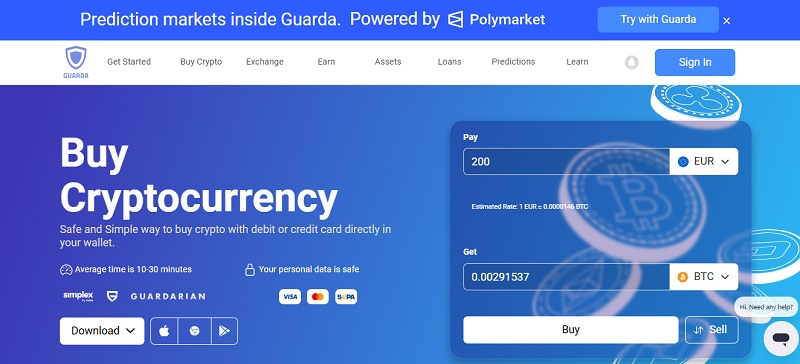
Fiat on-ramp (cards, SEPA, etc.)
NFT storage support
Web3 / dApp interaction
Ledger hardware wallet integration
However, exchange functionality relies on external providers, which directly impacts fee structure.
Account Registration and Guarda Access
Creating a Guarda personal account does not require traditional registration. The process is simplified:
Set a password
Generate wallet
Download backup file
Store recovery credentials
There is no centralized account database — access is tied to the backup file and password.
Access to the Guarda personal account is entirely dependent on user-controlled credentials. Losing backup data typically results in irreversible loss of funds.
Deposits and Withdrawing Money from Guarda
Deposits are straightforward — users receive funds via blockchain address. When withdrawing money from Guarda, transactions are processed directly on-chain, meaning:
Fees are network-based (not wallet-controlled)
Speed depends on blockchain congestion
No internal withdrawal approval system
The main concern: internal exchange costs can be significantly higher than centralized exchanges.
Transaction Conditions
| Operation | Fees | Notes |
|---|
| Deposit | Free | Network rules apply |
| Withdrawal | Network fee | Depends on blockchain |
| Exchange | ~0.2%–3.5% | Third-party providers |
| Fiat purchase | Variable | KYC may apply |
Background and Domain Analysis of Guarda Wallet
Domain registered: 2001 (significantly earlier than product launch)
Active product development since: 2017
Infrastructure: Cloudflare (USA)
Associated company: Guardarian (fiat gateway provider)
Guardarian itself operates as a fiat-crypto bridge with declared registration in the Czech Republic.
Important nuance:
Wallet infrastructure and fiat gateway are separate entities, which may complicate accountability in dispute scenarios.
Source: DomainTools
Client Feedback and Guarda Reviews
Analysis of Guarda reviews shows mixed sentiment:
Positive signals:
Negative patterns:
Complaints about high exchange fees
Occasional reports of security incidents linked to device compromise
Delays in swap operations
Overall perception: functional but not cost-efficient for frequent trading.
Security Model of Guarda Wallet
Guarda crypto wallet relies on a decentralized security approach:
Private keys stored locally
AES encryption for backup files
Optional biometric protection
Hardware wallet integration
Key implication:
Security depends heavily on the user’s device and backup management.
Pros and Cons
✅ Advantages
Non-custodial (full user control)
Wide asset and blockchain support
Multi-platform ecosystem
Built-in staking and exchange
Hardware wallet compatibility
❌ Limitations
High internal exchange fees
Responsibility fully on user
No regulatory protection
Complex structure (wallet + third-party providers)
Not ideal for beginners without crypto experience
Risk Assessment and Expert Conclusion on Guarda Wallet
| Factor | Assessment |
|---|
| Custody model | Non-custodial |
| Transparency | Medium |
| Fee structure | Above average |
| Security model | User-dependent |
| Regulatory clarity | Limited |
| Overall risk | Medium |
Final Verdict on Guarda
Guarda wallet can be classified as a medium-risk crypto infrastructure tool.
Suitable for:
Not suitable for:
Beginners without backup discipline
Users seeking low-cost trading
Those expecting institutional-level protection
Conclusion:
Guarda crypto wallet is a technically robust but user-responsibility-heavy solution. It performs well as a multi-chain storage and management tool, but cost structure and lack of regulatory safeguards should be carefully considered before active use.


