The digital platform Tether Wallet is a self-custodial software solution introduced by Tether in April 2026. Unlike centralized exchanges or custodial storage providers, the software interface does not hold private keys or retain control over digital holdings. According to official technical documentation, every vault is generated locally on the client's hardware, while outbound operations are signed offline prior to broadcast.
The developer states that seed phrases are never stored on company infrastructure in readable form, ensuring that Tether cannot access or move customer balances. Tether Wallet focuses primarily on digital dollar payments, Bitcoin settlements, and tokenized gold rather than serving as a general-purpose multi-chain Web3 portal.
Its initial release accommodates select Tether-issued tokens alongside Bitcoin, while integrating human-readable @tether.me handles for streamlined transactions between compatible vaults.
The software officially debuted on April 14, 2026, leveraging infrastructure under the established wallet.tether.io domain.
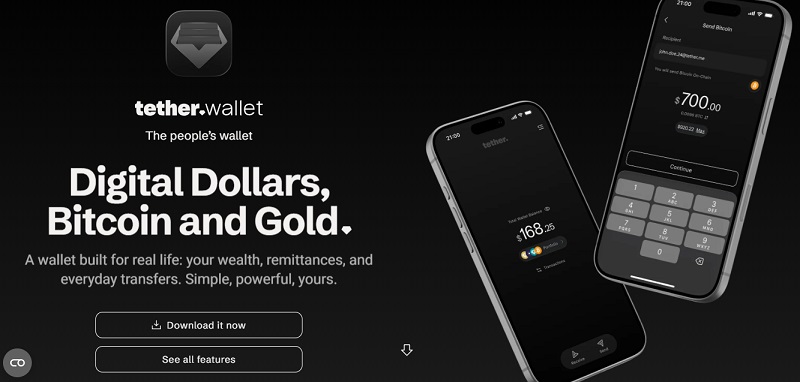
Supported Digital Assets in Tether Wallet
Unlike multi-currency tools attempting to aggregate thousands of tokens, Tether Wallet currently limits its scope to key instruments engineered within the Tether ecosystem.
The officially supported digital currencies include:
USD₮ (Tether USD)
USA₮
XAU₮ (Tether Gold)
Bitcoin (BTC)
These instruments are accessible across various distributed ledgers depending on token architecture.
Supported Protocol Networks:
The software interface automatically highlights available chain options for each selected holding, eliminating manual network configuration. The development team plans to expand chain compatibility in future updates.
Core Parameters
| Parameter | Data |
|---|
| Project | Tether Wallet |
| Wallet launched | 14 April 2026 |
| Wallet type | Non-custodial |
| Supported assets | USD₮, USA₮, XAU₮, Bitcoin |
| Primary networks | Ethereum, Polygon, Arbitrum, Plasma, Bitcoin, Lightning |
| Domain created | 2014-01-27 |
| Hosting | Cloudflare (San Francisco, USA) |
| WHOIS registrant | Domain Licenses Limited |
Main Functions of Tether Wallet
Although recently launched, Tether Wallet incorporates several core features tailored to streamline value movement for everyday clients.
Primary Capabilities:
Self-sovereign key storage;
Local private key encryption;
Multi-chain network interoperability;
Instant Bitcoin Lightning routing;
Custom @tether.me handles for address abstraction;
Native QR code scanner for quick payments;
Direct on-chain address handling;
Cloud-encrypted seed phrase backup;
Biometric authentication locks;
Local transaction authorization directly on the client device.
Unlike DeFi-centric storage options, the debut version omits staking modules, NFT galleries, and decentralized exchange aggregators, focusing strictly on asset security and direct value transfer.
Wallet Features Summary
| Feature | Availability |
|---|
| Self-custody | Yes |
| Bitcoin Lightning | Supported |
| Biometric protection | Yes |
| Cloud backup | Encrypted |
| QR code transfers | Supported |
| @tether.me usernames | Supported |
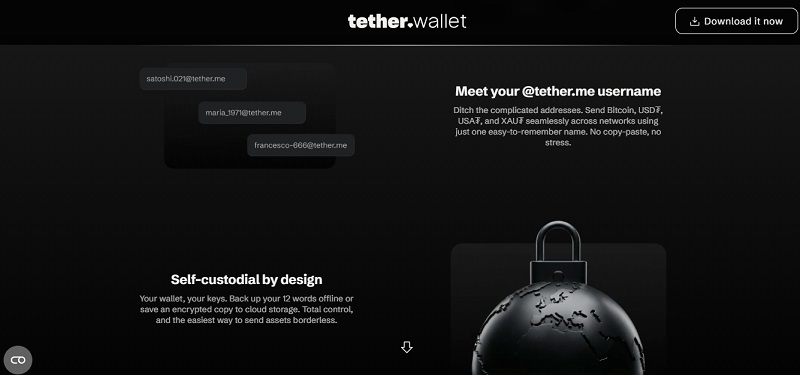
Creating a Tether Wallet Personal Account
Setting up a personal account differs from registering on a central trading exchange. During initialization, Tether Wallet builds a cryptographic seed directly on the user's hardware, generating a recovery phrase that must be stored offline.
Clients can register a personalized @tether.me handle, enabling direct asset delivery without sharing lengthy cryptographic addresses. A Tether personal account remains under exclusive client ownership because secret keys never leave the hardware environment in plain text. Furthermore, every outbound operation requires explicit manual sign-off before being transmitted to the network.
Depositing and Withdrawing Funds from Tether Wallet
The platform relies on direct peer-to-peer transfers rather than centralized balances. Account holders can receive funds via standard public keys or through their @tether.me identifier when using compatible software. Bitcoin can be processed via native layer-1 blocks or high-speed Lightning channels, while stablecoins settle on their respective blockchain networks.
Withdrawing funds from Tether Wallet follows the same decentralized mechanics. The sender can paste an external address, scan a payment QR code, or input a @tether.me handle. Before signing, the interface displays:
recipient address details;
target blockchain layer;
outbound amount;
estimated validator gas fee;
total expense in both base tokens and approximate USD equivalent.
According to technical documentation, Tether Wallet imposes no internal protocol fees for incoming or outgoing activity. Senders cover only standard blockchain execution fees (gas), which route directly to network validators rather than to Tether. Every operation is authorized locally on the device prior to submission, meaning confirmed entries on the ledger are permanent and non-reversible.
Transaction Conditions
| Operation | Fees | Comments |
|---|
| Receiving assets | Free | Only blockchain rules apply |
| Sending assets | Network fee only | No additional wallet fee |
| Lightning transfers | Low network fee | Bitcoin Lightning supported |
| Internal username transfers | Network fee | Uses @tether.me usernames |
Tether Wallet Background and Domain Information
Tether Wallet represents a modern addition to the broader Tether product suite. Launched on April 14, 2026, the application acts as a specialized self-custody client tailored for stablecoins and Bitcoin transactions. Despite the software's recent release, it operates under the long-established Tether brand.
DomainTools:
Domain Registered: January 27, 2014
Domain Updated: June 6, 2023
Edge Infrastructure: Cloudflare
Server Geolocation: San Francisco, California, USA
WHOIS Registrant: Domain Licenses Limited
Unlike enterprise exchange platforms, the official portal for Tether Wallet does not publish a standalone corporate registration number or dedicated office address specifically for the client app. Standard customer service email channels are omitted from the main portal, directing users instead to an integrated knowledge base and internal support ticketing systems.
Client Feedback and Tether Wallet Reviews
No dedicated Trustpilot profile is currently available for wallet.tether.io, meaning Tether Wallet reviews cannot be independently verified through the platform. General reviews associated with tether.to cover the broader ecosystem rather than this specific software release and have been excluded from this review.
Primary feedback streams were evaluated from the official Google Play application page.
Positive Client Observations:
Intuitive, clutter-free user interface;
Seamless handle-based address routing;
Fast Bitcoin Lightning execution;
Absence of hidden app-level service surcharges.
Critical Client Observations:
Concise feature set in the initial build;
Caution surrounding optional cloud-encrypted seed backups;
Requests for broader token compatibility and extended helpdesk features.
Given the recent product release, the volume of public feedback remains limited. As global usage grows, broader independent reviews will emerge.
Risk Assessment and Expert Conclusion for Tether Wallet
| Factor | Assessment |
|---|
| Custody model | Non-custodial |
| Asset support | Focused |
| Corporate transparency | Medium |
| Security model | User-controlled |
| Public track record | Limited (new product) |
| Overall risk | Medium |
Final Verdict on Tether Wallet
The platform Tether Wallet can be categorized as a medium-risk, self-custodial cryptocurrency client. The application benefits from direct integration with the established Tether infrastructure while offering features like handle-based address routing and Lightning Network settlement. However, its recent entry into the market means it carries a limited operational history and a small repository of third-party user feedback.
Suitable for:
Clients primarily storing and moving USD₮, USA₮, XAU₮, or Bitcoin;
Individuals seeking an accessible non-custodial storage tool;
Users prioritizing low-cost, instant Lightning transactions.
Less suitable for:
Web3 enthusiasts requiring multi-chain dApp connectivity;
DeFi investors and NFT collectors;
Traders looking for a legacy storage tool with years of independent security audits.


