The digital service MoonLight Wallet is a newly launched non-custodial crypto solution offering multichain support and browser integration. However, based on domain data, transparency issues, and external risk signals, the storage shows elevated risk, with limited verifiable track record and unclear ownership.
What Is MoonLight Wallet
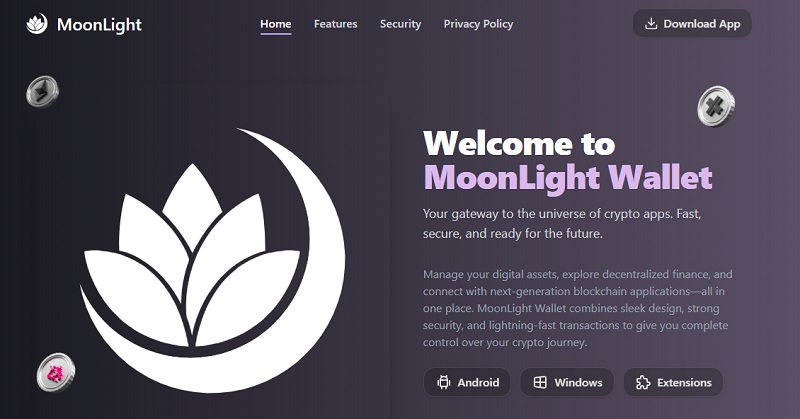
MoonLight is a browser-based crypto wallet positioned as a non-custodial multichain solution supporting Ethereum-compatible networks. The platform provides access to decentralized applications (DApps), token storage, and transaction management within a single interface.
The MoonLight Wallet extension is available via Chrome Web Store, allowing users to interact directly with blockchain ecosystems from their browser.
According to its official website moonlight-wallet.com, the service emphasizes user control over private keys and local storage of funds, which is typical for non-custodial wallets.
Key Functions of MoonLight Wallet
The crypto wallet MoonLight focuses on core Web3 functionality rather than advanced trading tools:
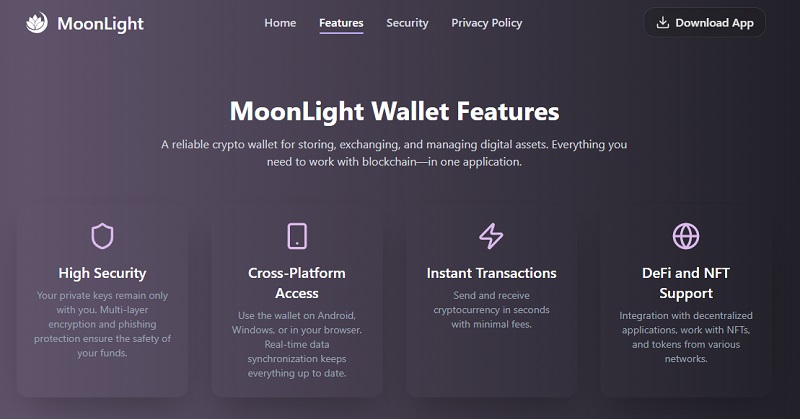
Multi-chain support (EVM networks)
Send / receive crypto assets
Token balance tracking
DApp connectivity
Local private key storage
Transaction history monitoring
The storage operates similarly to MetaMask-like solutions, prioritizing accessibility over institutional-grade infrastructure.
| Feature | Details |
|---|
| Wallet Type | Non-custodial browser wallet |
| Supported Networks | Ethereum, BSC, Polygon |
| KYC | Not required |
| Private Key Storage | Local (user-controlled) |
Supported Cryptocurrencies on MoonLight Wallet
MoonLight Wallet primarily supports EVM-compatible ecosystems, including:
Ethereum (ETH)
BNB Smart Chain (BSC)
Polygon (MATIC)
ERC-20 tokens
The scope is typical for lightweight browser wallets, but no evidence of support for non-EVM chains (e.g., Bitcoin, Solana) was found.
Account Registration in MoonLight Wallet
Creating a MoonLight Wallet personal account follows a standard non-custodial flow:
Install browser extension
Generate wallet
Receive seed phrase
Set password
Access storage dashboard
Notably:
This aligns with Web3 standards but increases user-side risk.
Depositing and Withdrawing Funds from MoonLight
The crypto service MoonLight does not directly support fiat transactions.
Deposit methods:
Withdrawal of money from MoonLight Wallet:
There is no integrated on-ramp (card/bank), no custody layer and no transaction guarantees. This means all transactions are irreversible, and user errors cannot be corrected.
Security Structure of MoonLight Wallet
The crypto wallet MoonLight claims:
However, there are important limitations:
No independent security audit disclosed
No public team verification
No institutional-grade custody
This places the wallet in the “self-managed risk” category typical for early-stage crypto tools.
Background and Domain Information of MoonLight
Domain created: August 20, 2025
Last updated: same day
Server location: USA, California (Cloudflare)
WHOIS: hidden ownership
Domain analysis provides critical insight into risk level:
| Parameter | Status |
|---|
| Domain Age | Registered in 2025 |
| Ownership Transparency | Hidden (WHOIS protected) |
| Company Registration | Not disclosed |
| Trust Signals | Low / limited data |
Source: DomainTools
Interpretation:
The domain is very recent, which indicates a lack of operational history and a limited track record.
The registrant’s identity is hidden, reducing overall transparency and making it difficult to verify ownership.
The use of Cloudflare hosting is considered neutral, as it is a widely adopted and standard infrastructure solution.
External security analysis flags additional concerns:
Legal Status and Ownership of MoonLight Wallet
There is no verifiable information about:
Legal entity
Registered company
Jurisdiction
Founders or team
TThis level of opacity is significantly below industry standards, even for Web3 projects.
Client Feedback and MoonLight Wallet Reviews
Available MoonLight Wallet reviews are extremely limited:
Key observations:
This makes it difficult to assess real-world reliability.
Risk Assessment and Expert Conclusion for MoonLight
Based on aggregated data, MoonLight Wallet shows several high-risk indicators:
Key risk factors:
Newly registered domain (2025)
Hidden ownership (WHOIS privacy)
No regulatory oversight
No verifiable company entity
Extremely limited user base
No independent audits
External warnings from security platforms
Neutral factors:
Positive aspects:
Expert Conclusion on MoonLight Wallet
The digital service MoonLight appears to be an early-stage or minimally transparent crypto wallet with limited credibility indicators.
From an expert perspective:
Suitable for experienced users testing new tools
Not suitable for storing significant funds, beginners and long-term asset management
Final assessment: MoonLight Wallet currently falls into the high-risk category due to lack of transparency, short history, and weak verification signals. Users should exercise caution and avoid using it as a primary storage solution.


