


Withdrawal button simply stopped working right after my balance crossed $1000 on this exchange…
1
Victor Rivera
The digital exchange Zamdex presents itself as an active cryptocurrency trading hub providing spot and futures markets alongside P2P transactions, swaps, margin products, and crypto purchases. Its official website zamdex.com advertises over 150 assets, 200 trading pairs, and support for three national currencies.
Official materials state that the venue launched on January 16, 2022. However, this claim conflicts with recent DomainTools records that indicate a much later domain event. Such discrepancies warrant a detailed examination of the project's actual operating timeline.
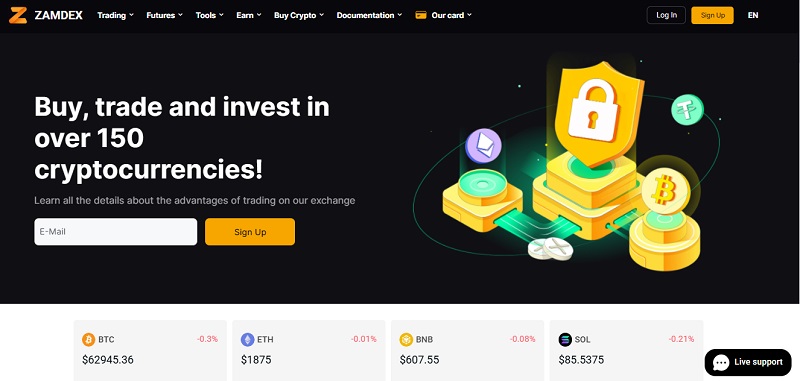
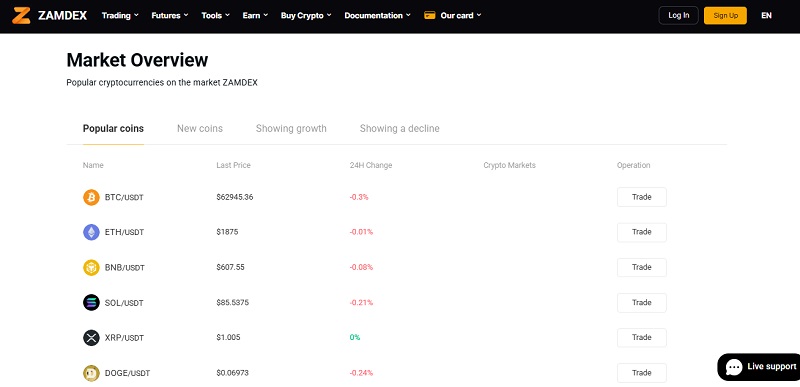
Representative assets displayed on the Zamdex exchange include:
XRP
SOL
BTC
TON
DOGE
ETH
TRX
BNB
The promotional material claims:
150+ supported tokens;
200+ active markets;
3+ fiat options.
Its advertised ecosystem encompasses:
| Product / Instrument | Status |
|---|---|
| Spot Execution | Advertised |
| Derivatives / Futures | Advertised |
| Margin Trading | Advertised |
| P2P Transfers | Advertised |
| Instant Swaps | Advertised |
| Fiat On-Ramps | Advertised |
| Staking / Yield | Advertised |
| Crypto Lending | Advertised |
| Competitions | Advertised |
While this broad selection gives the portal the appearance of a full-service crypto ecosystem, publicly available data does not independently confirm the actual depth of liquidity behind these order books.
The Zamdex exchange publishes a standard spot trading commission rate of 0.1%. While individual pairs may carry distinct structures, marketing pages state that the fee does not exceed this baseline.
For leveraged positions and borrowing, the stated daily rate is 0.078%.
| Operational Parameter | Stated Policy |
|---|---|
| Standard Trading Fee | 0.1% |
| Maximum Trading Fee | 0.1% |
| Daily Margin / Loan Rate | 0.078% |
| Spot Execution | Supported |
| Futures Execution | Supported |
| Margin Products | Supported |
| P2P Operations | Supported |
| Swap Tool | Supported |
An independent review of the project notes that detailed tariff schedules are kept behind registration barriers. Additional costs may also apply to payment processing and inactive profiles.
Consequently, the advertised 0.1% rate should not be automatically viewed as the total cost of using the Zamdex exchange.
Users must complete a registration process to open a Zamdex personal account and access its full suite of tools.
Available information points to a standard onboarding workflow involving:
personal details,
email submission,
telephone input,
identity document submission,
an initial deposit before trading.
The platform also maintains a basic online support desk.
While a Zamdex personal account combines: wallet and trading functionality, public documentation lacks details regarding how verification tiers impact deposit limits, withdrawal thresholds, available features, transaction monitoring, or account freezes.
This lack of pre-registration transparency is a critical factor when assessing any financial service provider.
The crypto exchange Zamdex offers cryptocurrency deposits alongside several fiat channels.
Depending on regional availability, users may see payment options including:
Bank cards;
Third-party payment processors;
Electronic wallets;
Direct wallet transfers.
Specific payment methods are revealed inside the user dashboard. Independent analyses report that deposit processing is advertised as taking roughly 15 minutes, whereas cash-out speeds vary by channel.
However, public pages do not define minimum payout thresholds or general account payout limits.
| Funding / Payout Parameter | Assessment |
|---|---|
| Crypto Deposits | Advertised |
| Crypto Payouts | Advertised |
| Card Support | Reported as available |
| E-Wallet Options | Reported as available |
| Payment Gateways | Reported as available |
| Deposit Speed | ~15 minutes claimed |
| Payout Speed | Dependent on channel |
| Minimum Payout | Undisclosed |
| Payout Limits | Undisclosed |
| Fee Schedule | Partially hidden |
As a result, the process of withdrawing money from Zamdex remains obscured prior to signing up.
This opacity is notable given that third-party forums contain allegations regarding zamdex.com. Some user reports claim that displayed account balances could not be paid out without requests for additional deposits or verification fees. While these remain unproven claims from external forums rather than official regulatory findings, they involve the exact domain under review and warrant attention.
Promotional text states that the Zamdex exchange launched on January 16, 2022.
However, no official corporate entity name, registration number, incorporation certificate, physical office, or named leadership could be identified in public registry searches.
Creation Date: June 21, 2026
Updated Date: June 21, 2026
Server Location: San Francisco, California, USA
Infrastructure: Cloudflare
Registrant: GDPR Masked
Historical WHOIS archives from IPAddress.com show an earlier record for zamdex.com dated September 4, 2020, with an update in 2023. This inconsistency suggests that the domain underwent expiration, transfer, or re-registration.
Neither the 2020 registry entry nor the stated 2022 launch date guarantees continuous operation by the current management team.
To add further ambiguity, an independent 2026 assessment describes the business as operating only since 2025.
The available data points to an unverified corporate structure rather than a well-established company operating continuously since 2022.
No financial license or regulatory registration was identified for the Zamdex exchange.
Public records fail to confirm a legal corporate operator, company incorporation number, registered address, primary financial supervisor, or recognized virtual asset service provider (VASP) license.
Independent reviews also confirm the absence of publicly disclosed licensing documents.
This is significant given that the site zamdex.com advertises derivatives, margin products, lending, staking, and P2P options. These financial services carry higher counterparty and operational risks than basic spot conversions.
Although promotional pages emphasize wallet segregation and safety features, no verifiable regulatory oversight was found.
The company claims to employ multi-layer security systems to safeguard client assets and user data. Web pages highlight cold storage practices and account protection protocols.
However, public materials do not provide independent evidence to confirm:
The percentage of funds stored in cold wallets;
Third-party security audit reports;
Proof-of-Reserves (PoR) attestations;
Insurance policies;
Penetration testing results;
Named custodial partners.
Self-reported claims on a website zamdex.com cannot substitute for independent third-party audits.
| Security Factor | Public Finding |
|---|---|
| Multi-Layer System | Claimed by operator |
| Asset Safeguards | Claimed by operator |
| Cold Storage | Claimed by operator |
| Third-Party Audits | Not identified |
| Proof of Reserves | Not verified |
| Insurance Coverage | Not verified |
| Corporate Controller | Unidentified |
| Regulatory License | Not verified |
The combination of generalized security claims and missing documentation makes evaluating the operational safety of the site difficult.
Independent Zamdex reviews are scarce across major consumer feedback platforms.
No verified Trustpilot profile associated with the domain was found during this evaluation. Unverified entries for similarly named entities on other domain extensions were excluded to maintain accuracy.
A dedicated third-party evaluation directory currently lists zero user ratings for the domain while noting an unverified corporate profile.
Recent third-party reports raise additional concerns.
A June 2026 forum post explicitly listed zamdex.com among suspicious crypto platforms, alleging a pattern where users see simulated dashboard gains but face extra deposit demands when attempting cash-outs. While these forum claims are unconfirmed, they directly target the primary domain.
| Evaluation Criteria | Assessment Finding |
|---|---|
| Claimed Launch Date | January 16, 2022 |
| Alternative Reported Date | 2025 |
| Current Domain Creation | June 21, 2026 |
| Historical WHOIS Record | September 4, 2020 |
| Operating Entity | Unidentified |
| Corporate Registration | Unverified |
| Registered Address | Unidentified |
| Financial Regulator | None identified |
| Official License | Not verified |
| Standard Trading Fee | 0.1% claimed |
| Daily Margin Rate | 0.078% |
| Payout Transparency | Partial / Hidden |
| Trustpilot Status | No verified profile |
| External Reputation | Negative risk signals |
| BrokerChooser Entry | No profile identified |
| Overall Classification | Critical Risk |
The Zamdex exchange is currently assigned a Critical Risk classification.
Primary concerns include:
No identifiable corporate legal entity;
Absence of financial licenses or VASP registrations;
Contradictory domain history and launch dates;
Incomplete fee disclosures and payout terms;
Unverified allegations regarding additional fee requests during withdrawals;
Inclusion in independent risk directories.
The platform retains standard design features, such as a multi-product interface, published headline trading rates, online support, and several funding options. However, these surface-level elements do not outweigh the absence of corporate and regulatory accountability.
BrokerChooser Observation: The Zamdex exchange currently has no active profile on the platfform. This absence should not be read as an official BrokerChooser declaration of fraud. Missing profiles can result from brief operating histories, insufficient regulatory disclosures, or non-submission for review. Thus, its absence is best categorized as an information gap.
Potentially Suitable For: No retail investor segment can be recommended to use this platform. Experienced market participants should only proceed after independently verifying the operating company, regulatory status, and payout functionality.
Not Suitable For: Beginners, conservative investors, traders seeking long-term capital custody, users requiring regulated oversight, or anyone asked to submit extra payments to unlock an existing account balance.
Bottom Line: The Zamdex exchange presents the visual layout of a standard trading portal, but its corporate standing and regulatory status remain unverified. Conflict between the claimed 2022 launch date and domain records, combined with missing legal entity details, limited fee transparency, and reports regarding withdrawal hurdles, results in a Critical Risk rating. Investors should not assume a platform is secure merely because it displays a functional interface and standard fee tables.
Checking a company's activities is accessible to everyone through specialized online resources. When evaluating an exchange, it is important to pay attention to the presence of legal status, the length of operation, and transparent earning conditions. It is crucial that the stated information is genuine and not fake. Fraudsters use fake data and documents to imitate the work of legitimate service providers.
To make the right choice, it is better to consult specialists. They will conduct a verification of the cryptocurrency exchange and determine what it really is — a reliable partner or a fraudulent project.
Thanks to comments about the company's services, potential clients receive information about the possibility of real earnings under the proposed conditions. These are written by both experienced traders who have conducted a preliminary assessment of the project and actual clients.
It is important to consider that unscrupulous exchanges may pay for positive reviews. In them, supposedly satisfied users share their achievements and encourage cooperation with a reliable company. You can distinguish such opinions from genuine ones by their content and presentation. They are filled with template and simplistic phrases, as well as expressive statements.
Manipulations involving extortion of additional investments to withdraw capital are undeniable facts of fraud. Real exchanges do not require clients to make payments for fees such as insurance, taxes, transfer commissions, opening transit accounts, etc. This is how scammers operate to profit by tricking traders into making further deposits.
If the exchange refuses to withdraw money, it is important not to fall for the tricks of fraudsters. This can lead to even greater financial losses. In such cases, it is better to consult experts. They will assist in withdrawing capital considering the circumstances.
The first thing to do is to contact the company's representatives and find out the reason for the block. If they ignore the sent requests and do not provide clear instructions for resolving the issue — they are scammers. Blocking accounts is one way to prevent clients from accessing their assets and to deny further service.
Consulting with specialized professionals will be the optimal solution in this situation. They will help determine the source of the exchange account closure and suggest ways to restore access to the personal account.
Various factors can lead to the inactivity of the exchange portal. These can include DDoS attacks, technical failures in server operation, or the company's own decision to cease operations. There may also be blocking of the platform according to the client's jurisdiction laws or violations of platform rules by the user themselves.
In fraudulent companies, a non-functioning website is one of the manipulations used to limit services to existing clients. When faced with such a situation, it is advisable to utilize the services of experts . They will help establish the true cause of the problem and provide useful recommendations for further actions.
Refusal to withdraw money is a common occurrence among illegal service providers. To initiate a refund, you should gather all available information (screenshots, wallet addresses, transaction IDs) and submit a request for a chargeback.
Disputing cryptocurrency transfers is a rather specific procedure that requires a competent approach. That is why it is best to entrust its initiation to qualified specialists. They will help recover assets in accordance with established timelines and regulations.