The established digital exchange EXMO was founded in 2013 and has positioned itself as a European-focused cryptocurrency platform. While the company references its roots in London, United Kingdom, the exact corporate address is not publicly disclosed.
EXMO exchange operates two domains:
exmo.com, which serves global users,
exmo.me, a platform that previously handled users from Russia, Belarus, and Kazakhstan.
In 2022, the regional business was sold to a separate company, which retained the EXMO brand and software but now operates independently.
The exchange promotes itself as “certified and registered” with certain regional administrations, yet it does not hold recognized financial licenses like FCA, SEC, or CySEC. Previous FCA registration was limited to AML oversight and did not offer full client protection. As of 2026, EXMO exchange is unavailable to U.S. residents due to licensing restrictions.
Customers can reach support via email, Telegram at @exmo_official, or social media channels such as Facebook, Twitter, and Instagram. A personal account EXMO is required to access most of the platform’s functions.
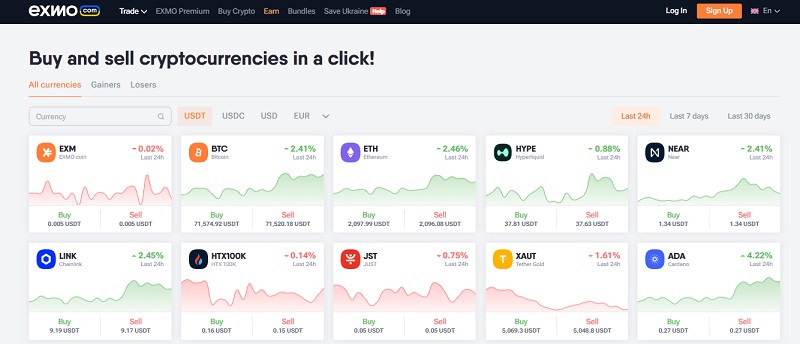
Range of Cryptocurrencies on EXMO
The exchange EXMO supports a wide range of assets including:
BTC,
ETH,
LTC,
BCH,
XRP,
USDT,
USDC,
numerous other altcoins.
The platform also handles multiple fiat currencies such as USD, EUR, RUB, PLN, UAH, GBP, and TRY, depending on region and payment method.
Overall, the number of trading pairs can exceed 100–180, allowing users to trade crypto-to-crypto and crypto-to-fiat pairs. Full access to all markets is granted only after registering a personal account EXMO.
Trading Conditions and Fees of EXMO
Trading on the EXMO exchange includes spot operations with fees generally ranging from 0.1% to 0.3% per trade (maker/taker), although rates can vary depending on trading volume, currency pair, and membership level. Premium participants can receive discounts on trading fees up to 100%, depending on program level.
Account Registration and Verification on the Website exmo.com
To fully use EXMO, users must create a personal account EXMO. Registration involves:
visiting the official website exmo.com,
selecting “Sign Up / Register,”
providing an email and password,
confirming via email.
For full access to deposit, withdrawal, and fiat services, identity verification is required, including uploading documents to confirm personal information.
Depositing Funds and Withdrawing Money from EXMO
The exchange EXMO supports crypto deposits and withdrawals at most times. Fiat deposits and withdrawals are possible via:
bank cards,
SEPA/Swift transfers,
local payment systems.
Information on withdrawing money from EXMO is available after registration and verification within the personal account.
Deposits in cryptocurrency are usually free, with users paying only blockchain network fees. Withdrawal fees differ per coin and network — for example, BTC withdrawals often carry a fixed fee around 0.0005 BTC.
Brief Conclusion about EXMO
EXMO is a long-standing digital exchange with global reach, multiple crypto and fiat assets, and tiered trading conditions. However, the platform does not provide fully regulated status in major jurisdictions, and fees, limits, and operational details often require registration to view. Prospective users should consult independent sources and EXMO reviews before trading.


