The digital exchange FastX operates through the official website fastx.co and positions itself as a decentralized perpetual futures trading platform focused on self-custody, cross-chain execution, and wallet-based trading. Unlike traditional centralized services, the project claims that user funds remain under personal wallet control rather than being held by a custodial intermediary.
The platform emphasizes perpetual futures trading, copy trading, grid bots, cross-chain liquidity, and decentralized infrastructure. At the same time, FastX Exchange remains a relatively new project with a recently registered domain and limited public corporate disclosure.
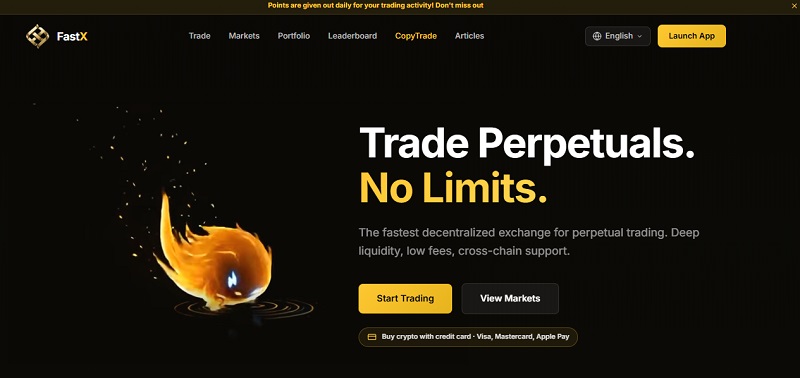
FastX Trading Infrastructure and Core Products
FastX exchange presents itself as a decentralized perpetuals environment designed for traders seeking leverage while maintaining self-custody of assets.
The platform publicly advertises:
| FastX Product | Availability |
|---|
| Perpetual futures | Core product |
| Copy trading | Available |
| Grid bots | Available |
| Cross-chain trading | Supported |
| Advanced orders | Available |
| Referral rewards | Supported |
FastX repeatedly highlights deep liquidity, decentralized execution, and self-custody architecture. According to the platform, trades are executed directly through connected wallets without depositing funds into a centralized exchange account.
Analytical interpretation: the self-custody model reduces traditional custodial risk, but trading infrastructure, liquidity aggregation, and smart-contract security still require independent verification.
FastX Exchange Markets and Supported Trading Assets
FastX exchange offers a broad list of perpetual markets spanning cryptocurrencies, commodities, equities, and stock indices.
Examples of publicly visible markets include:
BTC;
ETH;
SOL;
XRP;
DOGE;
AVAX;
ADA;
TON;
LINK;
BNB;
TAO;
NEAR;
XMR;
SUI;
ONDO.
The platform additionally lists synthetic exposure to:
XAU (Gold);
XAG (Silver);
CL (WTI Crude Oil);
NAS100;
SPX500;
NVDA;
TSLA;
GOOGL.
| Market | Maximum Leverage |
|---|
| BTC | 100x |
| ETH | 100x |
| SOL | 100x |
| BNB | 50x |
| DOGE | 50x |
| XRP | 50x |
| LINK | 20x |
| TON | 20x |
Analytical observation: FastX exchange offers a wider asset selection than many decentralized perpetual exchanges by including commodities, equities, and index-based synthetic markets alongside cryptocurrencies.
Trading Conditions and Fee Structure Offered by FastX
FastX exchange publicly advertises low trading costs and volume-based discounts.
The platform states:
competitive maker and taker fees;
professional order management tools;
cross-chain liquidity access.
For fiat-to-crypto purchases through external providers, the project states that the platform itself adds no additional fee, while payment providers charge their own rates.
The service also supports:
market orders;
limit orders;
stop-loss orders;
take-profit orders.
Analytical interpretation: while FastX provides more transparency than many anonymous crypto platforms, external verification of actual liquidity depth and execution quality remains limited.
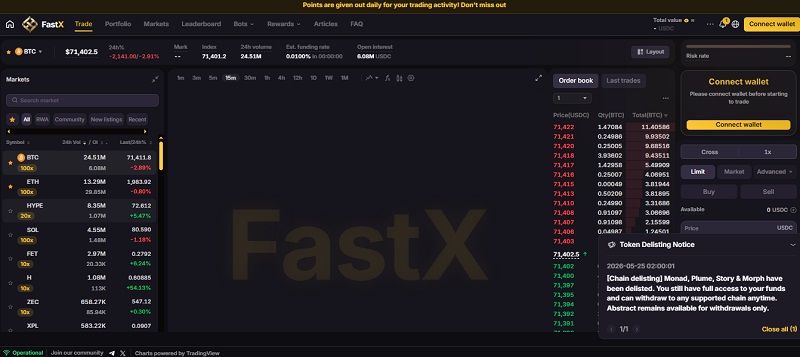
FastX Personal Account and Wallet Integration
Unlike traditional centralized platforms, FastX exchange primarily operates through wallet connections.
Supported wallet integrations include:
The FastX personal account structure is therefore tied primarily to connected blockchain wallets rather than traditional custodial balances.
| Access Method | Supported |
|---|
| MetaMask | Yes |
| OKX Wallet | Yes |
| Binance Web3 Wallet | Yes |
| WalletConnect | Yes |
| Google login | Available |
| Email login | Available |
The FastX personal account environment appears significantly different from standard exchange registration systems due to its emphasis on decentralized wallet connectivity.
Deposits and Withdrawing Money From FastX
FastX exchange primarily accepts stablecoin deposits.
The platform states support for:
Supported chains reportedly include:
Ethereum;
Arbitrum;
Base;
Polygon;
Optimism;
Solana.
The maximum account funding limit is listed as 1,000,000 USDC/USDT unless additional approval is granted.
| Payment Method | Estimated Total Cost | Settlement Time |
|---|
| Credit/Debit Card | 4–6% | 5–15 minutes |
| Apple Pay | 4–6% | 5–15 minutes |
| Google Pay | 4–6% | 5–15 minutes |
| SEPA Transfer | 1–3% | 1–3 business days |
| ACH Transfer | 1–3% | 1–3 business days |
| PIX | 1–3% | Minutes to 1 day |
The process of withdrawing money from FastX is presented as blockchain-based and dependent on network conditions. The platform states that withdrawals typically take between one minute and one hour.
Analytical observation: FastX exchange provides more publicly available withdrawal information than many recently launched crypto platforms, although long-term operational reliability remains difficult to assess due to limited project history.
FastX Corporate Background and Domain Information
Public corporate disclosure for FastX exchange remains limited.
The platform emphasizes decentralized infrastructure and self-custody trading but does not prominently disclose:
| Corporate Indicator | Observed Data |
|---|
| Domain creation date | 2026-04-03 |
| Latest update | 2026-05-07 |
| IP location | Pennsylvania, United States |
| Ownership visibility | Limited |
| Public headquarters | Not disclosed |
| Regulatory license | Not identified |
Source: DomainTools
Analytical interpretation: the absence of strong corporate transparency remains one of the primary credibility limitations for FastX exchange despite its decentralized positioning.
FastX Reviews and External Reputation Signals
Public FastX reviews remain relatively limited due to the platform's recent launch.
Available external publications primarily describe the project as a decentralized perpetual futures exchange focused on self-custody, copy trading, and cross-chain execution.
Unlike many newly launched anonymous exchanges, widespread public withdrawal complaints or large-scale scam allegations were not identified during this review. However, the platform's short operational history limits the reliability of long-term reputation analysis.
Analytical observation: FastX exchange reviews currently provide insufficient historical data for a definitive reputation assessment, making operational maturity difficult to evaluate.
Risk Assessment and Final Conclusion About FastX Exchange
| Risk Factor | Assessment |
|---|
| Corporate transparency | Moderate to low |
| Custodial risk | Lower due to self-custody |
| Regulatory oversight | Not verified |
| Operational history | Very limited |
| Platform transparency | Moderate |
| Overall project risk | Medium to high |
FastX exchange differs from many opaque offshore platforms because it uses a decentralized self-custody model and publicly discloses significant operational information regarding wallets, deposits, and trading functionality.
Potentially suitable for:
experienced DeFi traders;
users preferring self-custody infrastructure;
traders seeking decentralized perpetual futures exposure;
advanced users comfortable with leveraged products.
Not suitable for:
beginners unfamiliar with perpetual contracts;
conservative investors;
users requiring strong regulatory protections;
traders seeking long operational track records.
Bottom line:
FastX exchange presents a more transparent decentralized trading model than many recently launched crypto platforms, particularly through its self-custody architecture and detailed public disclosures.
However, the platform remains a newly established project with limited corporate transparency and a short operating history. As a result, FastX currently falls into a medium-to-high risk category rather than the extreme-risk profile commonly associated with anonymous custodial exchanges.


