


Read the reviews aand everyone says they block withdrawals and steal money..
2
Rahul
The digital service Bitly Exchange is a trading platform operating through the website bitly.exchange. The project positions itself as a CLOB-DEX (Central Limit Order Book Decentralized Exchange), combining elements of traditional market order books with non-custodial blockchain infrastructure.
Unlike many centralized crypto services, Bitly Exchange emphasizes self-custody, allowing users to maintain control of their assets while interacting with an order-book trading environment. However, publicly available information about the legal operator, licensing status, and corporate structure remains limited.
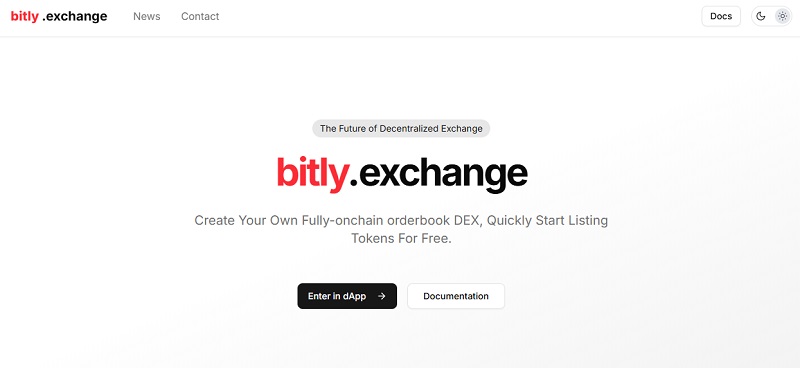
Bitly Exchange focuses on order-book-based decentralized trading rather than the automated market maker (AMM) model used by many DEXs. The platform supports trading across multiple blockchain ecosystems through its wallet and bridge infrastructure.
Publicly accessible documentation on the website bitly.exchange references trading functionality for blockchain-native assets, although the complete list of supported markets varies depending on the connected network and available liquidity pools. According to platform materials, users can bridge assets between supported chains before trading.
| Market Feature | Status |
|---|---|
| Spot Trading | Available |
| Order Book Trading | Available |
| Cross-Chain Asset Support | Supported |
| Bridge Functionality | Available |
| Complete Asset List | Not Fully Disclosed |
From an analytical perspective, Bitly Exchange appears to target users seeking decentralized execution while retaining familiar order-book trading mechanics.
One of the notable limitations of Bitly Exchange is the absence of a clearly published fee schedule on publicly accessible pages.
The platform explains deposit and withdrawal procedures but does not prominently disclose:
maker fees;
taker fees;
liquidity provider incentives;
withdrawal commissions;
bridge fees.
Because Bitly Exchange operates using a central limit order book structure, users may additionally incur standard blockchain network fees depending on the selected chain and asset. Order-book trading itself is designed to function similarly to CEX while remaining non-custodial.
| Trading Parameter | Public Information |
|---|---|
| Maker Fee | Not Published |
| Taker Fee | Not Published |
| Blockchain Gas Fees | Applicable |
| Bridge Costs | May Apply |
| Liquidity Incentives | Not Specified |
The lack of transparent fee disclosure makes it difficult to compare Bitly Exchange directly with larger decentralized competitors.
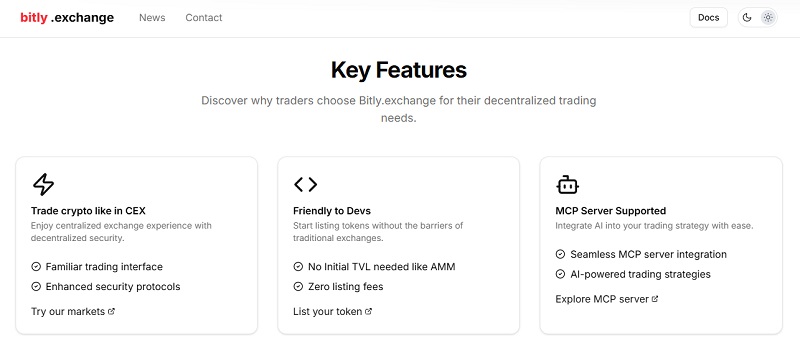
Unlike centralized platforms requiring extensive registration, Bitly Exchange primarily operates through wallet connectivity.
Users generally access the platform by:
connecting a supported crypto wallet;
selecting the desired blockchain;
depositing assets into the exchange environment;
initiating trading activity.
A traditional Bitly Exchange personal account based on identity verification is not prominently featured in public documentation. Instead, wallet ownership acts as the primary authentication method.
The Bitly Exchange personal account experience therefore differs significantly from conventional custodial services where assets are held by the platform itself.
| Access Method | Availability |
|---|---|
| Wallet Connection | Required |
| Email Registration | Not Required for Core Access |
| Identity Verification | Not Publicly Required |
| Self-Custody Model | Yes |
| Blockchain Wallet Authentication | Yes |
The deposit process follows a decentralized workflow.
According to Bitly Exchange documentation, users first select a supported blockchain and then deposit assets directly from their wallet into the exchange environment. Assets located on another blockchain can be transferred using integrated bridge functionality.
Deposits require two wallet authorizations:
approval of token spending allowance;
actual transfer of funds.
Withdrawal procedures are simpler and reportedly require only a single authorization step.
The process of withdrawing money from Bitly Exchange therefore follows a fully wallet-based model rather than traditional custodial approval workflows.
| Operation | Process |
|---|---|
| Deposit Authorization | Two-Step Approval |
| Withdrawal Authorization | Single Approval |
| Bridge Support | Yes |
| Custodial Storage | No |
| Withdrawal Processing Time | Depends on Blockchain |
Transparency regarding corporate ownership remains limited.
DomainTools information indicates:
Domain registration date: February 3, 2024;
Last update: January 7, 2026;
Hosting infrastructure: Vercel Inc.;
IP location: Walnut, California, United States.
No verified information was located regarding:
headquarters address;
company registration number;
executive team;
regulatory authorization.
At the time of analysis, Bitly Exchange reviews are relatively limited compared with established platorms.
No significant Trustpilot profile with a substantial review history was identified during the review process.
As a result, external reputation analysis relies primarily on:
project documentation;
community references;
technical architecture descriptions.
The absence of a large independent review footprint neither confirms legitimacy nor indicates misconduct. However, it limits the amount of third-party verification available to prospective users.
| Reputation Factor | Assessment |
|---|---|
| Trustpilot Presence | Limited or Not Significant |
| Independent Reviews | Limited |
| Community Visibility | Moderate |
| Transparency of Feedback | Moderate |
Bitly Exchange does not currently appear among the crypto platforms reviewed by BrokerChooser.
Several analytical explanations are possible:
the project remains relatively new;
the platform's decentralized structure may fall outside typical review coverage;
available corporate disclosures may not meet evaluation standards;
Bitly Exchange exchange has not yet developed sufficient market presence for inclusion.
When assessing credibility, absence from BrokerChooser should not be viewed as direct evidence of misconduct. However, combined with limited regulatory disclosure and sparse corporate information, it reduces the number of independent validation sources available to users.
| Evaluation Area | Assessment |
|---|---|
| Regulation | Not Verified |
| Corporate Transparency | Low |
| Custody Risk | Lower Due to Self-Custody |
| Fee Transparency | Limited |
| Community Verification | Moderate |
| Overall Risk | Medium |
Bitly Exchange represents an interesting attempt to merge decentralized asset custody with an order-book trading environment. The self-custody model removes certain counterparty risks typically associated with CEX, while bridge functionality expands access across multiple blockchain ecosystems.
Positive aspects:
decentralized architecture;
self-custody asset management;
order-book trading system;
bridge-enabled cross-chain functionality.
Risk factors:
lack of verified licensing;
limited corporate disclosure;
incomplete public fee schedule;
limited independent review coverage;
absence from BrokerChooser.
Risk Level: Medium-High
Potentially suitable for:
experienced DeFi users;
traders comfortable managing their own wallets;
users seeking decentralized order-book trading.
Less suitable for:
beginners unfamiliar with blockchain wallets;
investors seeking regulatory protection;
users preferring fully transparent corporate structures.
Checking a company's activities is accessible to everyone through specialized online resources. When evaluating an exchange, it is important to pay attention to the presence of legal status, the length of operation, and transparent earning conditions. It is crucial that the stated information is genuine and not fake. Fraudsters use fake data and documents to imitate the work of legitimate service providers.
To make the right choice, it is better to consult specialists. They will conduct a verification of the cryptocurrency exchange and determine what it really is — a reliable partner or a fraudulent project.
Thanks to comments about the company's services, potential clients receive information about the possibility of real earnings under the proposed conditions. These are written by both experienced traders who have conducted a preliminary assessment of the project and actual clients.
It is important to consider that unscrupulous exchanges may pay for positive reviews. In them, supposedly satisfied users share their achievements and encourage cooperation with a reliable company. You can distinguish such opinions from genuine ones by their content and presentation. They are filled with template and simplistic phrases, as well as expressive statements.
Manipulations involving extortion of additional investments to withdraw capital are undeniable facts of fraud. Real exchanges do not require clients to make payments for fees such as insurance, taxes, transfer commissions, opening transit accounts, etc. This is how scammers operate to profit by tricking traders into making further deposits.
If the exchange refuses to withdraw money, it is important not to fall for the tricks of fraudsters. This can lead to even greater financial losses. In such cases, it is better to consult experts. They will assist in withdrawing capital considering the circumstances.
The first thing to do is to contact the company's representatives and find out the reason for the block. If they ignore the sent requests and do not provide clear instructions for resolving the issue — they are scammers. Blocking accounts is one way to prevent clients from accessing their assets and to deny further service.
Consulting with specialized professionals will be the optimal solution in this situation. They will help determine the source of the exchange account closure and suggest ways to restore access to the personal account.
Various factors can lead to the inactivity of the exchange portal. These can include DDoS attacks, technical failures in server operation, or the company's own decision to cease operations. There may also be blocking of the platform according to the client's jurisdiction laws or violations of platform rules by the user themselves.
In fraudulent companies, a non-functioning website is one of the manipulations used to limit services to existing clients. When faced with such a situation, it is advisable to utilize the services of experts . They will help establish the true cause of the problem and provide useful recommendations for further actions.
Refusal to withdraw money is a common occurrence among illegal service providers. To initiate a refund, you should gather all available information (screenshots, wallet addresses, transaction IDs) and submit a request for a chargeback.
Disputing cryptocurrency transfers is a rather specific procedure that requires a competent approach. That is why it is best to entrust its initiation to qualified specialists. They will help recover assets in accordance with established timelines and regulations.