The digital exchange Websea functions as a centralized cryptocurrency venue catering to global retail and institutional traders. The platform advertises a multi-asset ecosystem incorporating spot trading, perpetual derivatives, automated copy trading, passive yield mechanisms, and a dedicated futures insurance fund.
While the Websea exchange highlights an expanding global compliance footprint across North America and Australia, prospective users must evaluate its regulatory disclosures, fee structures, and operational transparency before depositing funds.
Customer support is provided through:
an online live chat widget,
email assistance channels,
community social networks.
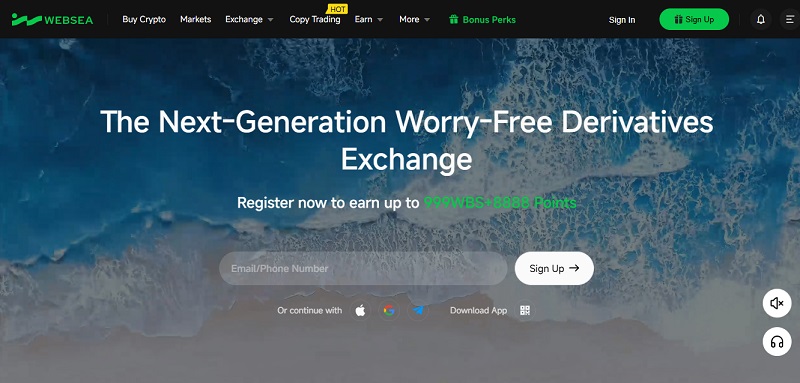
Asset Portfolio and Supported Markets on Websea
The Websea exchange supports a diverse catalog of digital currencies spanning major Layer-1 networks, stablecoins, DeFi protocols, and emerging tokens. The platform structures its spot and contract order books primarily against USDT.
Key market pairs active on the Websea digital exchange include:
SOL/USDT;
BTC/USDT;
WBS/USDT;
ETH/USDT;
BNB/USDT;
XRP/USDT;
USDC/USDT;
ASTER/USDT;
WLFI/USDT;
GRAM/USDT.
Beyond standard spot order execution, the platform provides proprietary tools including its native Websea Coin (WBS), copy-trading modules, and futures protection programs designed to cushion liquidation risk.
| Product Category | Operational Status | Public Verification Status |
|---|
| Spot Market Terminal | Active | Functional interface |
| Perpetual Futures | Active | Requires proper leverage risk management |
| Futures Insurance Fund | Active | Internal protection mechanism |
| Copy-Trading Platform | Active | Performance metrics managed internally |
| Websea Earn | Active | Passive yield options subject to terms |
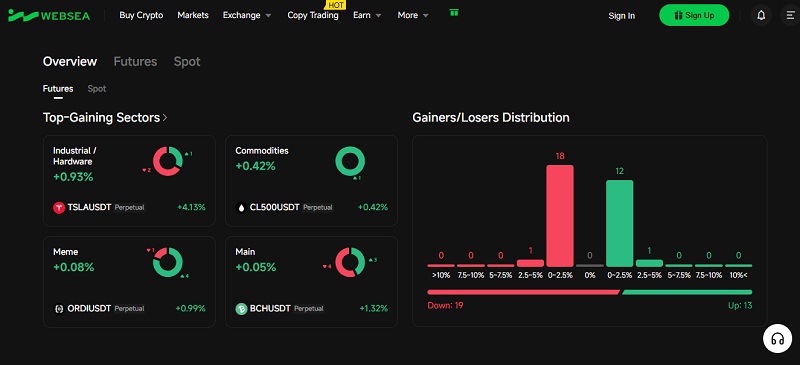
Websea Trading Conditions, Fee Schedules, and Infrastructure
Trading expenses on the Websea crypto exchange follow a standard maker-taker tier model across spot and derivatives markets. While promotional discounts are periodically offered for native token holders (WBS), baseline execution rates remain subject to dynamic market adjustments.
Key operational metrics include:
Spot Market Commissions: Floating maker and taker schedules (tiered by account volume and WBS holdings);
Derivatives Pricing: Tiered maker and taker rates with variable overnight funding costs on open contracts;
Deposit Costs: Free incoming transfers for supported digital currencies;
Technical Architecture: Modern web interfaces hosted via high-capacity cloud infrastructure.
Technical routing checks confirm that the domain websea.com resolves through Cloudflare Inc. networks located in San Francisco, California. The Websea exchange utilizes active SSL encryption certificates, DDoS protection, and Web Application Firewall (WAF) mitigations to maintain service uptime.
Registration and Account Verification via websea.com
Navigating the exchange infrastructure requires creating a Websea personal account through its web interface or mobile application. The registration workflow is tailored for retail users managing multi-asset digital wallets.
The standard onboarding pipeline inside a Websea personal account includes:
User sign-up utilizing an email address or mobile phone number;
Setting up account security parameters inside the user dashboard;
Managing wallet address books and accessing order books in a Websea personal account;
Submitting identity documentation for KYC verification tiers;
Enabling security measures such as 2FA and anti-phishing phrases.
Depositing Capital and Withdrawing Money from Websea
Account funding on the Websea exchange relies primarily on direct on-chain cryptocurrency deposits across supported blockchain networks. Fiat onboarding mechanisms are typically facilitated through integrated third-party payment gateways.
| Payment Channel | Deposit Fee | Withdrawal Parameters |
|---|
| On-Chain Crypto Transfer | Free (Zero platform fee) | Subject to network-specific execution fees |
| Fiat Partner Rails | Gateway-dependent charges | Handled via third-party providers where available |
| Internal User Transfers | Free | Instant off-chain balance clearing |
| Minimum Payout Limits | N/A | Asset-specific thresholds displayed inside wallet |
When withdrawing money from Websea, account holders encounter fixed or dynamic blockchain network fees depending on the selected token standard. The explicit rules and verification requirements for payouts are outlined within the asset manager dashboard before transaction finalization.
Domain Background, Corporate Footprint, and Licensing of Websea
Domain analytics disclose long-standing technical metadata regarding the root address, which was registered years before the current platform interface was established.
DomainTools technical parameters:
Official website: websea.com
Domain Registered On: September 26, 2000
Domain Updated On: December 28, 2023
IP Location: San Francisco, California — Cloudflare Inc.
In terms of compliance declarations, the company claims several international registrations:
Australia: Holds an ASIC business name registration under "WEBSEA GLOBAL";
United States: Registered as a Money Services Business with the FinCEN;
Canada: The Websea crypto exchange is registered as an MSB with the FINTRAC.
It is important to note that MSB registrations with FinCEN or FINTRAC deal primarily with Anti-Money Laundering reporting and do not constitute full regulatory oversight or statutory investor protection equivalent to a traditional financial market license.
Client Feedback and Public Websea Reviews
When conducting an analysis of public Websea reviews, no official dedicated profile could be verified for websea.com on Trustpilot at the time of review.
External user feedback on crypto discussion forums and social channels highlights appreciation for the platform's:
Conversely, negative Websea reviews frequently point to:
stringent compliance holds during large withdrawals,
slow customer support responses during peak traffic hours,
the inherent risks of trading high-leverage derivative contracts on unverified altcoins.
Risk Evaluation and Final Conclusion for Websea Exchange
As an analytical observation, the Websea crypto exchange is currently absent from the BrokerChooser rating index.
Several neutral explanations account for this status:
the venue may be relatively new,
it may not yet satisfy BrokerChooser's specific listing criteria,
publicly verifiable regulatory data may currently be insufficient for inclusion.
The absence of a profile should not by itself be interpreted as evidence for or against the Websea exchange's legitimacy.
| Evaluation Metric | Analytical Finding |
|---|
| Domain Creation Date | September 26, 2000 (Updated 2023) |
| Claimed Registrations | ASIC (Business Name), FinCEN MSB (US), FINTRAC MSB (Canada) |
| Top-Tier Financial License | None verified (MSB registrations only) |
| Support Options | Email, Live Chat, Help Center |
| Trustpilot Profile | No official websea.com profile found |
| BrokerChooser Coverage | Absent (Neutral observation) |
| Overall Risk Classification | Medium to High Risk |
User Suitability Profile:
Suitable for: Experienced altcoin traders, copy-trading enthusiasts, and users seeking leveraged perpetual contracts who understand crypto market volatility.
Not suitable for: Conservative retail investors requiring tier-1 regulatory oversight (e.g., FCA, CySEC), or individuals seeking direct statutory deposit guarantees.
Final Summary: The Websea exchange provides a functional trading interface with a diverse product line, including spot markets, copy trading, and futures insurance. However, while its MSB registrations in North America demonstrate baseline AML compliance efforts, they do not provide strict investor protections.
Combined with the absence of a verified Trustpilot record and top-tier financial licenses, the Websea crypto exchange maintains a Medium to High Risk profile. Market participants should manage exposure carefully and avoid holding large long-term reserves on the platform.


