The digital exchange BitradeX is a cryptocurrency trading platform operating through the official website bitradex.ai. The project presents itself as an AI-powered digital asset ecosystem focused on
The platform states that BitradeX exchange was established in 2022 and emphasizes institutional-grade security, compliance systems, and AI-driven trading services. However, several external investigations and community discussions raise questions regarding regulatory verification, aggressive yield marketing, and transparency inconsistencies.

BitradeX Markets and Trading Ecosystem
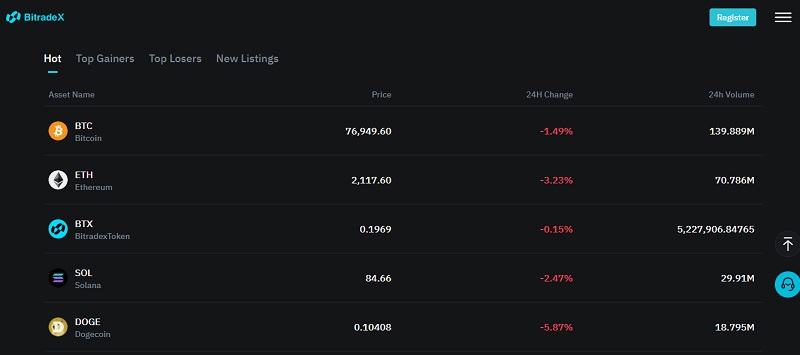
BitradeX crypto exchange publicly displays multiple cryptocurrency pairs before registration.
| Trading Pair | Market Category | Availability Status |
|---|
| BTC / USDT | Spot trading | Publicly accessible |
| ETH / USDT | Spot trading | Publicly accessible |
| ADA / USDT | Layer-1 asset | Publicly accessible |
| AVAX / USDT | Smart contract blockchain | Publicly accessible |
| PAXG / USDT | Tokenized gold asset | Publicly accessible |
| DOGE / USDT | Meme cryptocurrency | Publicly accessible |
BitradeX exchange additionally promotes:
AiBot quantitative trading;
perpetual futures products;
mobile trading application;
AI-based risk management systems.
Analytical interpretation:
Although the platform presents a technologically advanced ecosystem narrative, independently verified liquidity reports and proof-of-reserves documentation were not publicly identified during this review.
BitradeX Exchange Fees and Trading Conditions
Unlike many recently launched exchanges, BitradeX crypto exchange publicly discloses a detailed VIP fee structure.
The platform also references:
perpetual trading;
AI-driven portfolio optimization;
algorithmic trade execution;
quantitative risk systems.
However, leverage conditions, liquidation mechanics, and derivatives exposure limits are not fully disclosed publicly on the website bitradex.ai.
Interpretation:
The existence of transparent fee tables is a stronger operational signal than platforms that completely hide commissions. Nevertheless, disclosure of fees alone does not independently verify platform solvency or regulatory status.
| VIP Level | 30-Day Trading Volume | Maker / Taker Fee |
|---|
| VIP0 | ≥0 USDT | 0.2000% / 0.2000% |
| VIP3 | ≥20,000 USDT | 0.1400% / 0.1400% |
| VIP5 | ≥160,000 USDT | 0.1000% / 0.1000% |
| VIP8 | ≥1,200,000 USDT | 0.0600% / 0.0600% |
| VIP12 | ≥30,000,000 USDT | 0.0200% / 0.0200% |
BitradeX Personal Account and Verification Structure
Opening a BitradeX personal account reportedly provides access to spot markets, AiBot functionality, staking systems, and derivatives trading.
The client area environment allegedly includes:
multi-factor authentication;
AI-powered fraud monitoring;
internal wallet management;
end-to-end encryption systems.
BitradeX exchange repeatedly references compliance-oriented operations including KYC and AML procedures. The platform additionally claims to hold MSB-related qualifications and international compliance credentials.
However, several independent investigations note that entity-level regulatory verification remains incomplete or inconsistent.
| Security Feature | Verification Status |
|---|
| Cold and hot wallet separation | Claimed by platform |
| Multi-signature withdrawals | Claimed by platform |
| Third-party security audits | Partially referenced |
| 24/7 AI risk monitoring | Claimed by platform |
| Two-factor authentication | Advertised |
| Anti-phishing protection | Advertised |
Deposits and Withdrawing Money From BitradeX
The crypto exchange publicly discloses withdrawal commissions for multiple blockchain networks and assets.
The process of withdrawing money from BitradeX appears more transparent than many anonymous exchanges because the platform openly publishes network fees and minimum withdrawal amounts.
However, several community discussions reference allegations involving:
unusually high promised returns;
locked capital structures;
aggressive referral systems;
withdrawal concerns.
Analytical observation:
Public withdrawal tables improve operational visibility, but independent reserve verification and audited solvency disclosures remain absent.
| Asset | Network | Withdrawal Fee | Minimum Withdrawal |
|---|
| BTC | Bitcoin | 0.0008 BTC | 0.00085 BTC |
| USDT | TRC20 | 2 USDT | 3 USDT |
| ETH | Ethereum | 0.003 ETH | 0.005 ETH |
| ADA | BNB Smart Chain | 2 ADA | 5 ADA |
| DOT | DOT | 0.2 DOT | 2 DOT |
| BCH | Bitcoin Cash | 0.0005 BCH | 0.005 BCH |
Regulation and Corporate Transparency of BitradeX
BitradeX exchange repeatedly references:
| Corporate Indicator | Observed Status |
|---|
| Claimed establishment year | 2022 |
| Current domain creation | 2025-03-25 |
| Latest domain update | 2026-03-30 |
| Hosting provider | Cloudflare Inc. |
| IP location | San Jose, California |
| WHOIS ownership | Domains By Proxy, LLC |
| Customer support | Online chat |
Source: DomainTools
Independent analysis identified a timeline discrepancy between the project’s claimed 2022 operational history and publicly visible corporate registration timelines associated with BitradeX Fintech Limited.
Additionally, some sources reference FCA warning history associated with earlier BitradeX-related infrastructure.
Analytical conclusion:
BitradeX exchange demonstrates stronger public infrastructure disclosure than many newly launched offshore exchanges, but several regulatory and timeline inconsistencies remain unresolved.
BitradeX Reviews and External Reputation Signals
Public BitradeX reviews remain highly polarized.
Supportive materials emphasize:
CertiK-related audit references;
AI trading systems;
compliance-oriented operations;
institutional security architecture.
At the same time, independent investigations and Reddit discussions raise concerns regarding:
unrealistic yield claims;
referral-driven growth structures;
possible MLM-style promotion patterns;
regulatory warning exposure.
Analytical observation:
The coexistence of aggressive promotional narratives and detailed OSINT criticism creates a fragmented reputation profile that substantially increases counterparty risk uncertainty.
Risk Assessment and Final Conclusion About BitradeX Exchange
| Risk Category | Assessment |
|---|
| Corporate transparency | Moderate |
| Regulatory verification | Partially unverified |
| Operational disclosure | Above average |
| Withdrawal transparency | Moderate |
| External warning signals | Present |
| Overall project risk | Medium-high risk |
BitradeX exchange currently occupies a mixed position within the crypto trading ecosystem.
Potentially suitable for:
experienced crypto traders;
speculative users comfortable with elevated platform risk;
users interested in AI-driven trading experiments.
Not suitable for:
conservative investors;
institutional treasury storage;
users seeking fully transparent regulatory oversight;
investors relying on guaranteed-return narratives.
Bottom line:
BitradeX exchange provides more operational detail than many anonymous crypto platforms, including public fee structures and withdrawal tables. Nevertheless, unresolved regulatory inconsistencies, aggressive yield marketing, and fragmented external reputation signals substantially increase overall counterparty risk.


