


Slippage and MEV bots make trading frustrating. You lose money on execution.
2
David Patillo
The digital platform Uniswap is fundamentally different from a traditional centralized cryptocurrency service. Rather than holding customer funds or operating an internal order book, it provides a decentralized protocol that enables users to swap digital assets directly from their own wallets through smart contracts.
The project was introduced in 2018 by Hayden Adams, while the commercial products surrounding it — such as the web application and wallet — are developed by Uniswap Labs, headquartered in New York City, United States. Governance of the protocol itself is performed by UNI token holders through decentralized voting rather than by a conventional exchange operator.
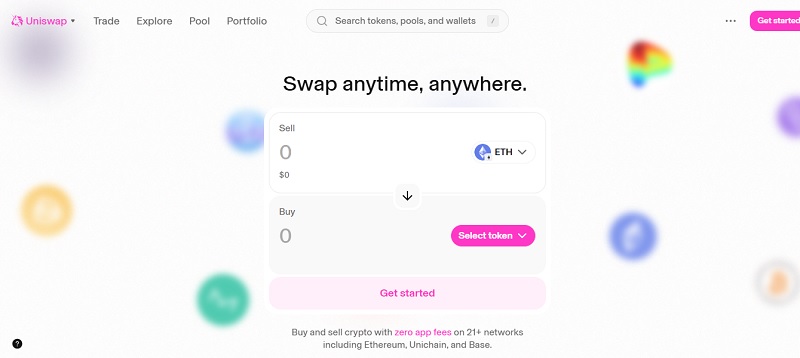
Unlike centralized marketplaces that maintain a fixed listing committee, the Uniswap platform allows permissionless trading of tokens deployed on supported blockchain networks.
The protocol currently operates across 16+ networks, including:
Ethereum
Unichain
Base
Arbitrum
Optimism
Polygon
Avalanche
BNB Chain
Blast
additional EVM-compatible chains.
Commonly traded assets include:
Ethereum (ETH)
Wrapped Bitcoin (WBTC)
Bitcoin wrappers and bridged assets
USDC
USDT
DAI
UNI
Chainlink (LINK)
AAVE
ARB
OP
PEPE
SHIB
thousands of community-issued ERC-20 tokens.
| Product | Available |
|---|---|
| Token Swaps | ✔ |
| Liquidity Pools | ✔ |
| Limit Orders | ✔ |
| Cross-Chain Access | ✔ |
| Self-Custody Wallet | ✔ |
| Margin Trading | No |
| Perpetual Futures | No |
Because listings are permissionless, users should independently verify token contracts before interacting with unfamiliar assets.
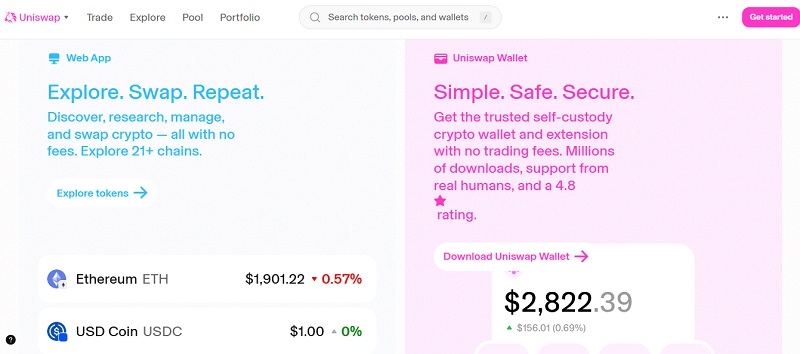
The Uniswap protocol fee model differs significantly from that of centralized platforms.
Trading expenses may consist of:
liquidity pool fee;
blockchain gas fee;
price impact;
slippage.
Since early 2026, the official project web interface has no interface fee, meaning Uniswap Labs no longer charges additional application-level swap costs through its official app.
Liquidity pool fees depend on the selected pool and commonly include:
0.01%
0.05%
0.30%
1.00%
| Cost Component | Typical Treatment |
|---|---|
| Interface Fee | 0% |
| Liquidity Provider Fee | Pool dependent |
| Network Fee | Blockchain dependent |
| Withdrawal Fee | None |
Academic research also shows that total trading costs on DEX are influenced not only by pool fees but also by gas prices and slippage, particularly for large transactions or illiquid assets.
There is no registration form comparable to those used by centralized exchanges.
Instead, a Uniswap personal account is effectively created by connecting a compatible self-custody platform.
Supported crypto apps include:
Uniswap Wallet
MetaMask
Coinbase Wallet
WalletConnect-compatible wallets
Binance Wallet
A connected Uniswap personal account allows users to:
swap tokens;
provide liquidity;
manage portfolio positions;
create limit orders;
interact with supported blockchain networks.
Because the protocol is non-custodial, private keys always remain under the user's control.
Traditional deposits and withdrawals do not exist in the same way they do on centralized exchanges.
Users interact directly with blockchain smart contracts.
Typical workflow:
Connect wallet.
Approve the token.
Confirm the blockchain transaction.
Receive assets directly into the wallet.
| Operation | Description |
|---|---|
| Deposit | Assets remain in user's wallet |
| Trading | Smart-contract execution |
| Custody | User controlled |
| Withdrawal | Wallet-to-wallet transfer |
Consequently, withdrawing money from Uniswap generally means transferring assets from a personal wallet to another blockchain address or another service. The protocol itself does not process withdrawal requests or hold customer balances.
The Uniswap Protocol was launched in 2018.
The software products surrounding the protocol are developed by Uniswap Labs, headquartered in New York City. The company develops:
Uniswap Web App and Wallet;
Trading API;
Unichain infrastructure.
Meanwhile, protocol governance is handled independently through UNI governance proposals.
The review did not identify:
a traditional exchange licence from the FCA;
CySEC authorization;
ASIC authorization;
BaFin authorization.
This reflects the decentralized nature of the protocol rather than automatically indicating regulatory deficiencies. Regulatory treatment of decentralized finance differs substantially across jurisdictions.
According to the supplied DomainTools information:
Domain created: 26 November 2018
Updated: 4 April 2022
IP location: San Francisco, California (Cloudflare)
WHOIS: DATA REDACTED
Official communication channels include:
Help Center;
Contact request form;
email;
developer documentation;
X (Twitter), LinkedIn, Farcaster, TikTok;
official blog.
Because users control their own wallets, customer support of the Uniswap platform cannot recover private keys or reverse completed blockchain transactions.
A Trustpilot profile exists specifically for app.uniswap.org.
At the time of research:
approximately 887 reviews of Uniswap were published;
the profile showed a low TrustScore;
many recent reviews were one-star ratings.
The complaints generally fall into several categories:
failed swaps caused by insufficient liquidity;
unexpected gas costs;
transactions involving fraudulent third-party tokens;
misunderstanding of self-custody responsibilities;
dissatisfaction with support response times.
Positive reviewers most often mention:
deep liquidity for major assets;
fast swap execution;
broad token availability.
| Criterion | Assessment |
|---|---|
| Founded | 2018 |
| Domain Registration | 2018 |
| Legal Developer | Uniswap Labs |
| Headquarters | New York City, USA |
| Traditional Financial Licence | Not identified |
| Corporate Transparency | High |
| Fee Transparency | High |
| Asset Custody | Self-custody |
| Overall Risk | Medium |
The Uniswap platform occupies a unique position within the cryptocurrency industry because users retain control of their own assets throughout the trading process.
Strengths:
established DeFi protocol launched in 2018;
open-source smart-contract infrastructure;
thousands of supported tokens;
compatibility with more than 16 blockchain networks;
transparent fee structure;
no official interface fee;
extensive technical documentation.
Limitations:
users are fully responsible for wallet security;
irreversible blockchain transactions;
permissionless token listings increase exposure to fraudulent assets;
transaction costs may rise during periods of network congestion;
regulatory protections differ from those offered by licensed centralized exchanges.
Suitable for:
experienced DeFi participants;
users comfortable with self-custody wallets;
liquidity providers;
traders seeking permissionless token access.
Less suitable for:
beginners unfamiliar with blockchain security;
users expecting custodial account recovery;
investors preferring centralized exchanges regulated by financial authorities.
Bottom line: the Uniswap protocol is best viewed as decentralized trading infrastructure rather than a conventional brokerage or custodial exchange.
Its transparent smart-contract architecture, mature ecosystem, and broad blockchain support make it one of the leading DeFi protocols, while its self-custody model places significantly greater responsibility on users to verify token contracts, protect wallet credentials, and understand blockchain transaction mechanics.
Checking a company's activities is accessible to everyone through specialized online resources. When evaluating an exchange, it is important to pay attention to the presence of legal status, the length of operation, and transparent earning conditions. It is crucial that the stated information is genuine and not fake. Fraudsters use fake data and documents to imitate the work of legitimate service providers.
To make the right choice, it is better to consult specialists. They will conduct a verification of the cryptocurrency exchange and determine what it really is — a reliable partner or a fraudulent project.
Thanks to comments about the company's services, potential clients receive information about the possibility of real earnings under the proposed conditions. These are written by both experienced traders who have conducted a preliminary assessment of the project and actual clients.
It is important to consider that unscrupulous exchanges may pay for positive reviews. In them, supposedly satisfied users share their achievements and encourage cooperation with a reliable company. You can distinguish such opinions from genuine ones by their content and presentation. They are filled with template and simplistic phrases, as well as expressive statements.
Manipulations involving extortion of additional investments to withdraw capital are undeniable facts of fraud. Real exchanges do not require clients to make payments for fees such as insurance, taxes, transfer commissions, opening transit accounts, etc. This is how scammers operate to profit by tricking traders into making further deposits.
If the exchange refuses to withdraw money, it is important not to fall for the tricks of fraudsters. This can lead to even greater financial losses. In such cases, it is better to consult experts. They will assist in withdrawing capital considering the circumstances.
The first thing to do is to contact the company's representatives and find out the reason for the block. If they ignore the sent requests and do not provide clear instructions for resolving the issue — they are scammers. Blocking accounts is one way to prevent clients from accessing their assets and to deny further service.
Consulting with specialized professionals will be the optimal solution in this situation. They will help determine the source of the exchange account closure and suggest ways to restore access to the personal account.
Various factors can lead to the inactivity of the exchange portal. These can include DDoS attacks, technical failures in server operation, or the company's own decision to cease operations. There may also be blocking of the platform according to the client's jurisdiction laws or violations of platform rules by the user themselves.
In fraudulent companies, a non-functioning website is one of the manipulations used to limit services to existing clients. When faced with such a situation, it is advisable to utilize the services of experts . They will help establish the true cause of the problem and provide useful recommendations for further actions.
Refusal to withdraw money is a common occurrence among illegal service providers. To initiate a refund, you should gather all available information (screenshots, wallet addresses, transaction IDs) and submit a request for a chargeback.
Disputing cryptocurrency transfers is a rather specific procedure that requires a competent approach. That is why it is best to entrust its initiation to qualified specialists. They will help recover assets in accordance with established timelines and regulations.