Overview: Ctoph Exchange presents itself as an international cryptocurrency trading platform focused on security infrastructure, blockchain scalability, and compliance-oriented operations. According to statements published on the official website toph-exchange.com, the service claims to use:
At the same time, Ctoph Exchange demonstrates several characteristics commonly associated with newly established offshore crypto platforms:
minimal corporate disclosure
absence of verifiable regulation
a very recent domain history
These factors require a more cautious analytical assessment beyond marketing claims.
Ctoph Exchange Market Infrastructure and Asset Ecosystem
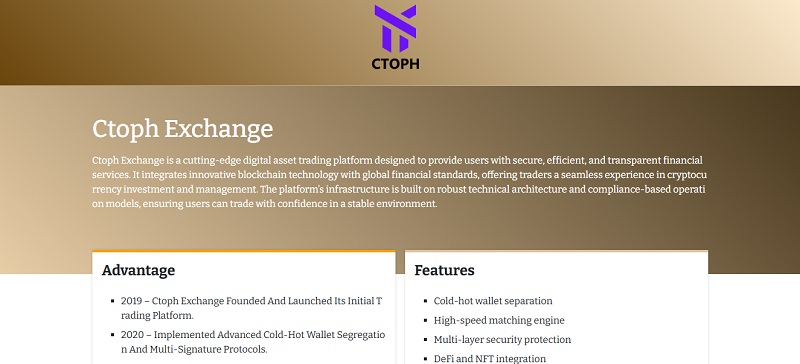
Ctoph Exchange positions itself as a multi-functional digital asset environment rather than a basic crypto platform.
The service advertises:
spot cryptocurrency trading
DeFi integration
NFT functionality
high-speed matching engine infrastructure
cold-hot wallet separation systems
Ctoph Exchange also claims to support scalable blockchain architecture capable of processing transactions with low latency.
Analytical interpretation:
While these features sound technically advanced, they largely reflect standard industry terminology rather than independently verified technological advantages. No audited performance metrics or institutional partnerships were publicly identified.
Trading Conditions and Platform Mechanics of Ctoph Exchange
Public information regarding fees, spreads, liquidity depth, or execution quality remains extremely limited.
Available operational characteristics:
| Parameter | Details |
|---|
| Trading interface | Web-based |
| Matching engine | Claimed high-speed |
| DeFi integration | Advertised |
| NFT functionality | Advertised |
| Fee transparency | Limited |
Ctoph Exchange repeatedly references:
However, no independently verified technical documentation or regulatory filings were identified.
Interpretation:
Ctoph Exchange appears to rely heavily on broad technological narratives, while core operational metrics remain insufficiently disclosed.
Ctoph Exchange Registration Process and User Environment
Opening a Ctoph Exchange personal account appears relatively simple:
email registration
password setup
account verification
The platform promotes:
The Ctoph Exchange personal account interface reportedly includes:
Although usability claims are emphasized, there is limited information regarding:
Deposits and Withdrawing Funds from Ctoph Exchange
Ctoph Exchange does not provide detailed public disclosure regarding supported banking partners or fiat infrastructure.
Funding & Withdrawal Overview
| Method | Deposit | Withdrawal | Transparency |
|---|
| Cryptocurrency | Yes | Yes | Limited |
| Bank transfer | Unclear | Unclear | Not disclosed |
| Third-party payments | Possible | Possible | Undefined |
The process of withdrawing money from Ctoph Exchange cannot be independently evaluated due to the lack of publicly available procedural documentation.
Multiple external review platforms contain allegations involving:
These reports alone do not conclusively prove misconduct, but they materially increase operational risk concerns.
Ctoph Exchange Corporate Information and Domain Profile
Publicly verifiable company data for Ctoph Exchange remains extremely limited.
DomainTools data:
Declared platform positioning:
However:
no confirmed headquarters address was identified
no executive team disclosure was verified
no licensing registry references were found
Analytical conclusion:
The absence of transparent corporate identification significantly complicates reliability assessment.
Ctoph Exchange Regulation and Compliance Claims
Ctoph Exchange repeatedly references:
Despite these statements:
no FCA license was identified
no SEC, ASIC, CySEC, or FINTRAC registrations were located
no official regulatory numbers were publicly disclosed
Interpretation:
The platform’s compliance positioning currently appears to rely primarily on self-declared statements rather than independently verifiable authorization.
This distinction is critical because many high-risk platforms use regulatory terminology without holding enforceable licenses.
Ctoph Exchange Security Architecture and Risk Controls
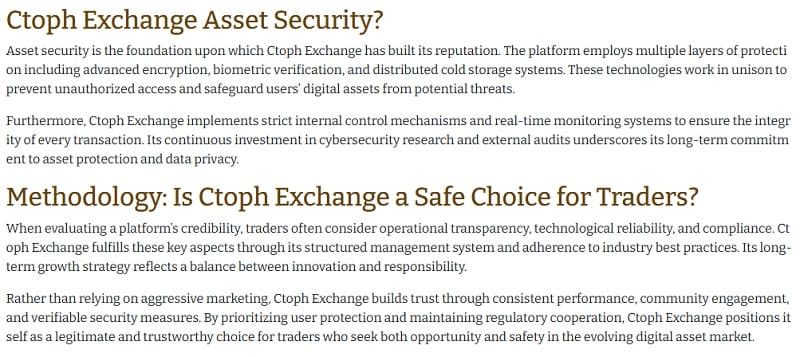
Security is the central theme of Ctoph Exchange marketing materials.
The platform claims to use:
multi-signature authorization
biometric verification
distributed cold storage
AI-based monitoring systems
real-time transaction surveillance
Analytical interpretation:
The language used by Ctoph Exchange resembles institutional cybersecurity documentation, yet independent audit evidence was not identified.
Security Features Summary
| Claimed Feature | Verification Status |
|---|
| Cold-hot wallet separation | Not independently verified |
| Multi-signature protection | Claimed only |
| Real-time monitoring | Claimed only |
| External audits | Not confirmed |
| Biometric verification | Unverified |
Ctoph Exchange Reviews and External Reputation Signals
Public Ctoph Exchange reviews show a strongly polarized pattern.
Negative reports reference:
At the same time, several websites publish highly positive reviews describing the platform as transparent and secure. However, these pages demonstrate:
Analytical observation:
The coexistence of aggressive praise and severe accusations creates a fragmented reputation profile, which is common among recently launched high-risk exchanges.
Risk Assessment and Expert Conclusion about Ctoph Exchange
| Criteria | Assessment |
|---|
| Regulation | Not verified |
| Corporate transparency | Very low |
| Operational disclosure | Insufficient |
| Security claims | Unverified |
| Overall risk | High |
Final Evaluation of Ctoph Exchange
Ctoph Exchange can currently be categorized as a high-risk and weakly transparent crypto platform.
The service is not listed on BrokerChooser, a platform specializing in broker and exchange evaluation.
This absence may indicate several possibilities:
the project is too new to be evaluated
the platform may not satisfy transparency or compliance requirements
or the exchange operates outside the standards typically associated with regulated financial services
Analytical implication:
For platforms claiming institutional security and global compliance, the lack of visibility on major independent comparison resources reduces external credibility signals.
Potentially suitable for:
Not suitable for:
long-term capital storage
institutional participation
conservative investors
users prioritizing regulatory protection and operational transparency
Bottom line:
Despite sophisticated marketing language focused on cybersecurity and compliance, Ctoph Exchange lacks many of the independent validation signals typically expected from established crypto exchanges. The combination of:
extremely recent domain registration
lack of verified regulation
limited corporate transparency and legal disclosures
mixed reputation indicators
substantially increases the platform’s overall risk profile.


