The digital exchange Bitfinex is one of the longer-running cryptocurrency trading platforms. It was founded in 2012 and is operated within the wider iFinex/Tether corporate ecosystem. The company provides spot markets, derivatives, margin products, lending, staking and tokenised securities services for eligible users.
The public leadership page identifies JL van der Velde as Chief Executive Officer. Bitfinex exchange offers online chat support, while its help-centre and ticket tools are used for account and transaction-related requests.
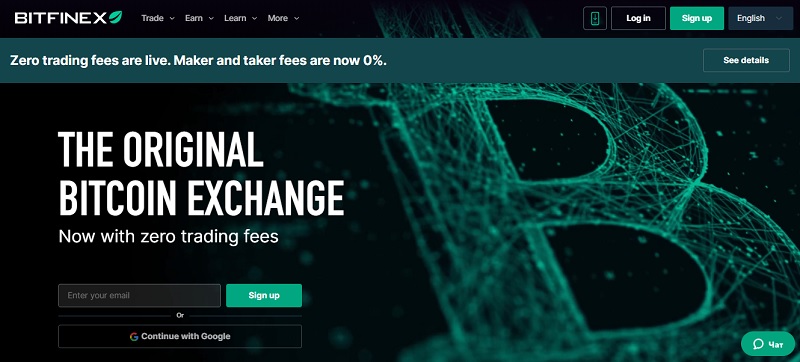
Bitfinex Corporate Structure and Legal Position
The Bitfinex exchange was launched in 2012. Its legal framework is not represented by a single universal licence for every product and jurisdiction. Instead, different group entities and product lines operate under different legal arrangements:
For example, Bitfinex Securities states that it is licensed in the Astana International Financial Centre in Kazakhstan and in El Salvador.
In May 2026, the company also announced that the core Bitfinex platform had received a Digital Asset Service Provider licence in El Salvador.
However, a licence covering a particular exchange entity or securities service should not automatically be treated as global authorisation for every service, user location, or product. Users should check the terms applicable to their jurisdiction before opening a Bitfinex personal account.
| Corporate Item | Available Information |
|---|
| Platform launch | 2012 |
| Chief Executive Officer | JL van der Velde |
| Core services | Digital asset trading and related products |
| Securities licensing | Kazakhstan AIFC and El Salvador, according to Bitfinex Securities |
| Core-platform DASP licence | El Salvador, announced May 2026 |
| Head office address | No single global headquarters address is prominently presented for the exchange platform |
Markets and Available Digital Assets Offered by Bitfinex
The Bitfinex exchange supports a broad catalogue of crypto assets, stablecoins and selected tokenised instruments. The market list changes over time, so traders should verify availability, liquidity and geographic restrictions directly on the platform before funding an account.
Examples of assets visible in the market interface include:
BTC
ETH
USDT
XAUT
USDC
XRP
SOL
XMR
ZEC
LTC
LINK
DOGE
SUI
LEO
TRX
AVAX
DOT
ADA
UNI
NEAR
HYPE
The presence of a token on the interface does not guarantee deep liquidity or availability in every country. Certain assets, including privacy-oriented tokens and tokenised securities, can be subject to regional restrictions.
| Market Segment | Bitfinex Exchange Offering |
|---|
| Spot trading | Cryptocurrency and stablecoin pairs |
| Margin trading | Margin-enabled markets for eligible users |
| Perpetuals and futures | Derivative instruments |
| Options | Options products for eligible users |
| Tokenised securities | Separate regulated Bitfinex Securities offering |
| Earn products | Lending, borrowing and staking-related services |
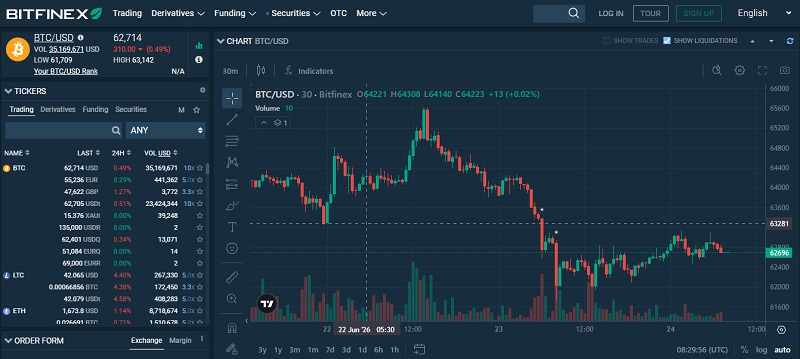
Trading Costs, Lending Fees and Product Conditions at Bitfinex
Bitfinex exchange advertises zero trading fees for certain products or campaigns, but this should not be interpreted as a universal zero-cost trading policy. Trading costs can depend on the:
selected market,
order type,
monthly volume,
account tier,
LEO token discounts,
the product used.
For lending products, Bitfinex Borrow states that lenders are generally charged 15% of fees generated by active loans, while hidden offers can carry an 18% charge. Margin Funding providers are shown under a similar structure. LEO-related reductions may apply under the stated conditions.
Key services promoted by the platform include:
Spot and margin trading
Perpetual contracts
Futures
Options
Lending and borrowing
Staking
Tokenised securities
A Bitfinex personal account may therefore provide access to a much broader product set than a basic spot-exchange account. That also means users need to understand product-specific risks, especially liquidation exposure in margin and derivatives markets.
| Fee Area | Published Structure |
|---|
| Spot and derivative trading | Depends on market, tier, volume and applicable promotions |
| Bitfinex Borrow lender charge | 15% of fees generated by active loans |
| Borrow hidden-offer charge | 18% of fees generated by active loans |
| Margin Funding lender charge | 15% of fees generated by active funding contracts |
| Margin Funding hidden-offer charge | 18% of fees generated by active contracts |
| LEO discount | May reduce selected charges under platform rules |
Bitfinex Registration, Verification and Account Access
Opening a Bitfinex personal account generally begins with an email address, password and security confirmation. Access to specific features can depend on:
Users should expect the platform to request additional information where required by compliance rules. This can include:
Identity documents
Proof of residence
Source-of-funds information
Tax or jurisdictional declarations
Enhanced verification for higher-risk or higher-value activity
The Bitfinex exchange terms also contain country restrictions and prohibited-person provisions. This is particularly relevant for users seeking derivatives, securities or fiat-related services.
Deposits and Withdrawing Money from Bitfinex
Bitfinex exchange supports:
crypto and stablecoin deposits,
securities-related deposits where applicable,
fiat funding through bank wires.
Crypto, stablecoin and securities deposits are listed as free, while bank-wire costs vary by payment route and currency.
Examples of published deposit charges include:
Standard bank wire: 0.10%, with a minimum of USD/EUR 60
For OpenPayd EUR and GBP transfers of up to 10,000, the fee is 5 per transaction.
Amounts exceeding EUR/GBP 10,000 are charged at 0.10%.
USD transfers via OpenPayd carry a 0.10% fee, subject to a minimum charge of USD 30.
Withdrawing money from Bitfinex involves asset-specific network fees. These charges are not static because blockchain conditions and platform policy can change. Examples shown in the fee schedule include:
0.00006 BTC for Bitcoin,
0.001 ETH for Ethereum,
0.3 ADA for Cardano,
0.002 DASH for Dash.
| Funding or Withdrawal Method | Published Cost or Condition |
|---|
| Crypto deposit | Free |
| Stablecoin deposit | Free |
| Securities deposit | Free |
| Standard bank wire deposit | 0.10%, minimum USD/EUR 60 |
| Bitcoin withdrawal | 0.00006 BTC listed |
| Ethereum withdrawal | 0.001 ETH listed |
| Cardano withdrawal | 0.3 ADA listed |
Before sending funds, users should confirm the active fee, destination network, minimum withdrawal amount and verification status. A wrong network selection or incomplete compliance check can delay a transaction.
Bitfinex Domain History and Transparency Signals
The Bitfinex exchange domain was registered on October 11, 2012.
DomainTools data lists:
an update date of March 15, 2021,
Cloudflare infrastructure in Mesa, Arizona, and Domain Protection Services, Inc. as the registration privacy provider.
A privacy-protected domain is not unusual for a large online platform, but domain data alone does not prove financial reliability. In this case, the long operating history, named management and published legal documentation provide stronger context than WHOIS details alone.
Bitfinex Reviews and External Reputation
Bitfinex reviews on Trustpilot are mixed:
Positive users mention trading tools, liquidity and prompt support responses.
Negative reviewers often describe account restrictions, lengthy verification requests, deposit or withdrawal delays, and disputes about compliance documentation.
These reports should be interpreted carefully. Trustpilot posts are individual experiences, not regulatory findings. Still, the recurring themes indicate that users should prepare for potentially detailed KYC checks and should avoid relying on immediate access to funds during a compliance review.
Risk Assessment and Final Verdict on Bitfinex Exchange
| Assessment Area | Conclusion |
|---|
| Operating history | Long-established platform since 2012 |
| Leadership disclosure | Named executive team is publicly available |
| Product range | Broad, including complex leveraged products |
| Regulatory footprint | Product- and jurisdiction-specific rather than universal |
| Customer feedback | Mixed, with recurring KYC and withdrawal complaints |
| Overall project risk | Medium |
Final assessment: Bitfinex exchange is an established crypto platform with a long market history, identifiable management, a wide product range and a developing regulated footprint in selected jurisdictions.
At the same time, the service offers leveraged and lending products that carry substantial market and counterparty risk. Its legal position differs by product and user location, while Trustpilot feedback shows that verification and access issues can be stressful for some customers.
May be suitable for:
Experienced cryptocurrency traders
Users seeking spot, derivatives and margin tools in one environment
Participants who understand KYC and jurisdictional restrictions
Traders who can independently assess leverage and liquidation risk
May not be suitable for:
Beginners looking for a simple regulated fiat investment account
Users who need guaranteed immediate withdrawals
Investors unwilling to complete detailed compliance checks
People who do not understand derivatives, lending or margin exposure


