


No legal info, domain is parked. Huge red flag.
Stay away
2
Maria Portell
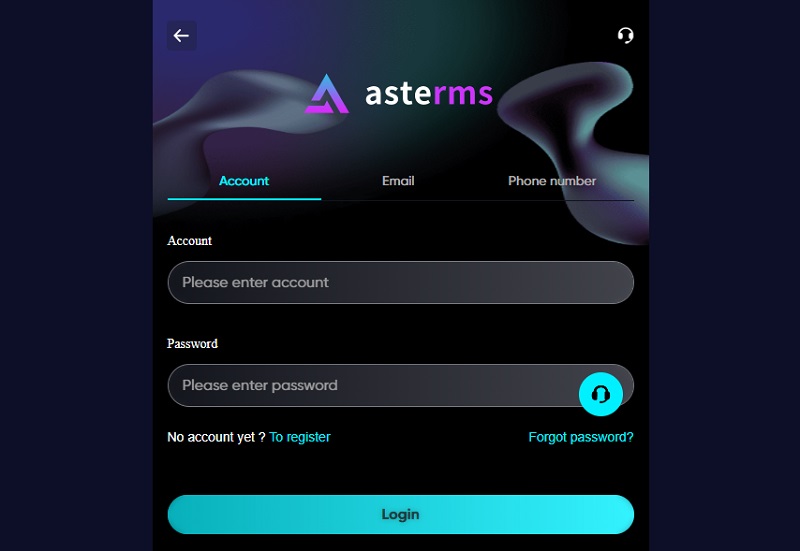
The crypto exchange Asterms presents itself as a digital-asset trading website, but the publicly accessible part of the platform provides very little verifiable information about the operator, trading conditions, asset coverage, custody model, or withdrawal rules.
The platform is effectively closed to visitors until they create an account using a login, password, and invitation code. This access model makes independent due diligence more difficult because a prospective user cannot inspect the trading interface, fee schedule, available markets, or account rules before registration.
The available legal text states that:
the official website asterms.com is intended to act as an online venue for digital-asset information and transactions rather than as a direct buyer or seller,
the platform does not provide fiat-currency deposit or withdrawal services.
However, these statements do not identify the company responsible for operating the Asterms exchange, its registered address, company number, financial licence, or named management team.
The Asterms exchange does not publicly disclose:
a legal entity name,
incorporation number,
registered office,
physical address,
financial-services licence,
regulator.
The Terms of Service refer generally to “the Company,” but do not explain which firm this is.
The agreement says that disputes are governed by the laws of the Republic of Seychelles and should be heard in Seychelles. This is a choice-of-law clause, not proof that the Asterms exchange is incorporated, licensed, or supervised in Seychelles. A jurisdiction reference alone cannot replace a verifiable company registration or a regulator-issued authorisation.
Domain creation date: August 31, 2017;
Last recorded update: June 17, 2026;
IP infrastructure location: Hong Kong;
Ownership details: protected by a privacy service.
Domain age can be a useful context, but it does not verify the current operator, financial standing, custody arrangements, or regulatory status.
Key transparency gaps include:
No disclosed legal entity behind the Asterms exchange;
No public registered address;
No licence number or regulator name;
No named founders, directors, compliance officers, or beneficial owners;
No independently verifiable proof-of-reserves page found in the supplied materials;
No public audit report, insurance certificate, or custody-provider disclosure.
Creating an Asterms personal account requires:
a login;
a password;
an invitation code.
An invitation-only registration process is not automatically evidence of misconduct. Some platforms use it for private launches, referral campaigns, regional onboarding, or controlled user acquisition. Still, it limits the ability of a prospective client to examine the Asterms exchange before sharing personal information or depositing assets.
The Terms say that registered members may be asked to provide:
an email address,
mobile number,
identity documents,
address evidence,
a photo holding an identity document.
The AML policy also states that records may be retained for at least six years and may be supplied to authorities without separate notice to the user.
Before opening an Asterms personal account, users should establish:
Who receives and processes identity documents;
Which legal entity controls customer data;
Whether the privacy policy names a data controller;
Whether KYC is mandatory before deposits, trading, or withdrawals;
Which countries are accepted or restricted;
Whether the invitation code comes from an official Asterms source.
The public Terms describe the Asterms exchange as a website for online digital-asset transaction services. Users may browse market information, submit trading instructions, and review transaction records through a member account. The website asterms.com says it does not itself participate in transactions as buyer or seller.
At the same time, the publicly visible materials do not clearly specify:
Spot trading pairs;
Futures or perpetual-contract availability;
Margin requirements;
Leverage limits;
Maker and taker commissions;
Spread methodology;
Funding rates;
Liquidation rules;
Minimum order sizes;
Listed coins and tokens;
Fiat payment methods;
API access;
Mobile applications.
This means the actual commercial terms of the Asterms exchange remain unavailable for pre-registration review.
The Terms expressly state that the website asterms.com does not provide services for fiat-currency deposits or withdrawals. They also say that the platform may set or adjust daily trading and cash-withdrawal limits based on security requirements and transaction conditions.
No public schedule was provided for:
Deposit and withdrawal minimums;
Blockchain withdrawal fees;
Processing times;
Supported networks;
Daily or monthly limits;
Withdrawal verification procedures;
Fees for account maintenance or inactivity;
Procedures for rejected or delayed withdrawals.
Because the available information is incomplete, withdrawing money from Asterms cannot be evaluated against a published fee table or a clearly stated operational timetable. A user should not assume that displayed account balances, if any, are immediately transferable until they have reviewed the exact withdrawal rules and tested the process with a small amount.
The Terms reserve broad discretion for the website asterms.com:
to suspend or terminate accounts,
stop transactions,
request additional information,
restrict services where it believes activity is unlawful, suspicious, incomplete, or unsuitable for high-risk investment.
The website asterms.com also says it may change, suspend, or terminate services without prior notice.
The Asterms exchange Terms contain extensive risk warnings. They state that digital assets are speculative, volatile, and may result in partial or total loss. They also place responsibility for transaction decisions, tax reporting, asset provenance, account security, and trading losses on the user.
Other notable provisions include:
The platform may freeze accounts or report suspicious activity;
The website may revoke an account after one year of inactivity;
The user is responsible for actions performed through account credentials;
The website asterms.com limits its liability for losses connected with service interruptions, market events, technical failures, third-party sites, or inaccurate information;
Direct liability is capped at the fees paid during the previous three months;
The agreement includes a minimum US$2 million compensation clause for certain user breaches;
Seychelles law and Seychelles courts are named as the governing legal framework.
These clauses are important because they give the Asterms exchange wide operational discretion while offering limited public information about the entity that would be responsible if a dispute arose.
The website’s AML text says it applies KYC and anti-money-laundering procedures, uses identity verification, reviews transactions, and may report suspicious activity. It also says credit cards are prohibited during transactions.
However, policy language alone does not independently confirm that the Asterms exchange is licensed, audited, or supervised by a financial authority. No public evidence was found in the supplied materials of:
A regulator-issued virtual-asset licence;
A named compliance provider;
External penetration-testing reports;
Proof of reserves;
Wallet-address disclosures;
Insurance coverage;
Segregation-of-client-assets policy;
Independent financial audit.
Users should distinguish between a platform’s stated compliance intentions and independently verifiable regulatory authorisation.
A Trustpilot page for asterms.com is available:
At the time reviewed, it displayed a Poor TrustScore of approximately 2.6/5, with eight reviews and a prominent notice that the company may be associated with high-risk investments.
The feedback sample is small, so it should not be treated as conclusive evidence on its own; however, the concentration of one-star ratings is a relevant warning signal that should be assessed alongside the platform’s lack of public corporate disclosure.
The available Asterms reviews should be interpreted carefully:
Trustpilot comments are user-generated claims, not regulatory findings;
A small number of reviews cannot establish the full quality of a platform;
Positive and negative posts may be incomplete, inaccurate, or influenced by individual circumstances;
Repeated allegations involving account restrictions or withdrawal problems deserve particular caution where public withdrawal rules are missing.
Independent security-scanning services also flag the website asterms.com as suspicious or potentially risky. These automated ratings are not a legal determination that the platform is fraudulent, but they reinforce the need for careful verification before providing identity documents, connecting a wallet, or transferring funds.
| Assessment Area | Findings | Why It Matters |
|---|---|---|
| Legal entity | Not publicly identified in the reviewed materials | Users cannot easily determine which company is contractually responsible for the platform |
| Registered address | Not disclosed | The operational location cannot be independently checked |
| Licensing | No licence number or named regulator was found | Regulatory status and potential user protections cannot be confirmed |
| Registration | Login, password and invitation code are required | Important platform information is restricted before onboarding |
| Contact methods | Online chat only | No published phone number, corporate email address or office address was provided |
| Trading conditions | Not publicly available | Fees, spreads, leverage and liquidation terms cannot be compared in advance |
| Fiat services | The Terms state that fiat deposits and withdrawals are not available | Users should clarify how funds can enter and leave the platform before depositing |
| Withdrawal policy | Limits may be adjusted, while a public fee schedule was not found | This creates uncertainty around processing time, costs and access to funds |
| Terms | The platform reserves broad powers to suspend accounts and services | Users may face restrictions with limited practical recourse |
| Reputation | Trustpilot lists Asterms with a Poor rating and a high-risk investment notice | User feedback is not proof of misconduct, but the concentration of negative feedback warrants additional caution |
| Domain information | Domain registration data shows privacy-protected ownership | Private WHOIS data does not establish who operates the Asterms Exchange |
The Asterms exchange should be classified as a high-risk crypto platform based on the information available for review
The principal issue is that the platform provides limited pre-registration transparency about its operator, legal status, trading conditions, custody arrangements, fees, and withdrawal process.
The service may only be considered by highly experienced users who can independently verify the operating entity, test the platform with an amount they can afford to lose, understand Seychelles-based dispute provisions, and avoid relying on informal assurances from referral sources.
The Asterms exchange is not suitable for:
Beginners seeking clear onboarding and regulated consumer protections;
Users who need transparent withdrawal rules before depositing;
Investors looking for independently audited reserves;
Clients who require a disclosed legal entity and physical address;
Anyone unable to tolerate a full loss of deposited funds;
Users who are asked to pay additional fees, taxes, or deposits before a withdrawal is released.
Before sending any digital assets:
verify the company identity through an official corporate registry,
request the exact fee and withdrawal policy in writing,
confirm the destination wallet and network,
test the process with a minimal amount.
Checking a company's activities is accessible to everyone through specialized online resources. When evaluating an exchange, it is important to pay attention to the presence of legal status, the length of operation, and transparent earning conditions. It is crucial that the stated information is genuine and not fake. Fraudsters use fake data and documents to imitate the work of legitimate service providers.
To make the right choice, it is better to consult specialists. They will conduct a verification of the cryptocurrency exchange and determine what it really is — a reliable partner or a fraudulent project.
Thanks to comments about the company's services, potential clients receive information about the possibility of real earnings under the proposed conditions. These are written by both experienced traders who have conducted a preliminary assessment of the project and actual clients.
It is important to consider that unscrupulous exchanges may pay for positive reviews. In them, supposedly satisfied users share their achievements and encourage cooperation with a reliable company. You can distinguish such opinions from genuine ones by their content and presentation. They are filled with template and simplistic phrases, as well as expressive statements.
Manipulations involving extortion of additional investments to withdraw capital are undeniable facts of fraud. Real exchanges do not require clients to make payments for fees such as insurance, taxes, transfer commissions, opening transit accounts, etc. This is how scammers operate to profit by tricking traders into making further deposits.
If the exchange refuses to withdraw money, it is important not to fall for the tricks of fraudsters. This can lead to even greater financial losses. In such cases, it is better to consult experts. They will assist in withdrawing capital considering the circumstances.
The first thing to do is to contact the company's representatives and find out the reason for the block. If they ignore the sent requests and do not provide clear instructions for resolving the issue — they are scammers. Blocking accounts is one way to prevent clients from accessing their assets and to deny further service.
Consulting with specialized professionals will be the optimal solution in this situation. They will help determine the source of the exchange account closure and suggest ways to restore access to the personal account.
Various factors can lead to the inactivity of the exchange portal. These can include DDoS attacks, technical failures in server operation, or the company's own decision to cease operations. There may also be blocking of the platform according to the client's jurisdiction laws or violations of platform rules by the user themselves.
In fraudulent companies, a non-functioning website is one of the manipulations used to limit services to existing clients. When faced with such a situation, it is advisable to utilize the services of experts . They will help establish the true cause of the problem and provide useful recommendations for further actions.
Refusal to withdraw money is a common occurrence among illegal service providers. To initiate a refund, you should gather all available information (screenshots, wallet addresses, transaction IDs) and submit a request for a chargeback.
Disputing cryptocurrency transfers is a rather specific procedure that requires a competent approach. That is why it is best to entrust its initiation to qualified specialists. They will help recover assets in accordance with established timelines and regulations.