The digital exchange Rhea Finance presents itself as a NEAR-based DeFi ecosystem formed after the 2025 merger of Ref Finance and Burrow Finance. Public sources also associate the early project development with Illia Polosukhin.
Despite its longer presence in the NEAR ecosystem compared to many newer DeFi platforms, Rhea Finance exchange still provides limited corporate transparency. Publicly accessible information about legal registration, management structure, and direct support channels remains relatively sparse.
Official website:
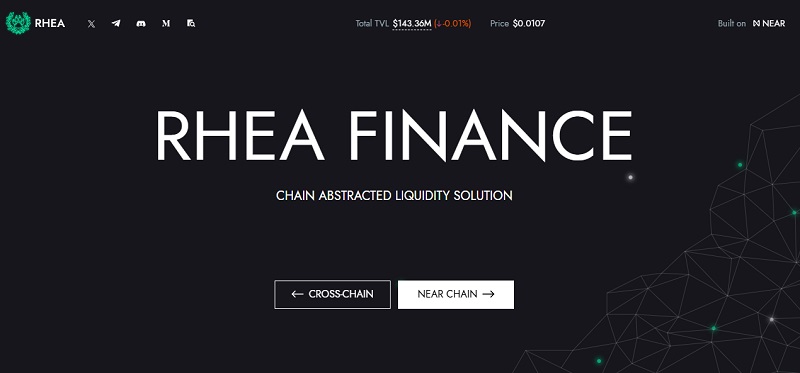
Digital Asset Ecosystem and Services Offered by Rhea Finance
Rhea Finance platform positions itself as a chain-abstracted DeFi liquidity environment rather than a traditional centralized exchange. The project integrates several DeFi-oriented products including decentralized swaps, lending, staking, liquidity farming, and bridge aggregation services.
The platform advertises:
decentralized token swaps;
lending and borrowing markets;
staking mechanisms;
cross-chain bridge aggregation;
SDK tools for developers;
liquidity pool infrastructure;
governance participation mechanisms.
| Rhea Finance Exchange Component | Operational Description |
|---|
| DEX infrastructure | Token swaps and liquidity pools on NEAR |
| Lending module | Borrowing and collateralized lending services |
| Bridge aggregator | Cross-chain asset transfer functionality |
| Developer SDK | Integration toolkit for external builders |
| Governance mechanics | DAO-based participation structure |
Analytical interpretation:
Rhea Finance exchange appears significantly more infrastructure-oriented than many anonymous offshore crypto platforms. The project maintains public GitHub references, developer documentation, and ecosystem integrations connected with NEAR Protocol infrastructure.
Trading Conditions and Liquidity Structure of Rhea Finance
Public fee disclosure on Rhea Finance crypto exchange remains partially decentralized in nature because pricing conditions depend on:
Unlike centralized exchanges, the service does not appear to rely on traditional order-book trading mechanics for all services. Instead, automated market maker (AMM) infrastructure plays a central role in liquidity distribution.
| Parameter | Current Observation |
|---|
| Trading architecture | Primarily decentralized AMM-based |
| Blockchain ecosystem | NEAR Protocol |
| Liquidity provision | Community and pool-driven |
| Order execution | Smart contract dependent |
| Fee transparency | Partially disclosed |
| Institutional licensing | Not verified |
Rhea Finance exchange repeatedly references decentralized governance principles and non-custodial asset interaction models. This operational structure reduces certain custodial risks but simultaneously transfers a portion of technical responsibility to users themselves.
Interpretation:
The platform’s infrastructure appears technologically legitimate within the NEAR ecosystem, although users should understand that DeFi participation involves smart contract and liquidity risks that differ substantially from regulated centralized exchanges.
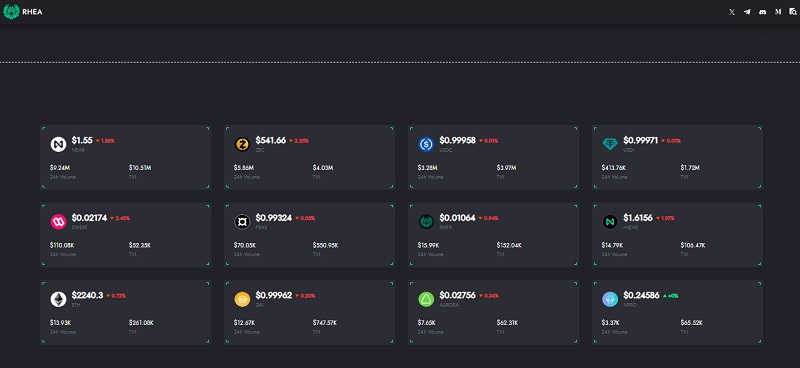
Rhea Finance Personal Account and User Access Mechanics
Creating a Rhea Finance personal account differs from conventional exchange onboarding because the platform primarily interacts through crypto wallets instead of traditional custodial registration systems.
The onboarding process generally includes:
wallet connection;
NEAR-compatible wallet authorization;
DeFi protocol interaction permissions;
liquidity and staking management access.
The Rhea Finance personal account environment reportedly includes:
liquidity management dashboards;
staking interfaces;
governance participation tools;
lending controls;
bridge aggregation utilities.
Unlike regulated centralized exchanges, the platform does not publicly emphasize extensive KYC onboarding for all protocol interactions. This may appeal to DeFi-native users but could create regulatory uncertainty across certain jurisdictions.
Deposits, Withdrawals, and Asset Movement Inside Rhea Finance
Depositing funds into the crypto exchange primarily occurs through wallet connectivity and blockchain-based transfers.
| Funding Method | Availability | Additional Notes |
|---|
| NEAR wallet transfer | Available |
| Cross-chain bridge | Supported |
| Bank card purchases | Not clearly disclosed |
| Fiat withdrawals | Limited visibility |
The process of withdrawing money from Rhea Finance largely depends on smart contract execution and external wallet infrastructure rather than direct exchange-side approval systems.
Analytical observation:
No widespread reports of systemic withdrawal freezes were identified during this review. However, as with most DeFi ecosystems, users remain exposed to:
Corporate Structure and Domain Background of Rhea Finance
Publicly available information suggests that Rhea Finance exchange evolved from Ref Finance, a long-standing NEAR ecosystem project. The documentation references grants connected with Proximity Labs and the NEAR Foundation ecosystem.
At the same time, full legal corporate transparency remains incomplete.
| Corporate Indicator | Current Status |
|---|
| Original project launch | 2021 |
| Rebranding to Rhea Finance | 2025 |
| Domain registration data | 2025-01-12 |
| Latest domain update | 2025-12-18 |
| Hosting provider | Cloudflare Inc. (United States) |
| Public headquarters disclosure | Not clearly verified |
| Support phone number | Not publicly identified |
Source: DomainTools
The project references “Rhea Finance Ltd” within website materials, although independently verifiable registration details, jurisdictional incorporation documents, and executive office addresses were not clearly disclosed on publicly accessible pages during this review.
Regulation Status and Compliance Positioning of Rhea Finance
Rhea Finance operates primarily as a decentralized finance protocol rather than a fully licensed centralized broker or exchange entity.
No evidence was identified confirming:
FCA authorization;
SEC registration;
ASIC licensing;
CySEC supervision;
FINTRAC registration.
At the same time, the absence of traditional licensing is relatively common among DeFi protocols operating through decentralized governance frameworks.
Interpretation:
This distinction is important because decentralized infrastructure projects function under substantially different legal models compared to custodial exchanges. Nevertheless, the lack of direct regulatory oversight means users receive limited formal financial protection.
Rhea Finance Reviews and Community Reputation Signals
Public Rhea Finance reviews demonstrate a substantially different pattern compared to many newly launched anonymous crypto exchanges.
Positive observations include:
long-term presence within the NEAR ecosystem;
visible developer documentation;
open-source infrastructure references;
known ecosystem affiliations.
Negative concerns primarily involve:
DeFi smart contract risks;
liquidity volatility;
protocol complexity for beginners;
incomplete corporate disclosure.
Unlike highly suspicious offshore exchanges, Rhea Finance exchange does not currently demonstrate large-scale public allegations involving widespread blocked withdrawals or fake support impersonation campaigns during this review period.
Analytical conclusion:
The platform appears more aligned with a legitimate DeFi infrastructure project than with a typical high-risk anonymous trading website. However, operational and regulatory risks remain elevated compared to fully licensed financial institutions.
Risk Assessment and Final Expert Opinion About Rhea Finance Exchange
| Risk Category | Assessment |
|---|
| Corporate transparency | Moderate |
| Regulatory oversight | Limited |
| Technical ecosystem maturity | Established within NEAR ecosystem |
| Operational disclosure | Partially transparent |
| Counterparty risk | Medium |
| Overall risk profile | Medium risk |
Final Evaluation of Rhea Finance
Rhea Finance exchange cannot currently be categorized alongside anonymous short-lived offshore crypto schemes because the project demonstrates a visible historical connection to the NEAR ecosystem, public documentation, GitHub activity, and long-term DeFi infrastructure development.
At the same time, several limitations remain relevant:
absence of verified financial regulation;
limited corporate disclosure;
unclear headquarters information;
no publicly verified support phone number;
elevated DeFi-related technical risks.
Potentially suitable for:
experienced DeFi users;
NEAR ecosystem participants;
liquidity providers familiar with smart contract exposure;
users comfortable with non-custodial infrastructure.
Less suitable for:
conservative investors;
users requiring regulatory protection;
individuals unfamiliar with DeFi mechanics;
long-term capital storage without risk diversification.
Bottom line:
Rhea Finance exchange appears substantially more credible than many newly created crypto platforms due to its historical ties to Ref Finance and the broader NEAR ecosystem.
However, the project still operates in a relatively high-risk DeFi environment where users rely heavily on smart contract security, decentralized governance structures, and ecosystem stability rather than traditional financial oversight.


