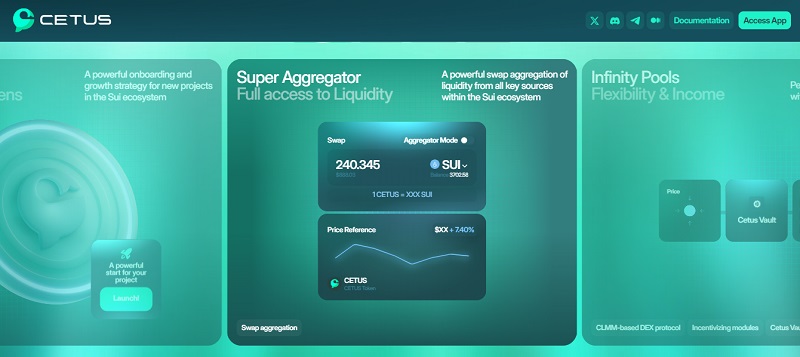
The digital exchange Cetus operates through the official website cetus.zone and positions itself as a decentralized liquidity and trading protocol built primarily for the Sui and Aptos ecosystems. Unlike centralized services, the project functions as a DeFi infrastructure platform focused on:
The service has gained significant visibility within the Sui ecosystem, but public discussion around Cetus Zone crypto exchange intensified after a major security breach in 2025 involving losses exceeding $220 million.

Trading Infrastructure and Liquidity Model of Cetus
The Cetus exchange presents itself as a decentralized liquidity protocol rather than a conventional custodial trading platform. The project emphasizes concentrated liquidity mechanics similar to Uniswap v3 architecture.
| Cetus Feature | Current Status |
|---|
| Decentralized exchange model | Operational |
| Concentrated liquidity pools | Core functionality |
| Sui blockchain integration | Primary ecosystem |
| Aptos ecosystem support | Advertised |
| Liquidity farming | Available |
| Non-custodial wallet access | Supported |
Cetus Zone protocol repeatedly references:
deep liquidity infrastructure;
efficient capital utilization;
CLMM architecture;
decentralized on-chain trading.
Analytical interpretation:
Unlike opaque offshore exchanges, the platform operates as an on-chain protocol where many smart contract interactions remain publicly visible. However, DeFi transparency does not eliminate smart contract and protocol-level risk.
Cetus Zone Security Incident and Smart Contract Risks
One of the defining events affecting Cetus exchange reputation was the May 2025 exploit affecting liquidity pools on the protocol.
Multiple blockchain security investigations concluded that the incident involved a flaw in liquidity calculation logic and overflow validation inside shared mathematical libraries.
| Security Incident Factor | Observed Information |
|---|
| Approximate exploit size | $220M–$260M reported |
| Attack date | May 2025 |
| Root vulnerability | Liquidity math overflow flaw |
| Affected infrastructure | CLMM liquidity pools |
| Frozen recovery funds | ~$162M reportedly frozen |
| Validator intervention | Confirmed publicly |
The exploit triggered major discussion across the crypto industry regarding:
validator intervention;
decentralization principles;
smart contract audit quality;
emergency fund freezing mechanisms.
Analytical observation:
The incident with the Cetus Zone platform demonstrated that even technically sophisticated DeFi protocols remain vulnerable to mathematical logic flaws and third-party dependency risks.
Cetus Personal Account and Wallet Connectivity
Unlike centralized platforms, the project does not rely on traditional custodial user accounts in the standard sense.
Instead of opening a classic Cetus personal account, users generally interact with the protocol through external crypto wallets connected directly to the decentralized application interface.
Supported interaction methods reportedly include:
Sui-compatible wallets;
browser wallet extensions;
non-custodial wallet integrations;
liquidity pool participation.
| Access Method | Availability |
|---|
| Custodial exchange accounts | Not primary model |
| Wallet connection login | Supported |
| Non-custodial trading | Core functionality |
| Liquidity provider participation | Available |
| On-chain smart contract interaction | Required |
Analytical interpretation:
The absence of traditional custodial infrastructure reduces certain centralized exchange risks, but users remain fully exposed to wallet security, smart contract vulnerabilities, and blockchain-level exploits.
Deposits and Withdrawing Money From Cetus
As a decentralized protocol, the service processes transactions directly through blockchain wallet infrastructure rather than internal custodial banking systems.
The process of withdrawing money from Cetus depends primarily on:
blockchain confirmations;
liquidity pool availability;
smart contract execution;
connected wallet infrastructure.
| Transaction Feature | Operational Model |
|---|
| Crypto deposits | Wallet-based |
| Crypto withdrawals | Wallet-based |
| Fiat deposits | Not primary functionality |
| Custodial storage | Limited/non-custodial |
| Liquidity pool dependency | High |
| Smart contract execution risk | Present |
Following the 2025 exploit, some liquidity pools temporarily lost operational stability due to drained reserves and disrupted pricing mechanics.
Analytical conclusion:
The non-custodial model of the Cetus Zone exchange improves transparency but does not eliminate operational and liquidity risks associated with decentralized finance protocols.
Cetus Corporate Information and Technical Background
Cetus platform publicly positions itself as a decentralized infrastructure project within the Sui ecosystem rather than a classic registered brokerage or custodial exchange. No confirmed SEC, FCA, ASIC, or CySEC licensing references were identified during this review.
| Corporate Indicator | Observed Status |
|---|
| Domain registration date | 2022-07-18 |
| Latest domain update | 2024-11-19 |
| Hosting provider | Amazon.com Inc. |
| IP location | New York, United States |
| Primary support method | Email support |
| Public headquarters address | Not clearly disclosed |
| Regulatory licensing | Not identified publicly |
Source: DomainTools
Analytical observation:
Because Cetus Zone operates as a DeFi protocol rather than a regulated custodial exchange, conventional licensing frameworks may not directly apply. Nevertheless, the absence of formal oversight increases user responsibility and technical risk exposure.
Cetus Reviews and Reputation Signals
Public Cetus reviews remain strongly divided following the 2025 exploit.
Positive assessments emphasize:
strong Sui ecosystem integration;
innovative CLMM infrastructure;
fast on-chain execution;
active liquidity ecosystem.
Negative commentary focuses on:
the $220M+ exploit;
validator intervention controversy;
smart contract audit concerns;
liquidity pool vulnerabilities.
Analytical interpretation:
Cetus Zone remains one of the most visible DeFi protocols within the Sui ecosystem, but the 2025 exploit materially damaged confidence regarding smart contract security and ecosystem resilience.
Risk Assessment and Final Conclusion About Cetus Zone
| Risk Category | Assessment |
|---|
| Operational transparency | High for DeFi standards |
| Regulatory oversight | Limited |
| Smart contract risk | High |
| Custodial counterparty risk | Lower than CEX model |
| Security incident history | Major exploit recorded |
| Overall project risk | Medium-high risk |
Cetus protocol occupies a unique position within the decentralized finance ecosystem.
Potentially suitable for:
Not suitable for:
conservative investors;
users unfamiliar with DeFi wallet management;
long-term capital storage without diversification;
users seeking regulated custodial protections.
Bottom line:
Cetus Zone platform demonstrates substantially stronger technical transparency than many anonymous offshore crypto platforms. However, the 2025 exploit involving more than $220 million confirmed that even mature DeFi protocols remain vulnerable to severe smart contract failures. Users should approach the platform with a full understanding of non-custodial and protocol-level risk exposure.


