The digital exchange Evedex presents itself as a hybrid decentralized derivatives platform rather than a conventional custodial venue. Built primarily on Arbitrum and Base network infrastructure, its core architecture pairs an off-chain order-matching engine with on-chain settlement, allowing users to maintain self-custody of their collateral wallets.
The operator operates with complete regulatory transparency regarding its status: legal documentation explicitly confirms that the Evedex exchange is not registered with the US SEC or CFTC, nor holds licensing as a financial broker or commodities derivatives venue.
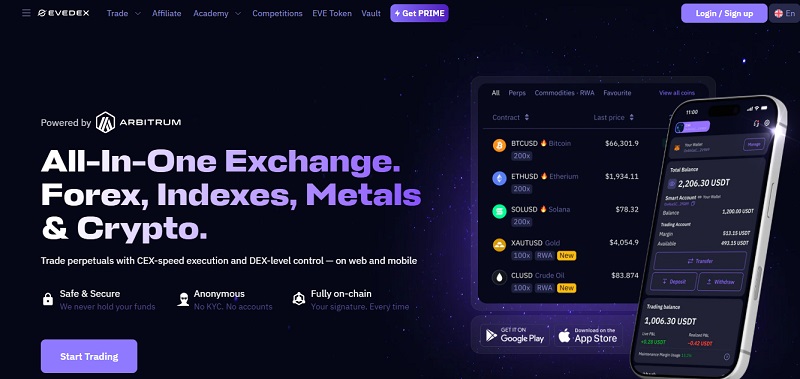
Evedex Markets and Supported Perpetual Contracts
The Evedex exchange focuses on perpetual futures rather than spot digital asset purchases. The system supports major crypto assets alongside synthetic exposure to precious metals and stock indices.
Supported instruments include:
BTC-USD,
ETH-USD,
SOL-USD,
XRP-USD,
LTC-USD,
DOGE-USD,
PUMPFUN-USD,
HYPE-USD,
LINK-USD,
1000PEPE-USD,
XAGUSD (Silver),
XAUTUSD (Gold),
SPYUSD (S&P 500),
SUIUSD,
NEARUSD,
APTUSD,
TAOUSD,
VIRTUALUSD,
SAHARAUSD,
MYX-USD,
AVNT-USD,
ASTER-USD,
CLUSD,
PENGUUSD,
1000BONKUSD,
FARTCOINUSDT,
PIPPINUSD,
VIRTUALUSD.
Venue Leverage by Market
| Instrument Category | Example Contracts | Maximum Leverage |
|---|
| Major Crypto | BTC-USD, ETH-USD | Up to 100x |
| Large-Cap Altcoins | SOL-USD, XRP-USD | Up to 75x / 30x |
| Precious Metals | XAGUSD, XAUTUSD | Up to 100x |
| Equity Indices | SPYUSD | Up to 50x |
| Altcoins / Emerging | LINK, SUI, NEAR, APT, TAO | Up to 10x – 50x |
Perpetual derivatives have no settlement expiry date, carrying ongoing funding rates and elevated liquidation risks when combined with high leverage.
Evedex Trading Mechanics and Fee Structure
The Evedex exchange uses a hybrid matching engine model:
Off-Chain Engine: High-speed order matching processed via Devexperts Solutions IE Limited REST API integration;
On-Chain Settlement: Smart contracts control margin collateral and trade clearing;
Gas Costs: Execution does not incur network gas fees for standard order placements.
Standard trading fees:
Maker Rate: 0.015%
Taker Rate: 0.045%
Fees apply to the total leveraged position size rather than the underlying margin balance. For instance, a $100 margin allocation with 10x leverage creates a $1,000 position, with trading fees calculated against the full $1,000 notional value.
Evedex Account Setup and KYC Requirements
Onboarding differs fundamentally from centralized platforms. The Evedex exchange requires no mandatory identity verification (KYC) for standard Web3 wallet connections.
Access methods:
Web3 Wallet Gateway: Users connect a non-custodial wallet (e.g., MetaMask, Rabby) directly to the smart contracts;
Managed Email Login: Optional email-based profile setup for users preferring managed wallet keys.
Because users control their private keys, there is no custodial Evedex personal account in the traditional centralized sense. Managing security, seed phrases, and private key storage rests entirely on the individual trader. The platform's application layer manages user balances, trading records, and reward tracking.
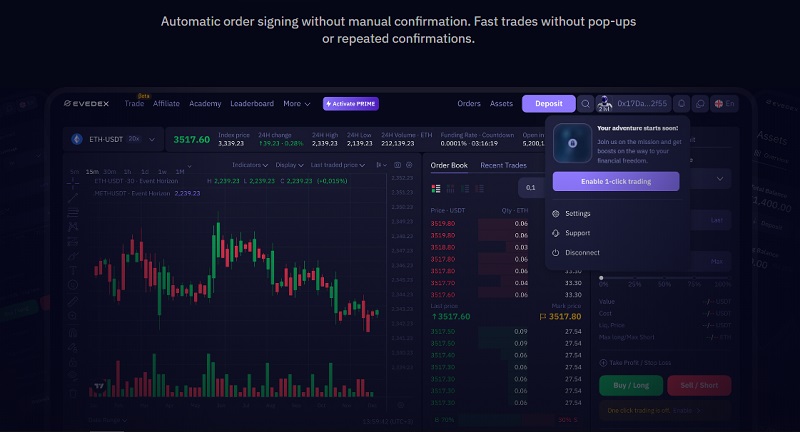
Depositing and Withdrawing Funds from Evedex
Funding relies on cryptocurrency collateral supported across Arbitrum and Base networks:
Supported Assets: USDC, USDT, ETH, WBTC, and BNB (on applicable chains).
Withdrawal Processing: Users manage payouts directly through the Assets dashboard interface by routing transfers back to an external Web3 destination address.
Asset Transfer Parameters
| Parameter | Platform Specification |
|---|
| Fiat Payment Support | No direct fiat deposits/withdrawals |
| Supported Collateral | USDC, USDT, ETH, WBTC, BNB |
| Custody Mechanism | Self-custody / Non-custodial smart contracts |
| Deposit / Payout Fees | No platform deposit fee; standard network gas applies |
| Cross-Chain Bridging | Third-party cross-chain bridges |
When considering withdrawing money from Evedex, traders should account for third-party cross-chain bridge risks. The operator does not maintain or secure underlying cross-chain bridge smart contracts.
Evedex Corporate Background and Legal Structure
Legal documentation identifies the operating corporate entity:
Legal Entity: Evedex Ltd
Registration Number: 2024-00551
Jurisdiction: Saint Lucia
Registered Address: Ground Floor, The Sotheby Building, Rodney Village, Rodney Bay, Gros-Islet, LC01 101, Saint Lucia
Public corporate records in Saint Lucia confirm that Event Horizon Ltd. was incorporated on September 18, 2024, and officially renamed Evedex Ltd. on October 25, 2024.
DomainTools data supplied for this review shows:
Official Website: evedex.com
Domain created: June 27, 2004
Updated: June 24, 2026
IP location: Portland, Oregon, United States
Hosting/network: Amazon.com Inc.
WHOIS organisation: Domains By Proxy, LLC
The 2004 domain creation date therefore should not be interpreted as proof that the Evedex exchange has operated since 2004. The domain may have existed under previous ownership or been acquired later.
Regulation and Legal Position of Evedex
The Evedex exchange maintains an explicit legal disclosure regarding its status:
| Assessment Factor | Regulatory Position |
|---|
| Corporate ID | Evedex Ltd (Saint Lucia #2024-00551) |
| SEC / CFTC Registration | None |
| Financial Broker Licensing | None |
| Derivatives Exchange Authorization | Unregulated DEX protocol |
| Jurisdictional Restrictions | Restricted for US persons and UK retail clients |
Operating as an unregulated non-custodial DEX is standard across DeFi, but users forfeit traditional regulatory protections such as statutory compensation funds or formal ombudsman dispute resolution.
Evedex Security Model and Technical Controls
Security relies on smart contract execution and pricing oracles. The Evedex exchange states that its smart contract codebase is audited and publicly verifiable on-chain.
Key technical risk factors:
Smart contract vulnerabilities or exploit risks;
Oracle manipulation or price feed latency;
Third-party cross-chain bridge failures;
Automated liquidation engine slippage during high market volatility.
Evedex Reviews and External Reputation
There is no dedicated Trustpilot profile for the exchange. Independent aggregators like CoinGecko track the venue as a Saint Lucia-based perpetual DEX, monitoring its volume, open interest, and fee structures.
When evaluating external Evedex reviews, DeFi users must separate standard smart-contract execution feedback from complaints about market liquidations caused by high leverage usage.
The project holds no profile on BrokerChooser.
Aggregator sites generally focus on custodial retail brokers rather than non-custodial decentralized protocols, making this absence an expected outcome rather than a negative indicator.
Final Risk Assessment of Evedex Exchange
| Parameter | Evaluation |
|---|
| Corporate Transparency | Verified Saint Lucia entity registration |
| Regulatory Oversight | Unregulated; explicitly disclaims SEC/CFTC registration |
| Custody Setup | Non-custodial Web3 wallet model |
| Leverage Risks | Up to 100x on selected perpetual contracts |
| Contract Audits | Claimed and verifiable code protocols |
| Overall Risk | High |
Final Evaluation of Evedex
The Evedex exchange operates as a non-custodial perpetual DEX with a clear technical structure and direct legal disclosures regarding its lack of financial licensing. Its hybrid model combines off-chain speed with on-chain settlement across Arbitrum and Base.
Main risk factors include:
Overall classification: High Risk.
Potentially suitable for:
experienced DeFi users;
traders who understand perpetual futures and liquidation mechanics;
users comfortable managing their own wallets and private keys;
technically sophisticated traders who specifically want non-custodial derivatives.
Not suitable for:
beginners;
conservative investors;
users unfamiliar with smart-contract and bridge risks;
anyone seeking regulatory protection comparable to a licensed securities or derivatives venue;
traders who cannot tolerate rapid losses from high leverage.


