The digital exchange VestraLX positions itself as a multi-functional crypto trading ecosystem that combines AI-assisted trading, derivatives products, spot markets, and lending functionality. At the same time, the platform provides very limited public disclosure regarding its legal structure, operational framework, and financial safeguards.
Collected project information:
Official website: vesxbot.com
Declared support channels: WhatsApp support only
Public legal information: Not disclosed
Company registration: Not disclosed
Licensing: Not disclosed
Headquarters: Not disclosed
Foundation date: Not disclosed
The Vestra LX exchange currently provides almost no verifiable corporate transparency, which significantly complicates independent due diligence.
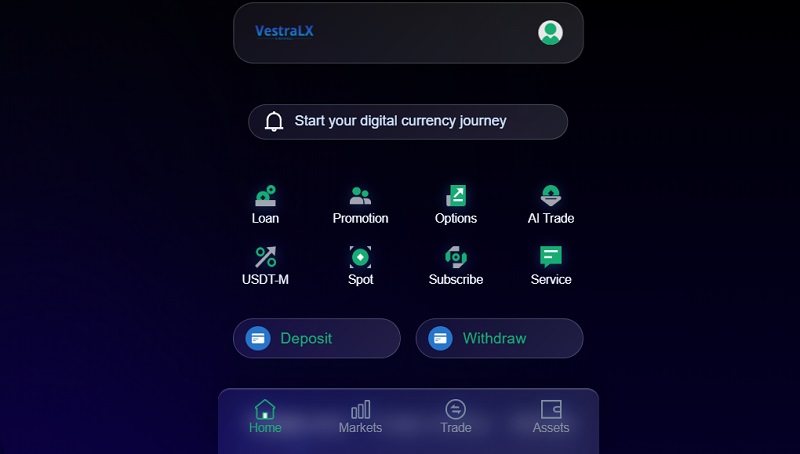
VestraLX Structure and Legal Transparency
The VestraLX exchange does not publish:
Unlike established cryptocurrency platforms, the VestraLX exchange also does not disclose:
This creates an environment where users cannot independently verify:
who controls client funds,
where the business legally operates,
or what protections exist in the event of disputes or insolvency.
The absence of legal disclosure is especially important because the VestraLX exchange promotes:
The service is also absent from BrokerChooser monitoring and institutional exchange rankings.
This absence may indicate:
a very recent launch phase,
insufficient regulatory transparency,
or an exchange ecosystem that has not yet established a verified operational reputation.
For analytical purposes, platforms missing from major industry review infrastructures generally require elevated caution.
| Criteria | Assessment |
|---|
| Regulatory status | Not disclosed |
| Corporate transparency | Very limited |
| Public ownership information | Unavailable |
| Reserve audits | Not published |
| Overall transparency | Low |
Trading Products and Crypto Markets at VestraLX
The VestraLX exchange advertises several product categories directly on the website interface:
Loan
Options
AI Trade
USDT-M
Spot
However, most operational details remain hidden until registration.
The VestraLX exchange does not publicly disclose:
The platform references support for multiple cryptocurrencies, including:
SOL
BTC
DOGE
ETH
VLX
LTC
BNB
EWRN
Additional assets reportedly become visible only after account registration.
The VestraLX exchange therefore operates with a partially closed-access structure where critical trading conditions are unavailable for external evaluation before onboarding.
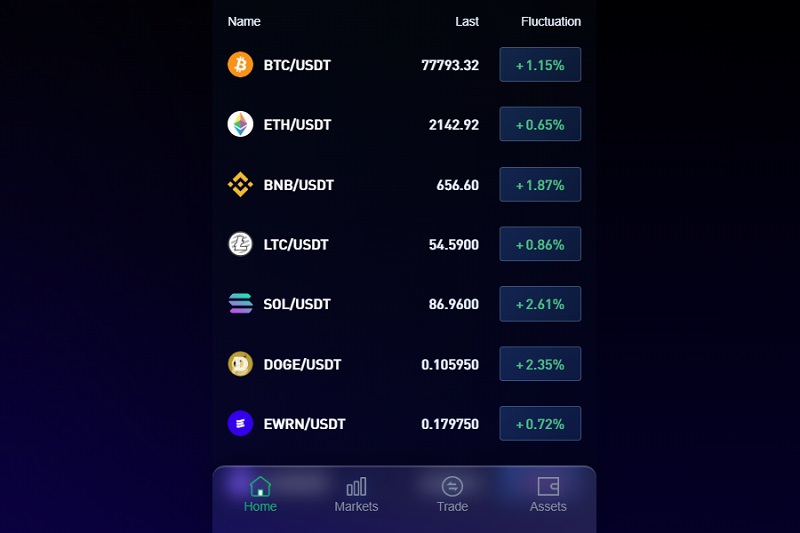
VestraLX Platform Access and Operational Restrictions
One notable characteristic of the VestraLX exchange is the restricted visibility of core platform mechanics.
Before registration, users cannot independently review:
This lack of pre-registration transparency is unusual compared to established crypto platforms where trading conditions are normally public.
The VestraLX exchange additionally references AI-assisted trading systems, derivative-style products, and crypto lending functions, yet provides no independently verifiable performance data or technical documentation.
Deposits and Withdrawing Money from VestraLX
The VestraLX exchange does not publicly disclose:
supported payment methods,
deposit processing times,
withdrawal processing schedules,
or standard fee structures.
One of the few visible operational conditions concerns KYC escalation requirements.
According to platform disclosures:
users must complete an upgraded KYC process after cumulative withdrawals of $200,000,
or after a single withdrawal exceeding $50,000.
The VestraLX exchange also states that users may need to pay an “upgrade channel fee” during this process.
However:
the exact fee amount is not disclosed,
the calculation method is unknown,
and the conditions triggering additional charges remain unclear.
When evaluating withdrawing money from VestraLX, this is an important risk factor because undefined compliance fees can create uncertainty regarding future withdrawal accessibility.
| Feature | Available Information |
|---|
| Deposit methods | Not publicly disclosed |
| Withdrawal methods | Not publicly disclosed |
| KYC escalation threshold | $200,000 total or $50,000 single withdrawal |
| Additional withdrawal fees | Upgrade channel fee mentioned but undefined |
| Fee transparency | Limited |
VestraLX Personal Account and User Verification Model
The VestraLX personal account appears to function as the primary gateway for:
Most operational details only become accessible after user onboarding.
The VestraLX personal account also appears connected to:
advanced KYC verification,
withdrawal review systems,
and internal compliance escalation procedures.
Because the platform does not publish detailed compliance documentation, users cannot independently assess:
identity verification timelines,
source-of-funds requirements,
or dispute resolution procedures.
The VestraLX personal account therefore operates within a relatively opaque compliance environment.
VestraLX Reviews and Reputation Analysis
Public VestraLX reviews remain extremely limited.
Independent analytical coverage of the exchange is currently minimal, while several online warnings and social-media discussions reference concerns involving:
potential withdrawal issues,
high-risk operational behavior,
and suspicious exchange patterns.
At the same time, these external reports are not formal regulatory findings and should be interpreted carefully.
Still, the overall operational risk profile appears elevated due to several factors:
VestraLX Infrastructure and Domain Analysis
DomainTools data:
The relatively recent domain registration is an important analytical factor.
Compared to established trading platforms with long operational histories, the VestraLX exchange currently has:
very limited historical presence,
short infrastructure visibility,
and minimal independently verified reputation data.
Newly created crypto trading domains statistically carry elevated operational risk due to the high turnover rate of short-lifecycle exchange projects.
| Infrastructure Factor | Observation |
|---|
| Domain age | Very recent |
| Ownership disclosure | Hidden |
| Public reputation | Limited |
| Operational history | Short-term |
| Risk profile | Elevated |
Final Assessment of VestraLX Exchange
The VestraLX exchange positions itself as:
a crypto trading ecosystem,
an AI-assisted trading platform,
and a multi-product digital asset environment.
The platform advertises:
However, the VestraLX exchange currently demonstrates several major transparency weaknesses:
no disclosed legal structure,
no visible licensing,
no public reserve verification,
no published trading conditions,
hidden fee structures,
and limited independently verifiable operational history.
Additional concerns include:
undefined “upgrade channel” withdrawal fees,
restricted pre-registration transparency,
and minimal institutional monitoring.
Project characterization
Risk level: High
Suitable for:
experienced crypto speculators comfortable with elevated counterparty risk,
users familiar with offshore exchange environments,
and traders willing to operate without strong regulatory safeguards.
Not suitable for:
From a due diligence perspective, the VestraLX exchange currently resembles a high-risk opaque crypto trading platform rather than a fully transparent institutional-grade exchange ecosystem.


