The digital exchange MetaCash presents itself as a blockchain-based fixed-odds trading service. The public website metacashpro.com explains the basic product, but most platform information is placed behind registration.
Before opening an account, visitors are not given clear information about:
the legal company operating the service;
headquarters or registration address;
regulatory licences;
trading fee structure;
deposit methods and limits;
withdrawal rules;
customer support contacts.
The website does, however, identify its core product as a fixed-odds trade where the result depends on whether a cryptocurrency's mid-price at expiry is above or below the price recorded when the position was purchased.
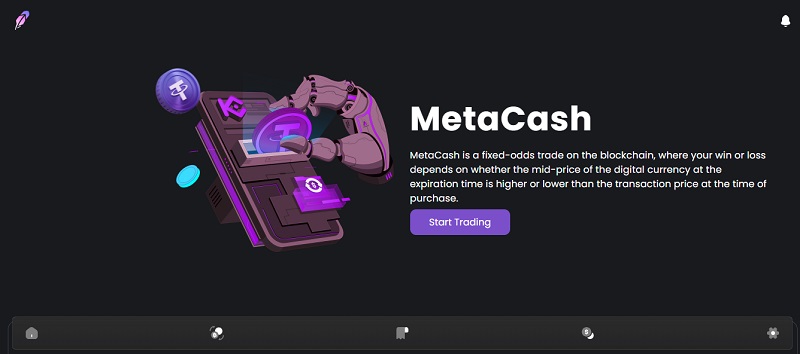
Crypto Trading Products Available on MetaCash
The crypto exchange MetaCashPro is not presented as a conventional spot marketplace. Its public interface includes:
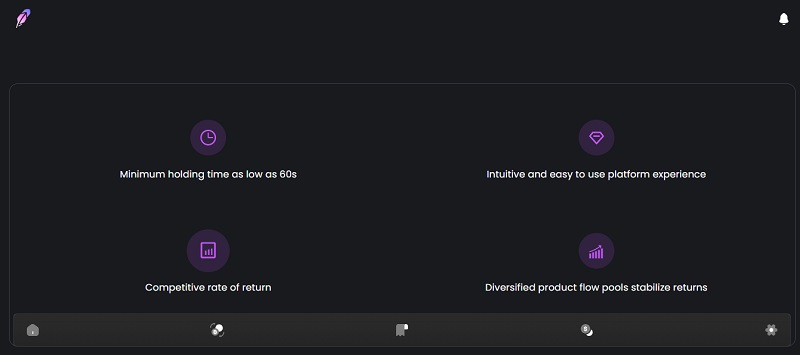
The main product resembles short-duration directional trading. The platform states that the minimum holding period can be as low as 60 seconds and advertises a “competitive rate of return.”
| MetaCash feature | Public description | Transparency |
|---|
| Fixed-odds trading | Higher/lower price outcome at expiry | Basic mechanism disclosed |
| Minimum holding time | From 60 seconds | Advertised |
| AI Quantification Trading | Separate platform section | Methodology not explained publicly |
| Market section | Available after platform access | Asset range unclear |
| Product flow pools | Claimed to stabilize returns | No technical evidence provided |
The website metacashpro.com also claims that “diversified product flow pools” stabilize returns. No public technical paper, audited trading data, or detailed explanation of this mechanism was identified.
A complete cryptocurrency list is not visible on the open homepage. Therefore, the actual number of supported assets and markets cannot be confirmed without registration.
MetaCashPro Trading Conditions and Fixed-Odds Mechanics
The short holding period is the most important characteristic of MetaCash exchange.
A trade reportedly works as follows:
The user selects a digital currency;
A transaction price is recorded;
The position has a defined expiration time;
The mid-price at expiration is compared with the purchase price;
The result determines a win or loss.
This differs from ordinary spot crypto trading, where a customer purchases an asset and can generally decide when to sell it.
Key conditions are not publicly specified:
payout percentages;
trading commissions;
spreads;
source of the reference mid-price;
price-feed providers;
dispute rules for abnormal price movements;
maximum position size;
early closure conditions.
MetaCashPro exchange also does not publicly explain how the advertised “competitive rate of return” is calculated. For fixed-odds products, payout ratios and price-source methodology are essential because they directly affect the probability and financial outcome of each trade.
Registration on Website metacashpro.com
The public website provides Login and Signup options. Most operational details become available only after account creation.
Before registration, no public contact telephone number, email address, or online support channel was identified on the accessible homepage.
A MetaCash personal account appears to provide access to:
The platform does not publicly explain its KYC process. There is no clear pre-registration description of:
required identity documents;
proof-of-address requirements;
verification levels;
restricted jurisdictions;
account limits;
compliance review periods.
This registration-first structure makes it difficult to evaluate the service before providing personal data.
The MetaCashPro personal account also gives access to AI-related trading functionality, but the public website does not describe the model, strategy, risk limits, or whether trades are fully automated.
Deposits and Withdrawing Money from MetaCash
No detailed public funding guide was found on the open website metacashpro.com.
The following information is unavailable before registration:
accepted cryptocurrencies;
supported blockchain networks;
minimum deposit;
deposit confirmation requirements;
minimum withdrawal;
withdrawal commissions;
daily limits;
average processing time.
| Transaction issue | Public information |
|---|
| Supported deposit assets | Not disclosed before registration |
| Blockchain networks | Not publicly listed |
| Minimum deposit | Not identified |
| Withdrawal fee | Not identified |
| Withdrawal time | Not disclosed |
| Account review procedure | Unclear |
The process of withdrawing money from MetaCash therefore cannot be independently assessed from the public documentation.
This is a major transparency issue. A prospective customer should be able to check withdrawal fees, limits, and processing conditions before transferring cryptocurrency to a platform.
MetaCash Domain History and Missing Corporate Information
DomainTools data supplied for this assessment shows:
Domain: metacashpro.com
Created: March 25, 2026
Expires: March 25, 2027
IP location: Los Angeles, California, United States
Infrastructure: Namecheap Inc.
WHOIS organization: Privacy service provided by Withheld for Privacy ehf
The WHOIS privacy entry is consistent with Namecheap's domain privacy service. Namecheap states that eligible domains may receive privacy protection provided through Withheld for Privacy. Therefore, the privacy record does not identify the real platform operator.
More importantly, MetaCashPro exchange does not clearly publish:
The domain is also very recent. A March 2026 registration provides only a short operational history for assessing withdrawal reliability, platform security, and customer dispute handling.
The Los Angeles IP location should not be treated as proof that MetaCash crypto exchange is legally based or regulated in California. Hosting infrastructure and company registration are separate issues.
Regulatory Status of MetaCash
No verifiable regulatory authorization for metacashpro.com was identified in the reviewed public materials.
The platform homepage does not display a licence number or name a supervising authority. This is particularly relevant because the service advertises fixed-odds, short-duration cryptocurrency trades.
MetaCash Reviews and Early Withdrawal Complaint
Public MetaCash reviews are extremely limited.
At the time of research, Trustpilot's Metacashpro profile contained only one comment, with:
The reviewer alleges that withdrawal requests remained unresolved for three weeks and that the account was restricted after an attempt to withdraw a large amount. The same post promotes a supposed recovery service, which materially reduces its evidentiary value because recovery-service promotion is a common feature of questionable crypto complaint content.
One user report cannot establish systematic misconduct.
Still, the complaint is relevant because MetaCashPro exchange does not publish a clear withdrawal policy that could be used to compare the allegation with official processing rules.
The current reputation picture is therefore:
almost no independent customer history;
one severe withdrawal allegation;
promotional recovery content inside that allegation;
no established long-term review pattern.
Risk Assessment and Expert Conclusion for MetaCashPro Exchange
| Risk criterion | Assessment |
|---|
| Domain age | Recent — March 2026 |
| Legal operator | Not publicly identified |
| Registered address | Not disclosed |
| Regulatory licence | Not verified |
| Trading model | Fixed-odds crypto trades |
| Minimum holding time | Advertised from 60 seconds |
| Fee transparency | Low |
| Withdrawal documentation | Not publicly available |
| Customer support before signup | Not identified |
| Independent reputation | Almost nonexistent |
| Overall risk | High |
MetaCash exchange should currently be classified as a high-risk and insufficiently transparent crypto trading platform.
The assessment is based on several concrete factors:
the domain was registered in March 2026;
the legal operator is not clearly named;
no company registration details are displayed;
no licence number was identified;
most platform information is hidden behind registration;
fixed-odds trades may last as little as 60 seconds;
payout and price-feed methodology are unclear;
the AI Quantification Trading function lacks public technical documentation;
deposit and withdrawal terms are not disclosed before account creation;
independent customer feedback is almost absent.
Potentially suitable for:
Not suitable for:
long-term cryptocurrency storage;
conservative investors;
beginners expecting conventional spot trading;
users requiring a verified legal operator;
customers who need transparent withdrawal conditions before depositing.
Bottom line: MetaCashPro crypto exchange provides enough public information to identify a short-duration fixed-odds trading model, but not enough to evaluate the company behind it. The combination of a recent domain, anonymous corporate structure, registration-gated operational information, unclear payout mechanics, and absent public withdrawal terms creates a high-risk profile.


