Trust Wallet

About broker Trust Wallet

Website Address
https://trustwallet.com
Email
Not mentioned
Support Phone
Not mentioned
Founded Date
Operating since 2017
Head Office
Not mentioned

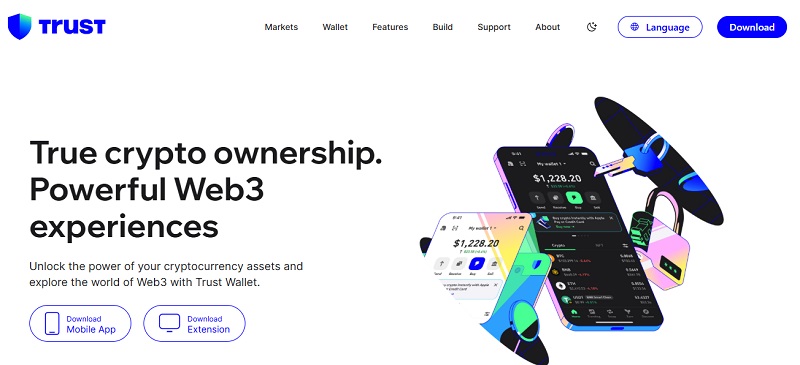
The digital service Trust Wallet is a non-custodial multi-chain crypto wallet launched in 2017 and used by over 200 million users worldwide. It offers full control over private keys, broad asset support, and deep Web3 integration. However, the absence of centralized oversight and user responsibility for security introduces specific risks typical for self-custody wallets.

TrustWallet provides support primarily through digital channels:

  • support center: support.trustwallet.com

  • community channels (Telegram, X, etc.)

  • email-based support (via ticket system)

No traditional customer support model (like phone hotlines) is guaranteed.
Trust Wallet

Supported Cryptocurrencies on Trust Wallet

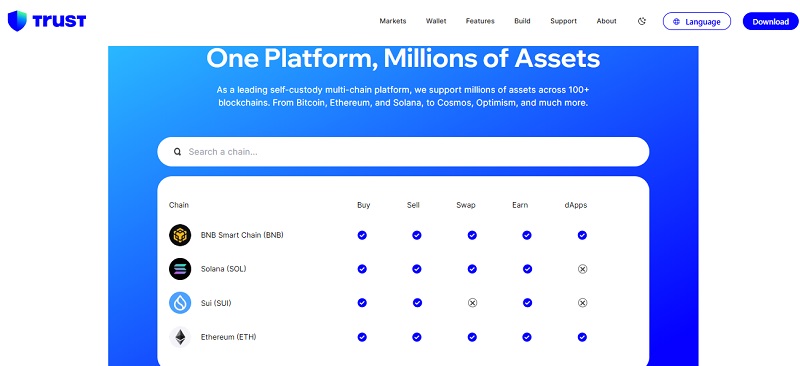
The service Trust Wallet supports one of the widest asset ranges among crypto wallets — over 10 million assets across 100+ blockchains.

Asset TypeAvailabilityDetails
Cryptocurrencies10M+ assetsBTC, ETH, altcoins, DeFi tokens
Blockchains100+Ethereum, BNB Chain, Solana, Polygon
NFTsSupportedMulti-chain NFT storage
Custom TokensSupportedManual contract input

Trust Wallet

Key Functions of Trust Wallet

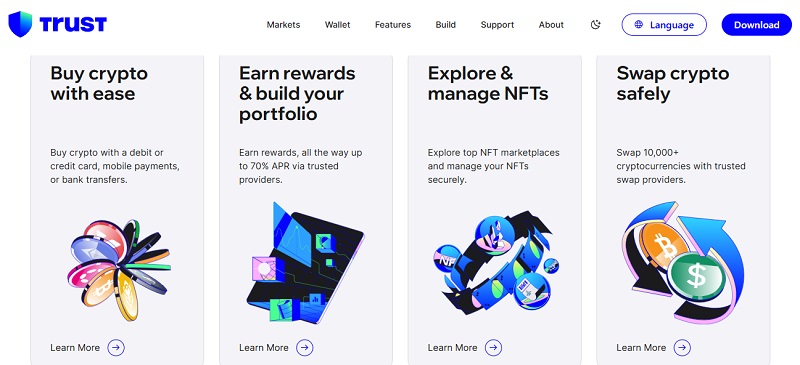
Trust Wallet provides a full Web3 toolkit. The service is not just storage — it is a full Web3 interaction layer.

Important:

  • swaps are executed via third-party liquidity providers

  • staking rewards depend on network conditions

FunctionAvailabilityDetails
StorageYesNon-custodial asset storage
Token SwapYesDEX integrations
StakingYesEarn rewards
dApp AccessYesWeb3 browser
NFT ManagementYesStore and transfer NFTs

Account Registration and Login on the Website trustwallet.com

Trust Wallet does not use traditional account registration. There is no “account” — access is controlled entirely via a seed phrase. This means:

  • no password recovery

  • no centralized access restoration

  • full responsibility lies with the user

FeatureStatus
Email RegistrationNot required
KYC VerificationNot required
Private KeysUser-controlled
Access MethodSeed phrase / device

Depositing and Withdrawing Funds from Trust Wallet

Transactions in Trust Wallet are blockchain-based. According to official documentation on the official website trustwallet.com:

  • users receive funds by sharing a public address

  • sending requires network confirmation

FeatureStatus
Deposit MethodTransfer to wallet address
Withdrawal MethodBlockchain transfer
Processing TimeNetwork-dependent
FeesBlockchain gas fees

Trust Wallet

Background and Domain Information of TrustWallet

Trust Wallet was acquired by Binance in 2018 and later became independent. The service operates as a software product, not a regulated financial institution.

ParameterDetails
Domain Registration DateOctober 14, 2005
Last UpdateAugust 4, 2023
Server LocationCalifornia, USA
OrganizationDApps Platform, Inc.
Founded2017
FounderViktor Radchenko

Source: DomainTools

Client Feedback and Trust Wallet Reviews

Independent reviews of Trust Wallet show a mixed but generally positive pattern.

Positive:

  • full control over assets

  • wide asset support

  • strong Web3 integration

Negative:

  • no recovery if seed phrase is lost

  • limited direct support

  • user responsibility for security

Most negative TrustWallet reviews are related to user errors, not platform failure.

Risk Assessment and Expert Conclusion for TrustWallet

CriteriaAssessment
Security ModelStrong (self-custody)
Asset ControlFull user ownership
RegulationNot applicable
User ResponsibilityVery high
Overall RiskModerate

Trust Wallet operates under a fundamentally different model compared to exchanges:

  • no custody of funds

  • no centralized control

  • no regulatory dependency

This leads to a critical distinction: risk shifts from the platform to the user.

Key risks:

  • loss of seed phrase = irreversible loss of funds

  • phishing and scam exposure

  • no legal recourse

Key advantages:

  • full ownership of assets

  • no third-party risk

  • censorship resistance

Trust Wallet is best described as a secure but responsibility-heavy self-custody wallet.

Suitable for:

  • experienced crypto users

  • DeFi and Web3 participants

  • users prioritizing control over assets

Not ideal for:

  • beginners

  • users expecting customer support or recovery options

  • those unfamiliar with private key management

Trust Wallet is not risky in itself — but it requires user competence. It provides maximum control and freedom, but also transfers full responsibility for security and asset management to the user.

Frequently Asked Questions

To determine if a wallet is a legitimate service, it is important to study its reputation among real users and experts. Special attention should be paid to the legality of its operations — the presence of registration and a license from the relevant authorities. The quality of the presentation portal and customer support is also an important factor in the verification process. Additionally, one should pay attention to URLs, as scammers can create phishing websites with domains that resemble official ones.

To make the right decision when choosing a crypto wallet, it is better to trust the verification to specialists . They will monitor the basic aspects of the service and provide a corresponding verdict.

Fake comments are characterized by a lack of specifics. Typically, they contain only general phrases without describing real user experiences. Additionally, artificially inflated reviews often show unnatural enthusiasm, indicating attempts at manipulation and psychological influence. The mass appearance of fake reviews within the same period is another sign of their inauthenticity.

Real comments provide a balanced assessment of the service. They include both the advantages and disadvantages of the wallet. A good indicator is if the reviews are published on different, independent platforms.

This is a classic sign of fraud. Legitimate platforms can only charge clients transaction fees, which are deducted from the withdrawal amount or paid at the time of the transaction. Any attempts to convince a client of the necessity of making additional payments to withdraw their own assets are pure manipulation.

If faced with such a situation, one should cease interaction with the platform and not make any transfers. To resolve the withdrawal issue, it is better to consult competent specialists. They will help clarify the circumstances and withdraw the assets.

You should contact the service support to find out the reason for the block. If the issues are related to a lack of verification, you need to provide the necessary information to personalize your profile. You can try to regain access by backing up data or using a seed phrase.

If the listed actions do not help resolve the issue, the block of the personal account may be related to fraud. This is how scammers terminate cooperation with clients and deprive them of the ability to withdraw their own assets. Seeking professional support will be the optimal solution. Experts will help identify the reason for the block and suggest measures for further actions.

This may be related to issues with user software and the digital platform. In the first case, the reasons for disruptions could be weak internet or its absence, VPN connection, or an outdated browser version. In the second case, incorrect software operation may result from server malfunctions, scheduled maintenance work, or service blocking due to numerous complaints.

Fraudulent services use website and app blocking to steal client assets. This way, they cut off contact with the user and appropriate their funds. In such situations, it is better to consult specialists . They will provide comprehensive answers to any questions.

In this case, it is advisable to use the services of experts who specialize in chargeback procedures. It is important for the client to prepare all available evidence of cooperation with the digital platform — screenshots of correspondence, receipts or statements of transfers, wallet addresses, etc.

When faced with the issue of recovering funds, it is crucial to act promptly. The chargeback procedure has its timelines and can only be conducted once. To ensure an effective recovery, it is essential to contact specialists immediately. This will allow for thorough preparation for initiating return payments in accordance with established regulations and requirements.

Reviews about Trust Wallet

My tokens disappeared without any record of transactions. Support ignored me or sent automated replies, and tickets were closed without resolution!
2
Does Trustwallet even offer real support? It’s hard to tell when you actually need help.
3
Support was extremely disappointing. After losing funds from my wallet, I expected help, but instead got endless verification requests and delays. No real solution was provided. The process felt like avoidance rather than support. I’ve completely lost trust in their ability to handle serious issues
2