


I agree. Better not keep large funds on this exchange because verification can take weeks.
3
Candace
The digital exchange Poloniex is one of the longest-established cryptocurrency trading venues, having entered the market in 2014. Accessible via the official website poloniex.com, the platform has expanded from a Bitcoin-centric marketplace into a global portal offering spot trading, futures, staking products, and programmatic API integration.
While the Poloniex exchange continues to serve traders across numerous jurisdictions, its regulatory profile differs from order-matching venues licensed by tier-one financial authorities.
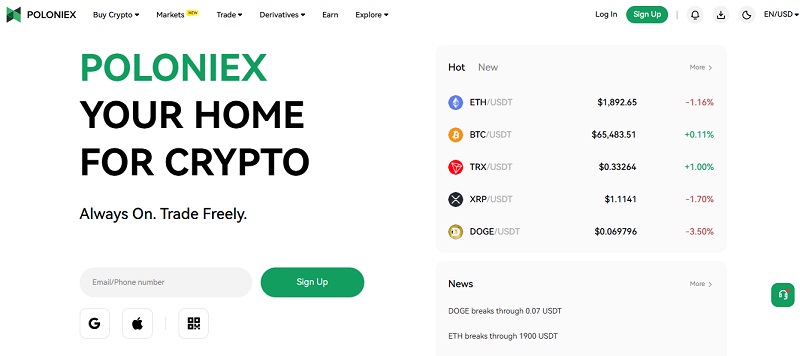
The crypto exchange Poloniex provides exposure to hundreds of digital assets across both spot and derivatives markets. Beyond top-tier tokens, the hub lists numerous emerging blockchain protocols.
Popular supported assets include:
Bitcoin (BTC)
Ethereum (ETH)
Tether (USDT)
TRON (TRX)
Solana (SOL)
XRP
Dogecoin (DOGE)
Litecoin (LTC)
Chainlink (LINK)
Avalanche (AVAX)
Toncoin (TON)
Hundreds of additional tokens
Available trading services include:
Spot order execution
Derivatives & futures contracts
Margin features (selected pairs)
Staking campaigns
Developer API access
Institutional solutions
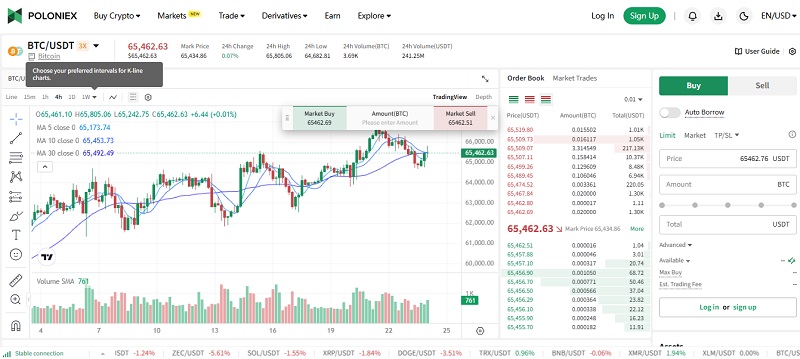
The Poloniex exchange maintains a transparent fee schedule based on 30-day trading volume. Commission rates decrease as execution volume grows or when clients qualify for higher VIP tiers.
| Order Type | Fee |
|---|---|
| Maker | 0.145% |
| Taker | 0.155% |
| Order Type | Fee |
|---|---|
| Maker | 0.01% |
| Taker | 0.075% |
Additional cost considerations:
On-chain crypto deposits are generally free.
Withdrawal costs depend on network congestion and specific blockchain rails.
Minimum payout thresholds vary by asset.
Because network gas costs fluctuate, outbound transfer fees may change without affecting the exchange's core execution commissions.
Creating a Poloniex personal account requires a valid email address, password, and security verification. Identity checks (KYC) may be required to unlock advanced features and raise daily transaction limits.
A verified Poloniex personal account provides access to:
Full spot and futures order books
Yield and staking programs
API key management
Institutional onboarding
Expanded withdrawal allowances
Profile protection mechanisms supported by the venue:
Two-factor authentication (2FA)
Custom anti-phishing codes
Mandatory withdrawal confirmation links
Automated device and IP address monitoring
Clients can fund balances using supported digital tokens. Direct fiat access depends on regional payment partners and local regulations.
| Funding Method | Status |
|---|---|
| Crypto Deposits | Available |
| Fiat Purchases | Limited by region |
| Internal Transfers | Supported |
| Withdrawal Fees | Network dependent |
The process of withdrawing money from Poloniex involves standard blockchain confirmations and, in specific cases, security protocols aimed at preventing unauthorized access. Transfers initiated from unrecognized IP addresses or to newly added wallet destinations may trigger manual review procedures before processing.
The Poloniex exchange began operations in 2014. While the platform provides public legal terms, it does not publish a single globally applicable certificate of incorporation or specify a single corporate headquarters governing all international activity.
Depending on the specific service used, clients contract with different corporate entities referenced in the legal documentation.
During this review, no publicly verifiable licenses were identified from major tier-one financial authorities, such as:
Financial Conduct Authority (FCA)
Australian Securities and Investments Commission (ASIC)
Cyprus Securities and Exchange Commission (CySEC)
Federal Financial Supervisory Authority (BaFin)
Consequently, the Poloniex exchange operates within a legal framework distinct from brokerages supervised by primary state watchdogs.
Domain Created: January 10, 2014
Last Updated: May 14, 2026
IP Location: New York, United States (Amazon Web Services)
WHOIS Privacy: c/o whoisproxy.com
The Poloniex crypto exchange handles client inquiries through digital support infrastructure rather than direct telephone lines.
Official contact channels:
Online Help Center
Live chat via the support portal
Electronic ticket system
Official X (Twitter) channel: @PoloSupport
Knowledge base & technical FAQs
The platform explicitly confirms that phone assistance is not provided. Users are cautioned against engaging with unverified Telegram groups, third-party messaging channels, or emails outside the poloniex.com domain to avoid phishing traps.
A dedicated profile exists for poloniex.com on Trustpilot. At the time of writing, the page accumulated over 400 user entries with an overall TrustScore of approximately 1.4 out of 5.
Commonly cited user concerns:
Delays during outbound cryptocurrency transfers
Extended identity verification processing times
Unresponsive or templated customer support replies
Accounts placed under manual security holds
Positive Poloniex reviews highlight:
An extensive selection of listed tokens
Reliable API uptime for automated trading
Competitive fee tiers for active traders
Successful resolution of complex technical tickets
Discussions across Reddit reflect similar sentiment. Several traders mention waiting periods during security checks or verification procedures, while others note that issues were resolved after contacting representatives via live chat. These reports should be viewed as individual experiences rather than formal audit metrics.
Overall, feedback indicates that the Poloniex exchange remains fully operational, though user satisfaction is frequently impacted by account verification checks and withdrawal processing speeds rather than trading engine performance.
BrokerChooser does not place the project among platforms providing high regulatory assurance.
This stance stems from the brand's public oversight record. No evidence indicates that the portal is supervised by tier-one bodies like the FCA or ASIC. BrokerChooser’s evaluation framework heavily prioritizes stringent regulatory oversight when determining provider trust scores.
This classification reflects the Poloniex exchange’s regulatory structure rather than proof of financial instability.
| Criterion | Assessment |
|---|---|
| Founded | 2014 |
| Domain Registration | 2014 |
| Public Legal Entity | Limited disclosure |
| Registered Headquarters | Not clearly identified |
| Top-Tier Regulation | Not identified |
| Fee Transparency | High |
| Customer Support | Help Center, live chat, tickets, email |
| BrokerChooser Assessment | Does not qualify as a highly trusted provider |
| Overall Risk | Medium |
The Poloniex exchange has maintained an active market presence for over a decade, offering broad asset coverage alongside clear pricing tiers.
Key Strengths:
Long operational history since 2014
Extensive catalog of digital assets
Integrated spot and derivatives markets
Transparent, tier-based fee schedule
Robust API infrastructure for algorithmic execution
Multiple digital support options
Main Limitations:
Lack of licensing from primary financial regulators
Limited transparency regarding central corporate ownership
Recurring user complaints regarding payout holds and review delays
Conservative ratings from independent regulatory auditors
Suitable for:
Experienced digital asset traders
Users seeking niche token listings
Traders comfortable operating on non-custodial crypto venues
Less suitable for:
Investors requiring strict regulatory protections
Traders needing immediate phone-based customer service
Users who exclusively trade on exchanges regulated by top-tier authorities
Bottom line: The Poloniex exchange remains an established brand in the digital asset space, providing access to a diverse range of trading tools and crypto assets. However, prospective users should balance its operational history against its offshore regulatory framework and mixed user feedback regarding account verification and withdrawal processing times.
Checking a company's activities is accessible to everyone through specialized online resources. When evaluating an exchange, it is important to pay attention to the presence of legal status, the length of operation, and transparent earning conditions. It is crucial that the stated information is genuine and not fake. Fraudsters use fake data and documents to imitate the work of legitimate service providers.
To make the right choice, it is better to consult specialists. They will conduct a verification of the cryptocurrency exchange and determine what it really is — a reliable partner or a fraudulent project.
Thanks to comments about the company's services, potential clients receive information about the possibility of real earnings under the proposed conditions. These are written by both experienced traders who have conducted a preliminary assessment of the project and actual clients.
It is important to consider that unscrupulous exchanges may pay for positive reviews. In them, supposedly satisfied users share their achievements and encourage cooperation with a reliable company. You can distinguish such opinions from genuine ones by their content and presentation. They are filled with template and simplistic phrases, as well as expressive statements.
Manipulations involving extortion of additional investments to withdraw capital are undeniable facts of fraud. Real exchanges do not require clients to make payments for fees such as insurance, taxes, transfer commissions, opening transit accounts, etc. This is how scammers operate to profit by tricking traders into making further deposits.
If the exchange refuses to withdraw money, it is important not to fall for the tricks of fraudsters. This can lead to even greater financial losses. In such cases, it is better to consult experts. They will assist in withdrawing capital considering the circumstances.
The first thing to do is to contact the company's representatives and find out the reason for the block. If they ignore the sent requests and do not provide clear instructions for resolving the issue — they are scammers. Blocking accounts is one way to prevent clients from accessing their assets and to deny further service.
Consulting with specialized professionals will be the optimal solution in this situation. They will help determine the source of the exchange account closure and suggest ways to restore access to the personal account.
Various factors can lead to the inactivity of the exchange portal. These can include DDoS attacks, technical failures in server operation, or the company's own decision to cease operations. There may also be blocking of the platform according to the client's jurisdiction laws or violations of platform rules by the user themselves.
In fraudulent companies, a non-functioning website is one of the manipulations used to limit services to existing clients. When faced with such a situation, it is advisable to utilize the services of experts . They will help establish the true cause of the problem and provide useful recommendations for further actions.
Refusal to withdraw money is a common occurrence among illegal service providers. To initiate a refund, you should gather all available information (screenshots, wallet addresses, transaction IDs) and submit a request for a chargeback.
Disputing cryptocurrency transfers is a rather specific procedure that requires a competent approach. That is why it is best to entrust its initiation to qualified specialists. They will help recover assets in accordance with established timelines and regulations.