The digital exchange P2B operates through the official website p2pb2b.com and positions itself as a global cryptocurrency trading platform focused on token listings, spot trading, futures infrastructure, and early-stage blockchain projects.
According to public statements on the website p2pb2b.com, the P2B Exchange team started operations in 2017.
The platform is widely known for supporting a large number of altcoins and newly launched tokens. At the same time, P2B crypto exchange has received mixed reputation signals related to:
BrokerChooser explicitly states that P2B Exchange is not considered a trusted service provider because it is not regulated by a top-tier authority.

P2B Trading Markets and Supported Assets
P2B digital exchange offers access to a broad range of cryptocurrency pairs, including both established assets and speculative low-cap projects.
Publicly visible markets include:
BTC/USDT
ETH/USDT
PENGU/USDT
ASTER/USDT
TRUMP/USDT
SHIB/USDT
DOGE/USDT
POL/USDT
CRV/USDT
The platform appears heavily focused on emerging token listings and smaller capitalization projects.
P2B Exchange additionally promotes:
Analytical interpretation:
The platform’s strategy appears heavily centered around rapid token onboarding and emerging-project liquidity, which can increase speculative opportunities but also raises market-quality risks.
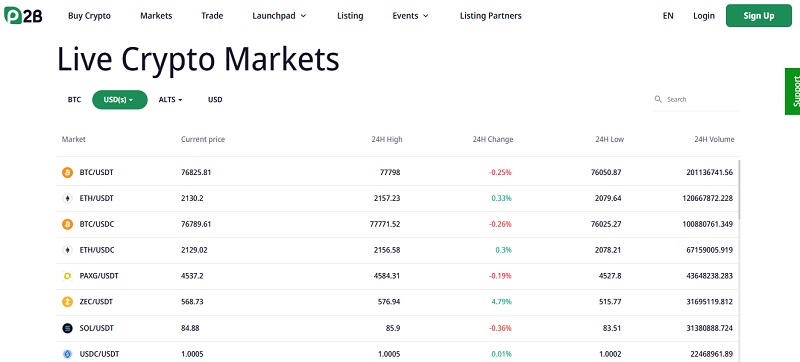
Trading Conditions and Platform Mechanics at P2B Exchange
Public information regarding exact spreads and liquidity quality on P2B crypto exchange remains somewhat limited, although multiple external reviews describe the platform as supporting both spot and derivatives trading.
The project reportedly supports hundreds of cryptocurrency pairs and provides API connectivity for traders and listing partners.
According to independent reviews, trading fees on the P2B Exchange generally range between 0.10% and 0.20%, depending on activity levels.
| Trading Infrastructure | Observed Status |
|---|
| Spot trading | Operational |
| Futures trading | Referenced publicly |
| API connectivity | Claimed available |
| Large altcoin inventory | Confirmed |
| Public reserve audits | Not identified |
| Liquidity transparency | Partially limited |
Analytical observation:
Although P2B crypto exchange demonstrates broader operational maturity than many newly launched offshore trading platforms, transparency regarding liquidity depth and internal market-making infrastructure remains incomplete.
P2B Personal Account Registration and Verification
Opening a P2B personal account reportedly provides access to:
The platform supports communication through:
| Account Infrastructure | Current Information |
|---|
| KYC verification | Required for extended functionality |
| Two-factor authentication | Supported |
| Customer support | Email, Telegram, ticket system |
| Futures access | Available after registration |
| Token launch access | Claimed available |
| Institutional tools | Partially referenced |
The P2B Exchange personal account environment appears more developed than many anonymous trading platforms, although some users publicly report delays involving verification and withdrawal processing.
Deposits and Withdrawing Money From P2B
The exchange supports cryptocurrency deposits and withdrawals across multiple blockchain networks.
However, public user feedback regarding withdrawing money from P2B remains mixed.
Several Trustpilot reviews reference:
| Funding and Withdrawal Area | Observed Status |
|---|
| Crypto deposits | Supported |
| Crypto withdrawals | Supported |
| Fiat support | Limited visibility |
| Withdrawal processing | Mixed public feedback |
| Wallet maintenance events | Reported by users |
| Reserve attestations | Not publicly confirmed |
Analytical conclusion:
While the P2B Exchange appears operational and active, repeated public complaints involving wallet maintenance and delayed withdrawals increase operational risk considerations.
Corporate Information and Domain Profile of P2B
P2B crypto exchange claims operational ties to Europe and publicly references Lithuania in several external company descriptions.
The platform’s technical domain history indicates significantly longer market presence than many newly created offshore exchanges.
| Corporate Indicator | Observed Data |
|---|
| Claimed operational start | 2017 |
| Domain creation date | 2017-02-21 |
| Latest domain update | 2022-03-09 |
| Hosting provider | Cloudflare Inc. |
| IP location | San Jose, California |
| WHOIS ownership | Domains By Proxy, LLC |
Source: DomainTools
Analytical observation:
Compared to recently launched anonymous exchanges, P2B Exchange demonstrates a materially longer operational timeline. Nevertheless, top-tier regulatory oversight remains absent.
P2B Reviews and BrokerChooser Safety Verdict
Public P2B reviews remain highly polarized.
Positive reviews emphasize:
broad token availability;
access to newly launched crypto projects;
active trading ecosystem;
responsive listing infrastructure.
Negative reviews frequently reference:
delayed withdrawals;
token listing controversies;
low liquidity in smaller markets;
support response problems.
BrokerChooser published a notably negative safety assessment of P2B Exchange, stating that the platform could not be considered a trusted cryptocurrency service provider due to the absence of regulation from major top-tier financial authorities, which may increase potential risks for users and their funds.
Additionally, Canadian regulator BCSC issued a warning connected to P2B-related compliance concerns.
Analytical interpretation:
The coexistence of long operational history and persistent transparency concerns creates a mixed reputation profile rather than a fully trusted exchange status.
Risk Assessment and Final Conclusion About P2B Exchange
| Risk Category | Assessment |
|---|
| Corporate transparency | Moderate |
| Regulatory oversight | Weak |
| Operational history | Relatively long-term |
| Withdrawal transparency | Mixed |
| Altcoin market exposure | Very high |
| Overall project risk | Medium-high risk |
P2B crypto exchange currently occupies an intermediate position between large mainstream trading platforms and high-risk offshore token services.
Potentially suitable for:
experienced altcoin traders;
speculative users seeking early token listings;
traders comfortable with elevated market volatility.
Not suitable for:
conservative investors;
institutional treasury storage;
users prioritizing top-tier regulation;
traders requiring strong investor protection frameworks.
Bottom line:
P2B Exchange demonstrates substantially longer operational history than many anonymous crypto platforms and maintains a broad token ecosystem. However, the lack of top-tier regulation, mixed withdrawal reputation, and recurring transparency concerns prevent the platform from being categorized as a fully trusted exchange environment.
BrokerChooser’s safety assessment materially reinforces these concerns.


