The digital exchange Foragem presents itself as a crypto platform and multi-chain stablecoin infrastructure provider. Its public website foragem.com focuses less on conventional order-book trading and more on receiving, screening, routing, and settling digital assets across blockchains.
The main claims include:
$8 billion in stablecoin volume settled on-chain;
a 99.99% transaction success rate;
average settlement below 10 seconds;
100% KYT-screened deposits;
support for 20+ networks;
deterministic 1:1 stablecoin settlement.
These figures are first-party metrics. The reviewed public materials do not provide an independent report validating the claimed $8 billion volume or 99.99% success rate. The website foragem.com also uses both “SOC 2 Compliant” and “SOC 2 Ready” wording, while its audit page says the project is progressing toward SOC 2 Type II attestation.
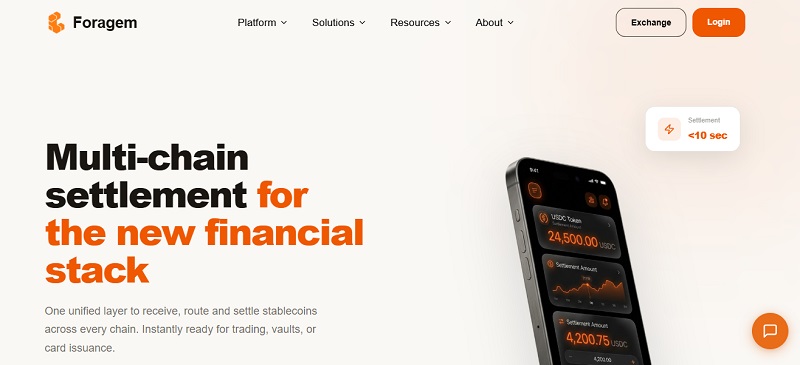
Crypto Assets and Multi-Chain Services of Foragem
The crypto exchange Foragem advertises more than 200 coins in its search description, with Bitcoin, Ethereum, and USDT specifically referenced. The main website, however, is primarily built around stablecoin flows and cross-chain infrastructure.
The listed networks include:
Ethereum;
Avalanche;
Solana;
Arbitrum;
Optimism;
Base;
Polygon;
BNB Smart Chain;
Tron;
Celo.
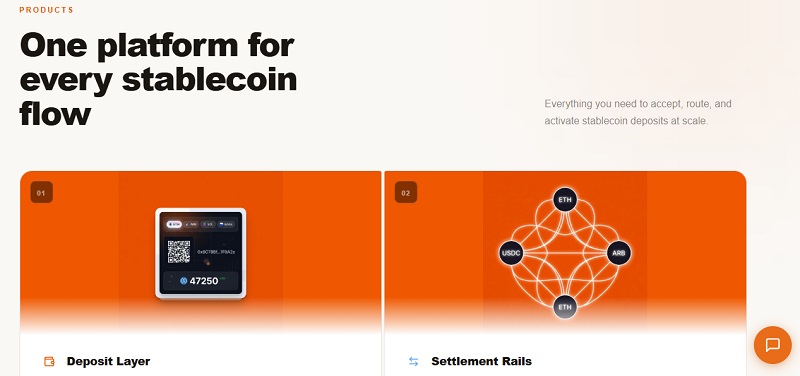
Its infrastructure is divided into four products:
| Foragem product | Advertised function |
|---|
| Deposit Layer | Multi-chain deposits through a persistent address |
| Settlement Rails | Cross-chain stablecoin routing and 1:1 swaps |
| Onchain Automation | Automated workflows after funds arrive |
| Embed & Pay | White-label deposit interface |
Foragem exchange describes a five-stage deposit process:
Receive
Screen
Route
Settle
Activate.
Transactions allegedly undergo KYT checks before funds are routed to the target chain and activated for trading, yield products, or cards.
The model resembles a B2B settlement layer more than a standard retail exchange. This distinction is important when evaluating the platform's advertised trading role.
Fees, Settlement, and Trading Conditions at Foragem
A conventional maker/taker fee schedule was not identified on the public pages reviewed.
The website instead emphasizes:
deterministic 1:1 stablecoin swaps;
no volatile bridge pricing;
exact output amounts;
settlement in under 10 seconds;
custom routing;
treasury management;
liquidity rails.
Foragem crypto exchange also claims a $10 million largest single processed transaction and a 99.99% success rate across supported networks. These operational figures are presented without a public third-party verification report.
Key information missing for retail users includes:
This creates an unusual mismatch: the website is indexed as a place to “buy, sell and swap crypto,” while most detailed documentation describes enterprise stablecoin settlement.
Registration on Website foragem.com
The public website prioritizes “Talk to the team” and B2B onboarding rather than a detailed retail registration guide. It claims that partners can integrate through an SDK, documentation, and white-label tools.
A Foragem personal account is not explained with the same level of detail as the settlement infrastructure. Public materials do not clearly specify:
required identity documents;
verification tiers;
retail account limits;
supported customer countries;
enhanced due diligence triggers.
The service lists (314) 784-8421 and offers online chat. The same telephone number later appears in BBB Scam Tracker reports connected with foragem.com.
For users expecting a normal crypto dashboard, the functions of a Foragem personal account should therefore be verified before sending assets. The public site is currently much clearer about institutional integrations than individual account mechanics.
Deposits and Withdrawing Money from Foragem
Deposits are the central product advertised by Foragem exchange. The company claims that its infrastructure can:
accept stablecoins from multiple chains;
screen transfers through KYT;
route funds automatically;
settle assets 1:1;
activate balances in under 10 seconds;
generate an on-chain audit trail and receipt.
The website also advertises white-label payment pages, webhooks, notifications, and 24/7 support.
| Transaction parameter | Platform claim | Verification issue |
|---|
| Settlement time | Under 10 seconds | Self-reported |
| Transaction success | 99.99% | No public independent report identified |
| KYT screening | 100% of deposits | Provider/methodology not clearly named |
| Stablecoin conversion | Deterministic 1:1 | Detailed fee structure unclear |
| Withdrawal conditions | Not clearly published | Limited retail documentation |
The process of withdrawing money from Foragem is not described through a comprehensive public fee and processing policy. Maximum limits, manual review periods, and dispute procedures are also difficult to establish.
This lack of documentation is significant in light of recent external reports concerning crypto-related payments associated with the platform name.
Corporate Address and Domain History of Foragem
The Foragem exchange states the following address:
The contact number is (314) 784-8421.
DomainTools data supplied for this assessment shows:
domain created: March 30, 2014;
domain updated: May 13, 2026;
IP location: San Jose, California, United States;
infrastructure: Cloudflare;
WHOIS organization: Domain Protection Services, Inc.
The 2014 creation date should not automatically be interpreted as evidence that the current crypto business has operated since 2014. The current website carries a 2026 copyright notice, and recent Reddit discussion specifically alleges that a previously parked domain was acquired and repurposed. That claim is user-generated and does not by itself establish the site's ownership history.
The Missouri address also requires context. BBB identifies Missouri Registered Agent LLC at exactly 117 S Lexington St Ste 100, Harrisonville, MO 64701-2444. Other public corporate records likewise associate the address with unrelated entities. This strongly suggests a registered-agent or shared corporate address rather than proof of a dedicated exchange office.
No licence number is prominently disclosed on the Foragem exchange website.
For U.S. crypto businesses, the CFTC advises users to check FinCEN's MSB Registrant Search and state-level NMLS records. The agency notes that digital-currency spot trading companies are treated as money services businesses under U.S. Treasury rules, while virtual-currency derivatives intermediaries may face CFTC/NFA registration requirements.
Security and Compliance Claims of Foragem Exchange
Foragem digital exchange uses strong compliance terminology:
“SOC 2 Compliant”;
“SOC 2 Ready”;
100% KYT-verified deposits;
audit-ready infrastructure;
full audit records;
compliance across jurisdictions.
The project's own security audit page gives a more qualified description. It says the company is progressing towards:
SOC 2 Type II attestation;
MiCA CASP requirements;
KYT screening on every transfer;
comprehensive audit trails.
Audit reports are said to be available on request to verified business partners and may be published publicly at the company's discretion.
The wording matters. “Progressing towards SOC 2 Type II attestation” is not equivalent to holding a completed SOC 2 Type II report. The simultaneous use of “SOC 2 Compliant” on marketing pages creates a compliance-communication inconsistency.
Foragem Reviews and Reported Employment Scheme
Public Foragem reviews reveal a more serious risk signal than ordinary complaints about fees or customer support.
Two BBB Scam Tracker reports dated July 1, 2026 identify foragem.com, the Harrisonville location, and the same telephone number provided by the project. Both reports are classified as employment scams.
BBB explicitly notes that Scam Tracker content is based on victim or potential-victim accounts, so the allegations should not be treated as a regulatory finding.
The reports allege a similar pattern:
recruitment for employment;
extended work before the first payment;
promised salary in cryptocurrency or USDT;
direction to a third-party crypto platform;
an upfront deposit required to access alleged salary funds;
additional “insurance” or account-related payments.
Risk Assessment and Expert Conclusion for Foragem Exchange
| Risk factor | Assessment |
|---|
| Domain | Created in 2014, current crypto use appears recent |
| Corporate address | Shared/registered-agent address indicators |
| Licence disclosure | No specific licence number prominently identified |
| SOC 2 status | Marketing and audit-page wording inconsistent |
| Fee transparency | Limited |
| Withdrawal documentation | Insufficient |
| BBB Scam Tracker | Two employment scam reports dated July 1, 2026 |
| Reddit signals | Multiple related employment allegations |
| Overall risk | Critically high |
Foragem exchange should currently be classified as a critically high-risk crypto project.
The main warning signals are specific:
two BBB Scam Tracker reports link the domain, location, and project contact details to alleged employment schemes;
both reports describe crypto-based salary arrangements followed by requests for upfront payments;
the Missouri address appears to be used as a registered-agent or shared corporate address;
no clear exchange licence number is displayed;
public withdrawal terms are limited;
the website's SOC 2 wording is internally inconsistent;
large operational claims such as $8 billion in settled volume remain self-reported.
Potentially suitable for: no retail investor category can currently be identified with reasonable confidence given the external risk signals.
Not suitable for:
cryptocurrency storage;
salary receipt in USDT;
users approached with employment offers;
traders asked to deposit money before receiving wages;
conservative crypto investors;
institutional clients requiring independently verified compliance documentation.
Bottom line: the problem with Foragem crypto exchange is not merely a lack of fees or incomplete corporate disclosure. The combination of recent BBB Scam Tracker reports, overlapping Reddit allegations, crypto salary narratives, and requests for alleged upfront payments creates a materially elevated risk profile.
Until these issues are independently resolved and the operator provides verifiable corporate, regulatory, and audit documentation, transferring money or cryptocurrency to the platform carries critically high risk.


