The digital platform Delta Exchange operates through the official website global.delta.exchange and positions itself as a professional cryptocurrency derivatives platform focused on:
The company was founded by Pankaj Balani, who currently serves as Chief Executive Officer of the project.
According to publicly available corporate disclosures, some services are provided by Bit Protocol LLC, a company incorporated in Saint Vincent and the Grenadines, operating as a wholly owned subsidiary of Protocol Labs Pte Ltd incorporated in Singapore.
The Delta Exchange primarily targets derivatives traders rather than long-term spot investors.
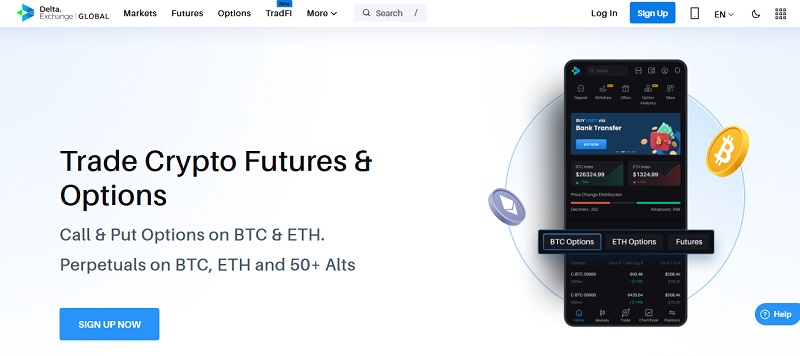
Delta Exchange Trading Infrastructure and Product Ecosystem
Delta Exchange promotes itself as a derivatives-first crypto platform with support for futures, perpetuals, options, and spot trading markets.
The service publicly advertises:
According to external reviews, Delta Exchange supports leveraged trading up to 100x on selected contracts.
Analytical interpretation:
The platform appears substantially more specialized in derivatives infrastructure than standard retail crypto exchanges. The project's strongest positioning remains leveraged crypto trading and options markets rather than spot asset accumulation.
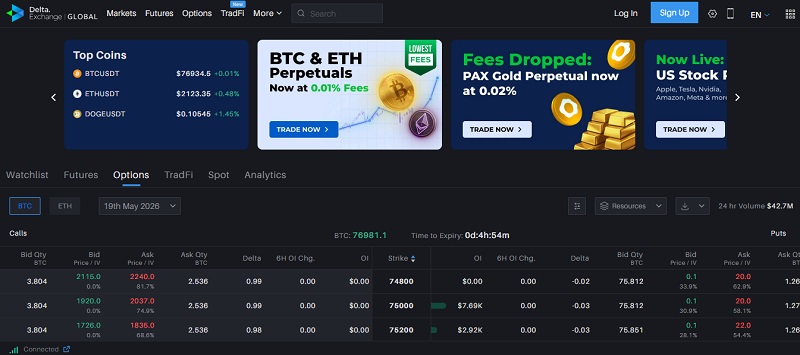
Delta Exchange Trading Fees and Contract Conditions
One of the stronger transparency elements of Delta Exchange is the public availability of fee structures for several trading products.
Published Fee Schedule
| Trading Product | Maker Fee | Taker Fee | Settlement Fee |
|---|
| BTC & ETH Futures (Non-API) | 0.01% | 0.01% | 0.01% |
| BTC & ETH Futures (API) | 0.03% | 0.03% | 0.03% |
| USDT Linear Futures | 0.03% | 0.03% | 0.03% |
| Options | 0.015% | 0.015% | 0.015% |
| Spot trading | 0.075% | 0.075% | N/A |
Delta Exchange also discloses liquidation factors ranging between 0.2 and 0.5 depending on contract category.
Analytical observation:
Compared with many offshore crypto platforms, the service demonstrates above-average transparency regarding derivatives fee mechanics and trading structure disclosure.
Delta Exchange Personal Account and Verification Process
Opening a Delta Exchange personal account provides access to derivatives markets, spot trading, and trading automation features.
The platform supports:
Official support infrastructure includes:
The Delta Exchange personal account interface reportedly includes advanced trading tools, options analytics, and automated strategy functionality.
Deposits and Withdrawing Money From Delta Exchange
Delta Exchange publicly publishes withdrawal fees and minimum withdrawal thresholds for several blockchain networks.
Withdrawal Examples
| Asset | Network | Withdrawal Fee | Minimum Withdrawal |
|---|
| USDT | BEP20 (BSC) | 1 USDT | 6 USDT |
| BTC | Bitcoin | 0.00002 BTC | 0.0001 BTC |
| ETH | ERC20 | 0.0025 ETH | 0.01 ETH |
| USDC | ERC20 | 10 USDC | 30 USDC |
| SOL | Solana | 0.01 SOL | 0.02 SOL |
Published Minimum Deposit Information
| Cryptocurrency | Network | Minimum Deposit | Required Confirmations |
|---|
| USDT | BEP20 (BSC) | 0.5 USDT | 15 |
| USDT | ERC20 | 0.5 USDT | 12 |
The process of withdrawing money from Delta Exchange appears substantially more documented than on many anonymous crypto platforms.
However, external user complaints on Trustpilot reference:
Analytical conclusion:
Although operational transparency is higher than many offshore exchanges, leveraged derivatives trading substantially increases trading risk exposure regardless of withdrawal infrastructure quality.
Corporate Structure and Domain Background of Delta Exchange
Delta Exchange publicly discloses more corporate information than many offshore crypto platforms.
According to public legal disclosures:
The Delta Exchange was founded in 2018 and maintains infrastructure targeting international derivatives traders.
| Corporate Indicator | Observed Data |
|---|
| Domain registration date | 2018-02-20 |
| Latest domain update | 2023-12-03 |
| Hosting provider | Cloudflare Inc. |
| IP location | San Jose, California |
Source: DomainTools
Delta Exchange restricts access from multiple jurisdictions including the United States, United Kingdom, Canada, and several sanctioned regions.
Analytical observation:
The project demonstrates materially stronger corporate disclosure than many recently created offshore trading platforms, although its offshore registration structure still limits traditional regulatory protections.
Delta Exchange Reviews and External Reputation Signals
Public Delta Exchange reviews remain mixed but substantially more developed than those of newly launched anonymous exchanges.
Positive reviews emphasize:
Negative reviews frequently mention:
Analytical interpretation:
Delta Exchange appears operationally legitimate and substantially more transparent than many anonymous crypto services, but aggressive leverage products naturally increase dispute frequency and user loss exposure.
Risk Assessment and Final Conclusion About Delta Exchange
| Risk Category | Assessment |
|---|
| Corporate transparency | Moderate-high |
| Regulatory oversight | Limited offshore structure |
| Fee transparency | Strong |
| Withdrawal transparency | Publicly documented |
| Leverage risk | Very high |
| Overall project risk | Medium risk |
Delta Exchange currently appears substantially more mature and operationally transparent than many recently launched offshore crypto platforms.
Potentially suitable for:
experienced derivatives traders;
options market participants;
API and algorithmic traders;
users comfortable with leverage exposure.
Not suitable for:
conservative investors;
beginners unfamiliar with derivatives;
long-term cold storage users;
traders seeking strong top-tier regulatory protection.
Bottom line:
Delta Exchange combines relatively transparent trading conditions, public corporate disclosures, and developed derivatives infrastructure with the elevated risk profile naturally associated with high-leverage crypto trading.
While the platform demonstrates stronger operational credibility than many offshore projects, users should still carefully evaluate leverage exposure, jurisdictional limitations, and offshore regulatory structure before trading.


