
Why MEXC Account Freezes Became a Major Discussion in 2026
- What MEXC Calls “Risk Control”
- Why Reddit Became Flooded With MEXC Freeze Complaints
- AML Reviews or Something More?
- Why Some Traders Believe Profitable Accounts Are Targeted
- The White Whale Incident Changed Public Perception
- The Core Problem: Lack of Transparency
- Why Keeping Large Balances on Exchanges Became Riskier
- Are MEXC Restrictions Unique?
- Common Reasons Exchanges Restrict Accounts
- Why Centralized Exchanges Became More Aggressive With Compliance
- What Users Can Learn From the MEXC Situation
- Safer Exchange Usage Practices
- So, Is MEXC Unsafe?
- Conclusion
- FAQ
- Sources
MEXC became one of the most talked-about crypto exchanges in 2026 — but not because of new token listings or futures campaigns.
Instead, Reddit and crypto forums are increasingly filled with stories about frozen withdrawals, “risk control” reviews, repeated KYC requests, and accounts locked for months without clear timelines.
Many users describe similar experiences:
- access restrictions appearing suddenly;
- withdrawals disabled after profitable trades;
- support responses repeating compliance language without specifics.
Some reports mention review periods lasting 30, 90, 180 days, and even up to a year.
The growing visibility of these complaints turned MEXC into one of the biggest discussion topics around centralized exchange risk in 2026. But the real question is more complicated than simply asking whether the platform is “safe.”
The controversy reflects a broader shift happening across the crypto industry: major exchanges are becoming far more aggressive with compliance enforcement — while users increasingly struggle with opaque review systems.
What MEXC Calls “Risk Control”
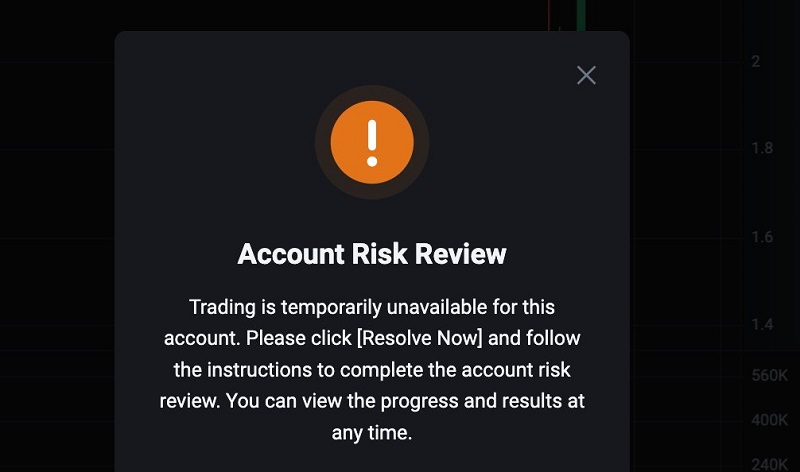
MEXC officially describes its internal review system as a “risk control framework.”
According to the exchange, these measures are designed to:
- prevent fraud;
- detect suspicious activity;
- comply with AML requirements;
- protect market integrity.
The company states that reviews may be triggered by:
- unusual trading patterns;
- withdrawal behavior;
- anti-money-laundering checks;
- compliance alerts.
Importantly, this is not unique to MEXC. Most major exchanges now operate sophisticated compliance systems because of increasing pressure from:
- FATF Travel Rule obligations;
- sanctions enforcement;
- anti-fraud monitoring;
- global AML regulation.
The core problem, according to many users, is not the existence of reviews themselves. It is the lack of transparency surrounding them.
Why Reddit Became Flooded With MEXC Freeze Complaints
Throughout 2025–2026, community complaints about MEXC became unusually visible across Reddit, Trustpilot, and trading forums.
Users frequently describe:
- delayed withdrawals;
- repeated document requests;
- automated support replies;
- unclear review deadlines.
Several reports specifically mention “30-day” or “365-day” review periods.
Bitcointalk discussions also contain complaints from users claiming their review timelines were repeatedly extended.
At the same time, it is important to recognize a major limitation of online complaints: negative experiences naturally receive disproportionate visibility.
Millions of users may use an exchange without issues while only problematic cases become public. Still, when similar stories appear repeatedly, users begin treating them as patterns rather than isolated incidents.

AML Reviews or Something More?
A major source of confusion is that many traders interpret account restrictions as proof of fraud or insolvency. In reality, compliance reviews became dramatically more aggressive across the entire crypto sector.
Modern exchanges now monitor:
- transaction flows;
- wallet exposure;
- sanctions risks;
- suspicious counterparties;
- cross-chain transfers;
- mixer interactions.
Large withdrawals or unusual trading behavior may trigger:
- source-of-funds checks;
- enhanced due diligence;
- temporary account limitations.
MEXC publicly states that complex AML investigations may take up to 30 days or longer depending on the case.
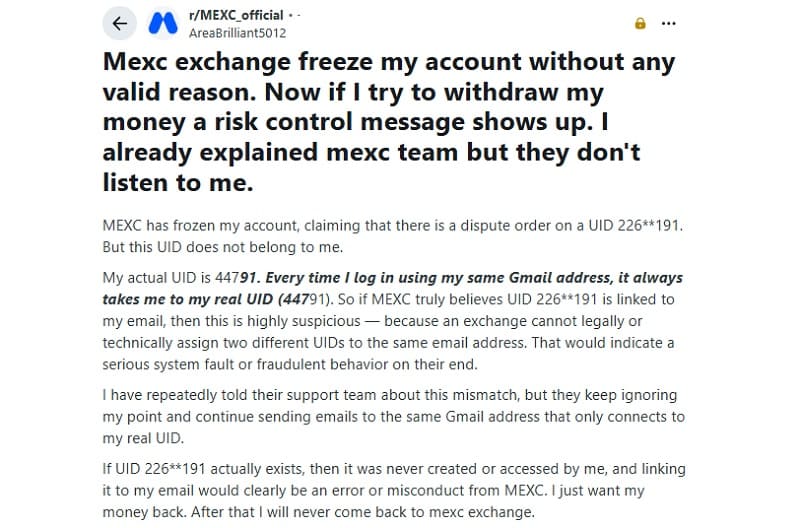
The issue is that many users report timelines extending far beyond those expectations. Some traders claim they submitted passports, bank statements, utility bills, and tax documentation, yet still received vague responses or repeated verification requests.
This creates a dangerous perception problem. From the user’s perspective, an indefinite review can feel almost identical to losing access permanently — even if the platform technically classifies it as a temporary compliance restriction.
Why Some Traders Believe Profitable Accounts Are Targeted
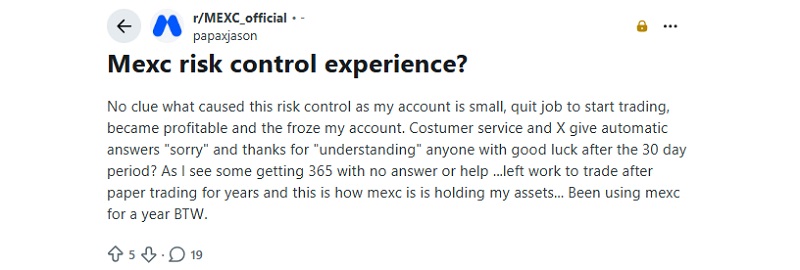
One of the most controversial narratives surrounding MEXC involves profitable traders.
Some users claim account restrictions appeared shortly after:
- successful futures trades;
- arbitrage activity;
- large profitable positions;
- high-frequency trading patterns.
These allegations became especially visible after the “White Whale” controversy.
Importantly: there is no verified evidence proving MEXC systematically freezes users simply for being profitable. However, aggressive trading behavior can interact with internal anti-abuse systems.
Exchanges often monitor:
- latency exploitation;
- market manipulation;
- API abuse;
- suspicious order behavior.
That distinction matters . A profitable account may attract scrutiny not because of profit itself — but because the trading pattern resembles behavior compliance systems classify as abnormal. Still, poor communication can quickly transform compliance disputes into public trust crises.
Also Read: What Makes a Crypto Exchange “Trustworthy”? A Beginner’s Checklist
The White Whale Incident Changed Public Perception
The controversy escalated dramatically after a public dispute involving pseudonymous trader “The White Whale.” According to public reporting, MEXC froze approximately $3.1 million connected to the trader, citing internal “risk control” concerns.
The situation exploded across crypto social media after allegations surfaced that the account had been locked for extended periods despite completed KYC procedures. The dispute became especially damaging because it moved from private support conversations into highly visible public confrontation.
Eventually, MEXC executive Cecilia Hsueh publicly acknowledged communication failures and stated the funds had been released. One of the most important moments came when she admitted: “We made a serious mistake.”
That statement significantly amplified public discussion because it appeared to validate at least some criticism regarding:
- escalation failures;
- communication problems;
- operational growing pains.
The incident transformed isolated complaints into a broader industry conversation about centralized exchange accountability.
The Core Problem: Lack of Transparency
Many users now say the biggest issue is not compliance itself — but uncertainty.
Common complaints include:
- generic support replies;
- unclear timelines;
- no escalation path;
- repeated document submissions;
- inconsistent explanations.
Several users report feeling trapped inside open-ended review processes where compliance requirements appear to expand continuously. This is particularly damaging in crypto because centralized exchanges depend heavily on trust.
Unlike traditional banks, many exchanges:
- operate internationally;
- lack clear jurisdictional dispute mechanisms;
- offer limited recovery options;
- rely heavily on internal policies.
When users cannot clearly understand why restrictions happened, what documents are sufficient, when reviews will end, confidence deteriorates rapidly.

Why Keeping Large Balances on Exchanges Became Riskier
The MEXC controversy reflects a broader custodial-risk problem across crypto. Users do not control private keys on centralized exchanges.
That means access to funds ultimately depends on:
- platform policies;
- internal compliance decisions;
- operational systems;
- regulatory obligations.
Even fully functioning exchanges may:
- delay withdrawals;
- impose enhanced verification;
- temporarily restrict access.
This is why many experienced traders increasingly separate trading balances from long-term storage holdings.
The old “not your keys, not your coins” principle regained relevance after multiple industry crises between 2022 and 2026. But unlike earlier years, the risk discussion today is not focused only on hacks or insolvency. It increasingly focuses on operational access.
Are MEXC Restrictions Unique?
No. Similar complaints exist across:
Industry-wide AML tightening affected virtually every major platform. The difference often comes down to support quality, transparency, communication speed, and public reputation.
Common Reasons Exchanges Restrict Accounts
| Trigger | Possible Reason |
|---|---|
| Large withdrawal | AML review |
| Rapid trading activity | Anti-abuse systems |
| Cross-chain transfers | Transaction monitoring |
| Suspicious wallet exposure | Compliance concerns |
| Incomplete KYC | Verification escalation |
The important takeaway: compliance pressure across crypto is rising everywhere.

Why Centralized Exchanges Became More Aggressive With Compliance
Global crypto regulation tightened significantly in recent years.
Major frameworks now include:
- FATF Travel Rule requirements;
- MiCA regulations in Europe;
- enhanced sanctions screening;
- stricter AML enforcement globally.
As a result, exchanges increasingly prioritize regulatory survival over frictionless user experience. This shift created a difficult balance.
Platforms attempt to avoid:
- legal exposure;
- regulatory penalties;
- money-laundering accusations.
But aggressive compliance systems also generate:
- false positives;
- delayed reviews;
- legitimate-user frustration.
The larger the exchange becomes, the more difficult this balance gets.
What Users Can Learn From the MEXC Situation
Regardless of whether a specific freeze is justified, the broader lesson is clear: centralized exchange access should never be treated as guaranteed.
Users increasingly need:
- transaction-history records;
- documented source-of-funds information;
- diversified custody strategies;
- realistic expectations around compliance.
Safer Exchange Usage Practices
| Practice | Why It Helps |
|---|---|
| Self-custody storage | Reduces custodial dependency |
| Transaction records | Helps during AML reviews |
| Limited exchange balances | Minimizes freeze exposure |
| Verified KYC information | Reduces compliance friction |
| Diversified platforms | Avoids single-platform dependency |
So, Is MEXC Unsafe?
There is no definitive evidence proving MEXC systematically confiscates user funds. The exchange continues operating globally and publicly emphasizes:
- compliance;
- risk management;
- anti-fraud systems;
- law-enforcement cooperation.
At the same time, the growing volume of withdrawal complaints, support frustrations, and long review timelines created serious reputation concerns in 2026. The central issue increasingly revolves around transparency.
When users do not understand why restrictions happened, how long they will last, what resolution path exists, trust breaks down quickly.
Conclusion
The MEXC controversy reflects a much larger transformation happening across crypto. Centralized exchanges increasingly operate under:
- aggressive AML enforcement;
- global compliance pressure;
- growing operational complexity.
At the same time, users still expect:
- instant withdrawals;
- frictionless access;
- minimal oversight.
That tension is becoming harder to manage. And in 2026, one of the biggest risks on centralized exchanges is no longer only hacking or insolvency — it is losing access to your own funds while waiting for an opaque “risk control” process to end.
FAQ
Why does MEXC freeze accounts?
Usually because of compliance reviews, suspicious-activity alerts, AML monitoring, or verification issues.
What is MEXC risk control?
It is the exchange’s internal framework for fraud prevention, compliance checks, and suspicious-activity monitoring.
How long do MEXC reviews last?
Officially, many cases resolve within days or weeks, but some users report significantly longer timelines.
Can MEXC freeze withdrawals after KYC?
Yes. Passing KYC does not prevent later compliance reviews or source-of-funds checks.
Are MEXC freezes related to AML?
Often yes. Large transfers or unusual activity may trigger anti-money-laundering reviews.
Is MEXC a scam?
There is no verified evidence proving MEXC systematically steals user funds, though criticism regarding transparency and communication remains significant.
Why do profitable traders complain about restrictions?
Some believe profitable activity triggered reviews, though exchanges generally attribute restrictions to compliance or anti-abuse concerns.
Can users recover restricted funds?
In many cases, yes — especially if requested documentation is successfully completed.
Are other exchanges restricting accounts too?
Yes. Similar complaints exist across many major centralized exchanges due to tightening AML enforcement.
Should traders store large balances on exchanges?
Many experienced users prefer limiting exchange balances and using self-custody for long-term storage.
Sources
Get professional help with your case.