


Used Kucoin for 2 years. Good tools, but support is slow. OK for small amounts.
4
Geoffrey_43Jones
The digital exchange KuCoin is one of the largest cryptocurrency trading platforms operating in the global digital asset market. Founded in 2017, the project has expanded beyond spot trading into derivatives, staking, lending, Web3 products, institutional services, and blockchain infrastructure. According to the company, the platform serves tens of millions of users across more than 200 countries and regions.
This independent review examines publicly available information about the KuCoin crypto exchange, separating independently verified facts from company statements.
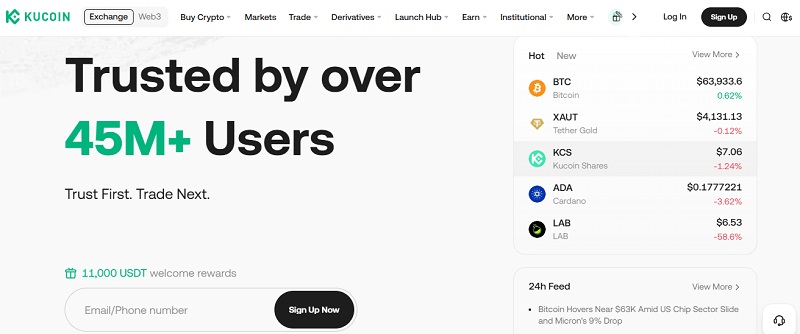
Publicly available corporate information:
Launch date: September 2017
Corporate entities: Mek Global Limited, PhoenixFin Pte. Ltd., Peken Global Ltd.
Operational presence: Singapore, Seychelles, and other jurisdictions
Publicly disclosed registrations and licences include:
Registration with India's Financial Intelligence Unit (FIU-IND)
Compliance initiatives in selected regional markets
KuCoin exchange is not supervised by major financial regulators such as:
FCA (United Kingdom)
SEC (United States)
ASIC (Australia)
BaFin (Germany)
Regulatory proceedings:
January 2025: Peken Global Ltd. pleaded guilty to operating an unlicensed money transmitting business in the United States
The settlement included financial penalties and a temporary withdrawal from the U.S. market
| KuCoin Exchange Corporate Information | Publicly Available Information |
|---|---|
| Launch year | 2017 |
| Known operating entities | Mek Global Limited, PhoenixFin Pte. Ltd., Peken Global Ltd. |
| CEO | BC Wong (appointed 2025) |
| Top-tier financial regulation | No independently confirmed top-tier regulator supervision found |
| Public compliance registrations | Includes registration with India's FIU according to company disclosures |
| Customer support | Online chat and Help Center |
The company advertises access to more than 1,000 cryptocurrencies together with thousands of trading pairs across spot and derivatives markets.
Examples of markets publicly available:
BTC,
ETH,
SOL,
XRP,
XAUT,
LEO,
LTC,
LINK,
DOGE,
HYPE,
NEO,
STX,
TRX,
ZEC,
AVAX,
ADA,
DOT,
SUI,
XLM,
XMR,
| Markets | Public Information |
|---|---|
| Supported cryptocurrencies | 1,000+ (company claim) |
| Spot trading | Available |
| Perpetual futures | Available |
| Margin trading | Available |
| Options | Available for selected products |
| Representative assets | BTC, ETH, SOL, XRP, DOGE, ADA, AVAX, XAUT, TRX, LINK, LTC, SUI |
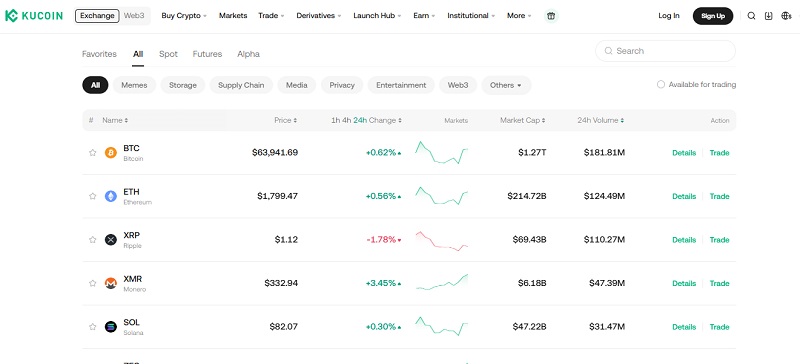
According to publicly available documentation, users can access:
Spot, futures and margin trading
Perpetual contracts
Crypto lending and borrowing
Staking and KuCoin Earn
Trading bots
Token launchpad
Web3 wallet
Institutional services
API trading
Platform availability:
Web terminal
Android and iOS applications
Desktop interface
API connectivity
The KuCoin exchange also publishes Proof of Reserves using Merkle Tree verification and reports independent security certifications including SOC 2 Type II and ISO 27001:2022.
| Products | Availability |
|---|---|
| Spot Trading | Available |
| Margin Trading | Available |
| Perpetual Futures | Available |
| Options | Supported for selected markets |
| Trading Bots | Available |
| Lending & Borrowing | Available |
| Staking & Earn | Available |
| Web3 Wallet | Available |
| API Trading | Available |
The KuCoin exchange applies a tiered fee schedule where trading costs decrease as users increase volume or hold the platform's native token, KCS.
Publicly disclosed fee structure:
Spot Trading:
Standard Maker and Taker: 0.10%
Additional discounts available with KCS
Futures Trading:
Maker: from 0.02%
Taker: from 0.06%
| KuCoin Exchange Trading Conditions | Publicly Available Information |
|---|---|
| Spot trading fee | 0.10% Maker / 0.10% Taker (standard) |
| Futures trading fee | From 0.02% Maker / 0.06% Taker |
| Fee discounts | Available through VIP levels and KCS holdings |
| Margin trading | Available |
| Trading bots | Supported |
| API trading | Supported |
| Institutional services | Available |
| VIP programme | Available |
Creating a KuCoin personal account begins with an email address or mobile number followed by identity verification. Since 2023, KYC verification has become mandatory for newly registered users to access the full range of exchange services.
Registration process:
Email address or mobile phone
Password creation
Email or SMS confirmation
Enabling two-factor authentication (recommended)
Identity verification (KYC)
Optional institutional verification
Additional security tools:
Google Authenticator
Anti-phishing codes
Withdrawal whitelist
Login notifications
Device management
Proof of Reserves verification
Funding an account is possible through cryptocurrency transfers and supported fiat payment providers, depending on jurisdiction. Crypto deposits are generally free, while fiat transactions may incur fees.
Publicly available information:
Cryptocurrency deposits — generally free
Bank transfers — supported in eligible regions
Debit and credit cards — available through third-party partners
P2P marketplace — available in supported countries
When withdrawing money from KuCoin, withdrawal fees depend on the selected blockchain network rather than a single fixed platform fee. Minimum withdrawal amounts vary by cryptocurrency.
Examples of published withdrawal conditions:
BTC — network-based fixed withdrawal fee
ETH — dynamic fee linked to network conditions
USDT — varies depending on TRC20, ERC20, BEP20
| KuCoin Exchange Deposits and Withdrawals | Publicly Available Information |
|---|---|
| Crypto deposits | Generally free |
| Bank transfers | Supported in eligible jurisdictions |
| Card purchases | Available through payment partners |
| P2P marketplace | Available |
| Withdrawal fees | Depend on blockchain network and asset |
| Minimum withdrawals | Asset-specific |
| Processing time | Depends on blockchain confirmations and security checks |
The KuCoin exchange operates through a long-established domain originally registered on 11 October 2012, several years before the trading platform launched in 2017.
Domain created: 11 October 2012
Last update: 16 May 2026
Hosting infrastructure: Cloudflare
IP location: San Jose, California, United States
The longevity of the domain differs from many recently established crypto platforms, although domain age alone should not be interpreted as evidence of regulatory compliance.
Public KuCoin reviews are available across several independent platforms, with Trustpilot remaining the largest identifiable feedback source.
Positive comments frequently mention:
Extensive cryptocurrency selection
Competitive trading fees
Advanced trading tools
Availability of trading bots
High liquidity
Negative KuCoin reviews most commonly relate to:
Delayed customer support responses
Lengthy identity verification procedures
Account recovery difficulties
Withdrawal disputes
Inactivity fee complaints
From a transparency perspective, KuCoin digital exchange publishes considerably more information than many newly established cryptocurrency services. Public documentation covers trading products, fee schedules, Proof of Reserves, supported services, and corporate announcements.
Strengths:
Operating history dating back to 2017
Publicly available trading rules and fee schedules
Published Proof of Reserves
Extensive product ecosystem
Institutional-grade security measures
Considerations:
U.S. enforcement proceedings concluded with a settlement in 2025
Not supervised by a top-tier financial regulator
Independent analysts also note the platform's regulatory status. BrokerChooser, for example, does not classify the KuCoin exchange as a trusted provider because it is not supervised by a top-tier financial regulator. This assessment reflects the level of investor protection available under regulatory oversight rather than an allegation of fraudulent activity.
Overall assessment:
Risk level: Medium
May be suitable for:
Experienced cryptocurrency traders
Users seeking access to a broad range of digital assets
Traders interested in futures, margin trading, lending, staking, and automated strategies
Investors who understand exchange custody risk
May not be suitable for:
Beginners looking for maximum regulatory protection
Investors who require oversight from a top-tier financial regulator
Users located in jurisdictions where KuCoin services are restricted
Long-term holders who prefer regulated custodians or self-custody
Overall, KuCoin exchange demonstrates significantly greater operational transparency than many recently launched cryptocurrency platforms. Nevertheless, prospective users should weigh its extensive functionality against the regulatory limitations and determine whether the available investor protections align with their own risk tolerance.
Checking a company's activities is accessible to everyone through specialized online resources. When evaluating an exchange, it is important to pay attention to the presence of legal status, the length of operation, and transparent earning conditions. It is crucial that the stated information is genuine and not fake. Fraudsters use fake data and documents to imitate the work of legitimate service providers.
To make the right choice, it is better to consult specialists. They will conduct a verification of the cryptocurrency exchange and determine what it really is — a reliable partner or a fraudulent project.
Thanks to comments about the company's services, potential clients receive information about the possibility of real earnings under the proposed conditions. These are written by both experienced traders who have conducted a preliminary assessment of the project and actual clients.
It is important to consider that unscrupulous exchanges may pay for positive reviews. In them, supposedly satisfied users share their achievements and encourage cooperation with a reliable company. You can distinguish such opinions from genuine ones by their content and presentation. They are filled with template and simplistic phrases, as well as expressive statements.
Manipulations involving extortion of additional investments to withdraw capital are undeniable facts of fraud. Real exchanges do not require clients to make payments for fees such as insurance, taxes, transfer commissions, opening transit accounts, etc. This is how scammers operate to profit by tricking traders into making further deposits.
If the exchange refuses to withdraw money, it is important not to fall for the tricks of fraudsters. This can lead to even greater financial losses. In such cases, it is better to consult experts. They will assist in withdrawing capital considering the circumstances.
The first thing to do is to contact the company's representatives and find out the reason for the block. If they ignore the sent requests and do not provide clear instructions for resolving the issue — they are scammers. Blocking accounts is one way to prevent clients from accessing their assets and to deny further service.
Consulting with specialized professionals will be the optimal solution in this situation. They will help determine the source of the exchange account closure and suggest ways to restore access to the personal account.
Various factors can lead to the inactivity of the exchange portal. These can include DDoS attacks, technical failures in server operation, or the company's own decision to cease operations. There may also be blocking of the platform according to the client's jurisdiction laws or violations of platform rules by the user themselves.
In fraudulent companies, a non-functioning website is one of the manipulations used to limit services to existing clients. When faced with such a situation, it is advisable to utilize the services of experts . They will help establish the true cause of the problem and provide useful recommendations for further actions.
Refusal to withdraw money is a common occurrence among illegal service providers. To initiate a refund, you should gather all available information (screenshots, wallet addresses, transaction IDs) and submit a request for a chargeback.
Disputing cryptocurrency transfers is a rather specific procedure that requires a competent approach. That is why it is best to entrust its initiation to qualified specialists. They will help recover assets in accordance with established timelines and regulations.