


Leveraged products carry high risk, though platform order execution is smooth.
4
Jose
The digital exchange BTCC is one of the oldest cryptocurrency trading platforms still operating in the market. According to the company, it was founded in 2011 and today offers spot trading, perpetual futures, copy trading, demo trading, and crypto investment tools for retail and professional users.
The project states that it serves millions of customers globally and has expanded its regulatory footprint in Europe through a Polish Virtual Asset Service Provider (VASP) registration.
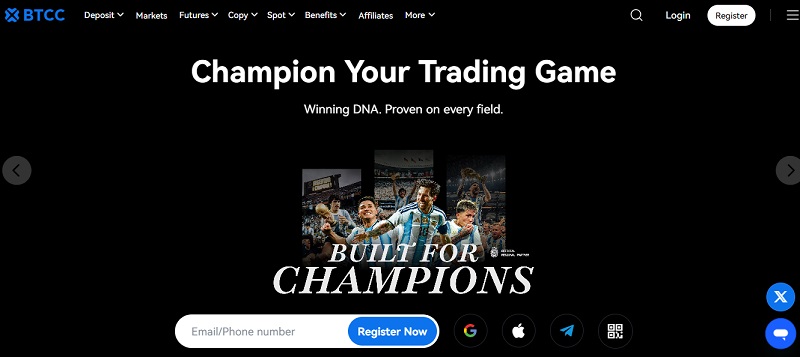
Unlike many offshore crypto marketplaces, the BTCC exchange publicly discloses the legal entity currently serving European customers.
According to information published by the company:
Company: BTCC POLAND LIMITED
Registered office: Piotrkowska No.116, Suite No.52, 90-006 Łódź, Poland
Company registration number: 0001129321
VASP registration number: RDWW-1524
The firm also explains that historical EU accounts opened before 2026 were serviced by BTCC Lithuania Limited UAB, registered in Vilnius, Lithuania (Company code 305950582). The project states that this Lithuanian entity no longer actively accepts new clients after 31 December 2025.
| Corporate Information | Status |
|---|---|
| Founded | 2011 (company statement) |
| Current EU entity | BTCC POLAND LIMITED |
| Registered office | Łódź, Poland |
| Company registration | 0001129321 |
| VASP registration | RDWW-1524 |
Analytical interpretation:
Compared with many recently launched marketplaces, the BTCC exchange provides considerably more corporate information. Nevertheless, a company registration or VASP registration should not automatically be interpreted as equivalent to prudential supervision by a major financial regulator.
The BTCC exchange positions itself as a multi-product cryptocurrency trading platform rather than a spot-only marketplace.
Publicly available services include:
Spot trading
Perpetual futures
Copy trading
Demo access
VIP programme
Proof of Reserves
Mobile applications
API access
The service also advertises support for more than 300 perpetual futures markets and 200+ spot cryptocurrencies, including:
Bitcoin (BTC)
Ethereum (ETH)
Solana (SOL)
XRP
Litecoin (LTC)
Dogecoin (DOGE)
Shiba Inu (SHIB)
hundreds of additional digital assets.
Analytical interpretation:
The BTCC exchange provides a broader product ecosystem than many newer providers, combining derivatives, copy trading, and spot markets within a single interface.
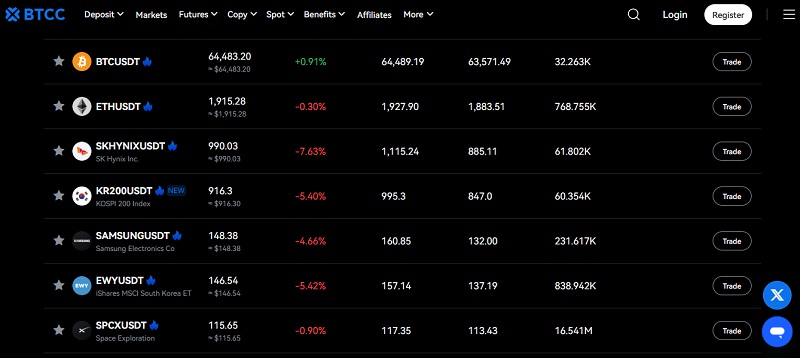
The crypto exchange BTCC publishes its trading fees openly and applies a tiered pricing system based on VIP level and trading activity.
Standard published rates include:
| Market | Maker | Taker |
|---|---|---|
| Spot | from 0.20% | from 0.30% |
| Perpetual Futures | from 0.025% | from 0.045% |
Additional costs may include:
blockchain withdrawal fees;
funding payments for perpetual contracts;
network transaction fees depending on the selected cryptocurrency.
Analytical interpretation:
Unlike many smaller venues that disclose little pricing information, the BTCC exchange maintains a publicly accessible fee schedule. Actual trading costs, however, may vary according to VIP status, promotional campaigns, and the selected market.
Creating a BTCC personal account requires:
email address or mobile number;
password creation;
security verification.
Users may subsequently complete identity verification to unlock higher limits and additional platform functions.
A verified BTCC personal account provides access to:
spot trading;
perpetual futures;
copy trading;
demo trading;
VIP benefits;
Proof of Reserves verification tools.
The service also advertises several security mechanisms, including two-factor authentication, withdrawal verification, and risk-control systems designed to monitor suspicious account activity.
The provider states that its European operations are conducted through BTCC POLAND LIMITED, which is registered in Poland and included in the country's Register of Virtual Currency Activities as an authorized Virtual Asset Service Provider (VASP) under registration number RDWW-1524.
The company also explains that legacy EU accounts opened before 2026 were serviced by BTCC Lithuania Limited UAB, although this entity is no longer onboarding new customers.
It is important to distinguish between VASP registration and prudential financial supervision. During this review, no publicly verifiable evidence was identified showing that the BTCC exchange is licensed by major tier-one financial regulators such as:
FCA;
ASIC;
CySEC;
BaFin.
According to the supplied DomainTools information:
Domain created: 2 June 1995
Updated: 8 April 2026
Hosting: Cloudflare (San Francisco, California, USA)
WHOIS: Domain Protection Services, Inc.
The domain registration predates the launch of the firm by many years. The BTCC exchange states that the cryptocurrency platform itself began operating in 2011.
Analytical interpretation:
The disclosed Polish VASP registration provides greater corporate transparency than many offshore venues. However, a VASP registration primarily relates to AML/CFT compliance and should not be viewed as equivalent to authorization from a top-tier financial regulator.
The digital exchange BTCC offers several official customer support channels.
Available contacts include:
24/7 online live chat;
support ticket system;
email;
Help Center and FAQ database.
Unlike some cryptocurrency platforms, the platform publishes dedicated email addresses for different business functions alongside its live support service.
A Trustpilot profile exists specifically for btcc.com. At the time of research, the profile contained 378 BTCC reviews with an overall TrustScore of 2.5/5.
Positive reviewers frequently mention:
easy onboarding for beginners;
competitive futures trading;
copy trading functionality;
improved trading fees following recent fee reductions.
Recurring complaints include:
delayed withdrawals;
prolonged compliance reviews;
frozen accounts during investigations;
slow communication from customer support;
disputes regarding account security and unauthorized transactions.
Independent Reddit discussions show similar themes. Several users describe delayed withdrawals or extended account reviews after risk-control checks, while others report concerns about communication during investigations. These discussions represent personal experiences and should not be interpreted as independently verified findings.
Analytical interpretation:
The available public BTCC reviews present a mixed reputation profile. Positive comments generally focus on trading functionality, whereas negative reviews most often concern withdrawal processing, compliance procedures, and customer support responsiveness rather than trading execution itself.
BrokerChooser takes a cautious approach when evaluating BTCC exchange. Based on the publicly available regulatory information, the platform is not included among venues that BrokerChooser considers to offer the highest level of regulatory confidence.
This assessment appears to reflect the fact that, although the entity publicly discloses a Polish VASP registration, no evidence was identified of authorization from a leading financial regulator such as the FCA, ASIC, or CySEC. BrokerChooser's methodology places considerable emphasis on the strength of regulatory oversight when assessing trustworthiness.
Analytical interpretation:
This evaluation should be understood as an assessment of the BTCC's regulatory framework rather than proof of operational misconduct or financial instability.
| Criteria | Assessment |
|---|---|
| Founded | 2011 |
| Corporate transparency | Above average |
| VASP registration | Poland (RDWW-1524) |
| Top-tier regulation | Not identified |
| Fee transparency | High |
| Public support channels | Comprehensive |
| Overall risk | Medium |
The BTCC exchange demonstrates a higher level of corporate disclosure than many cryptocurrency platforms operating internationally. The publication of company registration details, a Polish VASP registration, transparent fee schedules, and multiple official support channels provides users with more verifiable information than is commonly available among newer providers.
Nevertheless, several considerations remain relevant:
no publicly verified licence from a tier-one financial regulator was identified;
Trustpilot feedback reveals recurring complaints about withdrawal reviews and customer support delays;
BrokerChooser assigns a relatively conservative trust assessment because of the platform's regulatory profile.
Potentially suitable for:
experienced cryptocurrency traders;
users seeking futures and copy trading;
traders comfortable using exchanges operating under VASP registration.
Less suitable for:
investors who prioritize supervision by top-tier financial regulators;
users seeking the highest level of regulatory protection;
conservative investors focused primarily on custodial safeguards.
Bottom line: BTCC exchange combines a long operating history with comparatively strong corporate disclosure and publicly identifiable legal entities. However, the absence of authorization from major financial regulators and the mixed customer feedback regarding withdrawals and support mean prospective users should evaluate both the platform's strengths and its regulatory limitations before committing significant funds.
Checking a company's activities is accessible to everyone through specialized online resources. When evaluating an exchange, it is important to pay attention to the presence of legal status, the length of operation, and transparent earning conditions. It is crucial that the stated information is genuine and not fake. Fraudsters use fake data and documents to imitate the work of legitimate service providers.
To make the right choice, it is better to consult specialists. They will conduct a verification of the cryptocurrency exchange and determine what it really is — a reliable partner or a fraudulent project.
Thanks to comments about the company's services, potential clients receive information about the possibility of real earnings under the proposed conditions. These are written by both experienced traders who have conducted a preliminary assessment of the project and actual clients.
It is important to consider that unscrupulous exchanges may pay for positive reviews. In them, supposedly satisfied users share their achievements and encourage cooperation with a reliable company. You can distinguish such opinions from genuine ones by their content and presentation. They are filled with template and simplistic phrases, as well as expressive statements.
Manipulations involving extortion of additional investments to withdraw capital are undeniable facts of fraud. Real exchanges do not require clients to make payments for fees such as insurance, taxes, transfer commissions, opening transit accounts, etc. This is how scammers operate to profit by tricking traders into making further deposits.
If the exchange refuses to withdraw money, it is important not to fall for the tricks of fraudsters. This can lead to even greater financial losses. In such cases, it is better to consult experts. They will assist in withdrawing capital considering the circumstances.
The first thing to do is to contact the company's representatives and find out the reason for the block. If they ignore the sent requests and do not provide clear instructions for resolving the issue — they are scammers. Blocking accounts is one way to prevent clients from accessing their assets and to deny further service.
Consulting with specialized professionals will be the optimal solution in this situation. They will help determine the source of the exchange account closure and suggest ways to restore access to the personal account.
Various factors can lead to the inactivity of the exchange portal. These can include DDoS attacks, technical failures in server operation, or the company's own decision to cease operations. There may also be blocking of the platform according to the client's jurisdiction laws or violations of platform rules by the user themselves.
In fraudulent companies, a non-functioning website is one of the manipulations used to limit services to existing clients. When faced with such a situation, it is advisable to utilize the services of experts . They will help establish the true cause of the problem and provide useful recommendations for further actions.
Refusal to withdraw money is a common occurrence among illegal service providers. To initiate a refund, you should gather all available information (screenshots, wallet addresses, transaction IDs) and submit a request for a chargeback.
Disputing cryptocurrency transfers is a rather specific procedure that requires a competent approach. That is why it is best to entrust its initiation to qualified specialists. They will help recover assets in accordance with established timelines and regulations.