
Understanding ASIC: How It Operates, How to Check Brokers, and Recovery Possibilities
- What ASIC Is and How It Works
- How ASIC Licensing Works
- Official ASIC Tools: What You Can Actually Check
- How to Verify a Broker Using ASIC
- ASIC Warnings, Blacklists, and Scam Alerts
- Can ASIC Help You Recover Money?
- ASIC Communication: What They Will and Will Not Do
- Why People Misunderstand Regulators
- Structural Insight: Where ASIC Fits Globally
- Risk Assessment: When ASIC Protection Applies
- Conclusion: Is ASIC Enough to Protect You?
- FAQ
- Sources
- Need Help?
Financial regulators are often seen as a safety net. Many people assume that if a broker is “regulated,” their money is protected — and if something goes wrong, the regulator will step in and recover funds.
In reality, the system works differently. The Australian Securities and Investments Commission (ASIC) is one of the world’s most respected financial regulators. But understanding what it actually does — and what it doesn’t do — is critical, especially in today’s environment of rising investment and crypto scams.
What ASIC Is and How It Works
ASIC is Australia’s national corporate and financial services regulator, established in 1998 to oversee companies, financial markets, and investment providers.
Its core responsibilities include:
- licensing financial services providers
- monitoring compliance
- enforcing financial laws
- protecting consumers and investors
ASIC operates under legislation such as the Corporations Act 2001 and has authority over:
- investment firms
- brokers
- derivatives providers
- financial advisers
Australia’s national corporate and financial services regulator does not manage companies or investments — it regulates how they operate.

How ASIC Licensing Works
To legally provide financial services in Australia, a company must obtain an Australian Financial Services Licence (AFSL).
This license confirms that the company:
- meets competency standards
- has financial resources
- complies with regulatory obligations
ASIC assesses applicants before issuing licenses and requires ongoing compliance. However, there is a critical nuance. An AFSL is a point-in-time approval — it does not guarantee future behavior or honesty.
This means:
- a licensed broker can still act unfairly
- a license is a baseline, not a guarantee
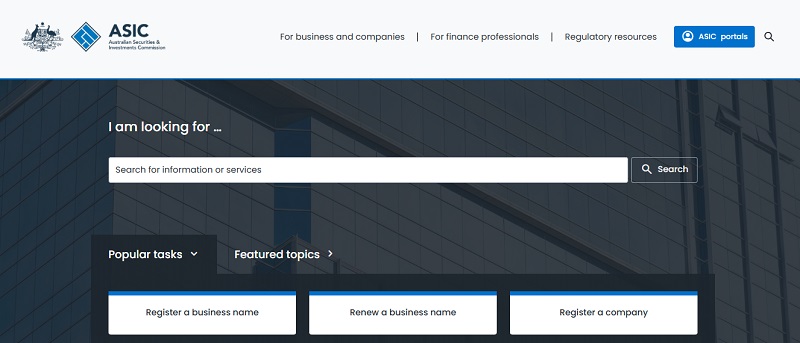
Official ASIC Tools: What You Can Actually Check
ASIC provides several public tools that are extremely useful if you know how to use them:
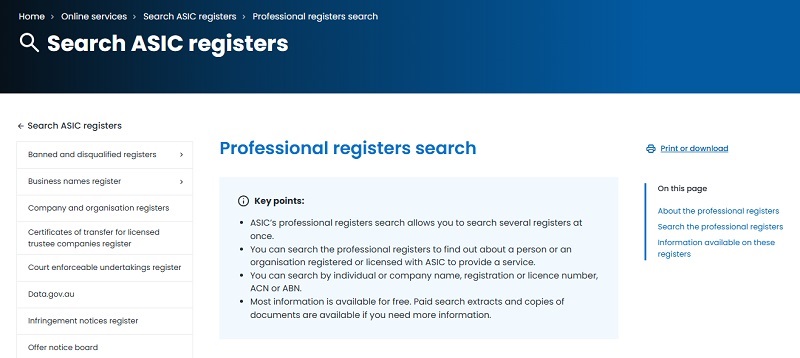
- Professional Registers
- Search companies and license holders
- Verify AFSL status
- Check legal entity details
- Review historical data
- Educational platform for investors
These tools allow users to verify whether a company is legally recognized and licensed.
How to Verify a Broker Using ASIC
Here’s a practical process:
- Go to ASIC’s Professional Registers
- Enter the broker’s name or AFSL number
- Confirm:
- license status (active/suspended)
- authorized services
- Compare:
- official company name
- contact details
ASIC databases allow you to verify whether a license is valid and what services it covers.
The Australian Securities and Investments Commission does not list website domains, which creates a major risk. Scammers often:
- copy real license numbers
- create clone websites
So verification must include:
- matching legal entity
- matching contact details
ASIC Warnings, Blacklists, and Scam Alerts
ASIC regularly publishes:
- scam alerts
- warning notices
- enforcement updates
In 2026, Australian Securities and Investments Commission intensified action against misleading financial promotion, including a crackdown on unlicensed “finfluencers” spreading risky investment advice.
This reflects a broader trend:
- scams are becoming more sophisticated
- misinformation is spreading through social platforms
- regulators are reacting — but often after damage occurs
Also Read: Financial Conduct Authority (FCA): How It Works, Reliability, and Can It Help You Recover Funds?
Can ASIC Help You Recover Money?
This is the most misunderstood part. The Australian Securities and Investments Commission does not recover funds for individuals.
ASIC can:
- investigate companies
- take legal action
- impose fines
- force compensation in some cases
But it does not:
- act as your lawyer
- process individual claims
- reverse transactions
In some enforcement cases, large-scale compensation has occurred — for example, refunds to investors in misconduct cases involving financial products. However, these outcomes are rare, they take years and apply to groups, not individuals.

ASIC Communication: What They Will and Will Not Do
Understanding this prevents false expectations.
ASIC can:
- investigate fraud
- issue warnings
- shut down illegal operations
- enforce penalties
ASIC cannot:
- recover your money directly
- intervene instantly in disputes
- resolve individual complaints
Instead, complaints are typically handled through dispute resolution bodies (like AFCA) and legal channels.
Why People Misunderstand Regulators
Many investors assume that “regulated” automatically means “safe.” In reality, regulation reduces risk but does not eliminate it. Even well-established regulators like ASIC operate within a broader financial ecosystem that includes internal dispute resolution processes, external complaint bodies, and financial institutions themselves.
For example, investors are often required to first resolve issues directly with the financial firm, and only then escalate complaints to independent bodies such as the Australian Financial Complaints Authority. While ASIC oversees the system and sets standards, it does not handle individual disputes or guarantee outcomes.
As a result, a gap emerges between expectations and reality: regulation provides a framework for accountability, but it does not fully protect investors from losses, misconduct, or operational failures.
Also Read: CySEC Regulation: How It Works and What to Do If Funds Are Lost
Structural Insight: Where ASIC Fits Globally
ASIC is comparable to:
- UK’s FCA
- US SEC
All of them:
- license companies
- enforce laws
- issue warnings
None of them:
- guarantee returns
- prevent all scams
- recover funds on demand
Risk Assessment: When ASIC Protection Applies
| Scenario | Protection Level |
|---|---|
| Licensed Australian broker | Medium |
| Clone of licensed broker | Low |
| Offshore unregulated broker | Very low |
| Crypto-only platform (no license) | Minimal |

Conclusion: Is ASIC Enough to Protect You?
The Australian Securities and Investments Commission is a powerful regulator — but it is not a safety net for individual losses. It operates at a system level, not a personal level.
ASIC helps create a safer financial environment — but it does not guarantee your safety within it.
The responsibility still lies with the user to:
FAQ
Is an ASIC license enough to trust a broker?
No. It’s a baseline requirement, not a guarantee of reliability.
Can ASIC freeze a scammer’s funds?
In some cases, yes — but not quickly enough to prevent most losses.
Can ASIC help me get my money back?
Not directly. Recovery is indirect and rare.
What if the broker is offshore?
ASIC has little or no authority.
How do scammers fake ASIC regulation?
By copying license numbers and creating clone websites.
Sources
- ASIC official overview and role
- Australian Securities and Investments Commission (overview)
- AFSL licensing framework
- ASIC licensing limitations
- Broker verification methods
- Financial regulation system (Australia)
- ASIC enforcement and scam warnings (2026)
Need Help?
If you’re unsure whether a broker is genuinely regulated or potentially fraudulent, you can request a license and risk check. Stock View team specialists can verify regulatory status and identify warning signs before you invest.
Get professional help with your case.