
The New Era of Crypto-Forex Hybrid Brokers
- What Are Crypto-Forex Hybrid Brokers?
- Why Traders Love the “Super App” Model
- Copy Trading Became the Core Engagement Engine
- Why Crypto Exchanges Started Looking Like Forex Brokers
- The Hidden Risk of Financial Super Apps
- Custodial Risk Is Quietly Expanding
- Regulators Are Becoming Increasingly Concerned
- Why These Platforms Feel Addictive to Retail Traders
- Are Hybrid Platforms Actually the Future?
- What Modern Hybrid Platforms Typically Combine
- Benefits vs Risks of Trading Super Apps
- The Real Question Is No Longer “Broker or Exchange”
- Conclusion
- FAQ
- Sources
A few years ago, retail traders usually needed several separate apps to manage their financial activity. One platform for forex. Another for crypto. A different wallet for staking. A separate app for copy trading or social investing.
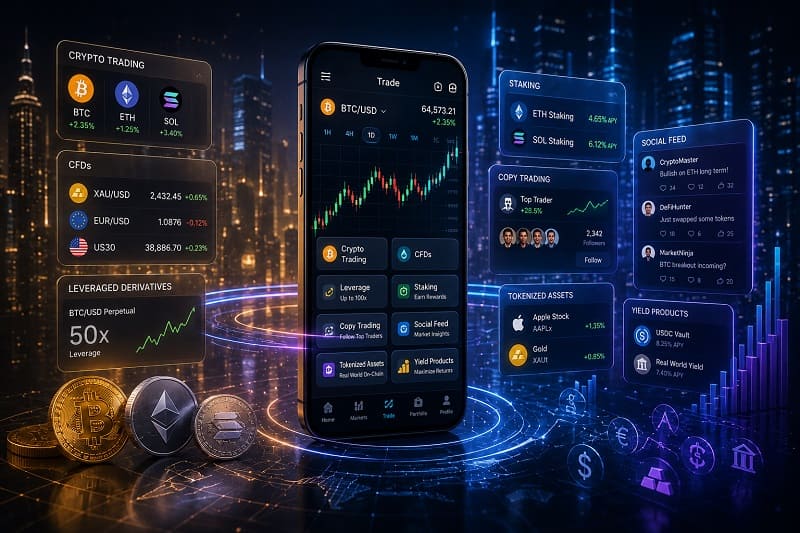
In 2026, that separation is disappearing rapidly. Modern retail platforms increasingly combine multiple services inside one ecosystem, including:
- crypto trading;
- CFDs;
- leveraged derivatives;
- staking;
- copy trading;
- social feeds;
- tokenized assets;
- yield products.
The result is the rise of a new category of financial “super apps” — hybrid platforms designed to retain users inside one interface, investing, earning yield, and interacting socially without ever leaving the same interface.
For many retail users, this feels incredibly convenient. For regulators and risk analysts, it raises much more complicated questions.
What Are Crypto-Forex Hybrid Brokers?
The modern hybrid broker is no longer just a traditional CFD platform or a standard crypto exchange.
Instead, these ecosystems increasingly merge:
- multi-asset trading;
- social investing;
- staking products;
- copy trading;
- perpetual futures;
- integrated wallets;
- mobile-first banking features.
The boundaries between “broker” and “exchange” became increasingly blurred. Some firms evolved from traditional forex infrastructure and later added:
- crypto spot trading;
- staking;
- tokenized assets.
Others started as crypto exchanges and expanded into:
- leveraged CFDs;
- social trading;
- copy-trading networks;
- forex-like derivative products.
Platforms such as eToro, Bitget, Bybit, OKX, and BingX increasingly market themselves as all-in-one financial services rather than standalone exchanges. This shift reflects changing retail behavior.
Users increasingly expect instant onboarding, mobile-first UX, unified balances, and one-click switching between markets. The “single financial hub” became one of the strongest growth narratives in fintech.
Why Traders Love the “Super App” Model
The appeal is easy to understand. Retail traders increasingly move rapidly between different asset classes during the same day.
A user might:
- scalp gold in the morning;
- trade Bitcoin volatility at noon;
- copy a futures trader in the evening;
- stake idle stablecoins overnight.
Hybrid ecosystems are built precisely for this type of behavior. Instead of fragmented financial tools, users get one account, one dashboard, one balance and one mobile app. For many younger traders, this feels natural.
The modern retail audience grew up inside:
- TikTok;
- Discord;
- Telegram;
- gaming platforms;
- mobile payment apps.
They expect instant switching, constant engagement, and seamless UX. Financial super apps fit the attention economy perfectly. That convenience is becoming one of the biggest competitive advantages in retail finance.
Copy Trading Became the Core Engagement Engine
One of the biggest drivers behind these ecosystems is copy trading.
Social-investment mechanics dramatically increase user engagement because they transform finance into entertainment, community participation, and competitive identity.
Modern copy-trading environments increasingly resemble influencer economies.
Users follow:
- leaderboard traders;
- funded-account influencers;
- “smart money” personalities;
- Telegram signal providers;
- viral trading accounts.
Some platforms now integrate:
- performance feeds;
- public P&L dashboards;
- social interaction layers;
- live trade mirroring.
This creates the illusion that trading success can be outsourced. That psychological shift matters enormously. Instead of studying markets independently, many users increasingly believe they simply need to “find the right trader to copy.”
Research around financial “gamblification” warns that many retail apps increasingly blur the line between investing and entertainment by using:
- instant rewards;
- immersive feedback loops;
- competitive mechanics;
- social validation systems.
At the same time, survivorship bias remains massive. Most users only see winning screenshots, profitable streaks, and viral success stories.
They rarely see liquidation cycles, overleveraging, hidden risk exposure, and failed copy strategies.

Why Crypto Exchanges Started Looking Like Forex Brokers
The convergence works both ways. Traditional brokers increasingly added:
- crypto trading;
- staking products;
- tokenized assets.
Meanwhile, crypto exchanges increasingly adopted features historically associated with forex brokers:
- leverage;
- perpetual derivatives;
- advanced charting;
- TradingView integration;
- demo trading;
- copy trading;
- trading competitions.
This transformation accelerated after exchanges realized retail traders wanted more than simple spot markets. Many users now expect futures, yield products, AI signals, social feeds, and automated strategies inside one interface.
Some ecosystems even combine multiple asset categories under unified account structures, including crypto, commodities, forex exposure, and tokenized equities.
The distinction between exchange, broker, and fintech app is becoming increasingly difficult to define.
The Hidden Risk of Financial Super Apps
The biggest issue is not necessarily fraud, but the growing concentration of services and financial exposure within a single ecosystem. When one service combines leverage, derivatives, staking, yield products, copy trading, and social speculation, risk becomes deeply interconnected.
Users can move from passive staking to high-leverage scalping within seconds. That creates behavioral danger.
Financial super apps increasingly optimize for:
- retention;
- engagement;
- continuous activity.
Many platforms now use mechanics resembling gaming environments:
- achievement systems;
- streak psychology;
- social ranking;
- instant P&L animations;
- push notifications.
Researchers increasingly describe this as “gamblified finance.” The concern is not simply that users trade. It is that the ecosystem encourages continuous emotional interaction with speculative markets. That distinction is critical.
Custodial Risk Is Quietly Expanding
Another major issue is custodial concentration. In many hybrid networks, users keep trading balances, staking funds, copied portfolios, and savings products inside centralized custody systems. This creates dependency on one company for multiple financial functions simultaneously.
If problems emerge withdrawal restrictions, compliance reviews, liquidity issues, or technical outages, multiple financial activities can become affected at once.
Some integrated fintech ecosystems already faced criticism regarding:
- account restrictions;
- customer-support delays;
- limited asset portability.
For example, reviews of Vivid Money describe concerns around:
- locked infrastructures;
- transfer limitations;
- account-access issues;
- support responsiveness.
The broader concern is structural. As ecosystems become more integrated, users increasingly lose operational flexibility. Moving assets between platforms becomes slower, more complex, and psychologically less likely. That increases platform dependency.

Regulators Are Becoming Increasingly Concerned
Regulators globally are watching this convergence carefully. Why?
Because hybrid ecosystems combine several high-risk financial categories simultaneously:
- leveraged CFDs;
- crypto assets;
- staking products;
- social investing;
- copy trading.
This creates difficult compliance questions. Authorities including the Financial Conduct Authority and Australian Securities and Investments Commission already expressed concerns regarding:
- leveraged retail products;
- social trading influence;
- misleading risk presentation;
- gamified investment mechanics.
Meanwhile, European frameworks such as MiCA increasingly push platforms toward stricter operational compliance. The challenge is that these ecosystems often operate globally while combining products regulated differently across jurisdictions.
A single app may simultaneously involve:
- derivatives regulation;
- securities law;
- AML compliance;
- virtual-asset licensing;
- copy-trading oversight.
That complexity is becoming one of the defining regulatory challenges of modern fintech.
Why These Platforms Feel Addictive to Retail Traders
The psychological design of these infrastructures deserves serious attention. Modern trading super apps are not neutral utilities. They increasingly optimize around user retention, screen time, and behavioral engagement.
Many platforms now integrate social notifications, leaderboard dynamics, profit streak visuals, and real-time performance feeds.
The emotional cycle becomes extremely powerful:
- Social validation
- Quick market exposure
- Short-term reward
- Increased activity
- Higher leverage
- Emotional attachment
Retail users can instantly switch between passive yield products, copy trading, speculative futures, and meme-coin volatility without ever mentally “leaving” the environment. This creates a psychological environment closer to entertainment platforms than traditional investing.
That does not automatically make these ecosystems malicious. But it fundamentally changes how users interact with financial risk.

Are Hybrid Platforms Actually the Future?
Despite growing criticism, market momentum clearly points in one direction: integration.
Retail users increasingly prefer:
- unified onboarding;
- consolidated portfolios;
- fewer fragmented apps;
- instant access to multiple asset classes.
Even traditional financial institutions are moving toward integrated ecosystems.
Reuters reported that Interactive Brokers explored stablecoin infrastructure and broader digital-asset integration as institutional finance increasingly adapts to hybrid financial systems.
The broader trend extends beyond retail speculation.
It reflects the emergence of:
- tokenized finance;
- 24/7 global liquidity;
- integrated payment ecosystems;
- digital financial identities.
In many ways, the super-app model may simply represent the next stage of financial UX evolution.
What Modern Hybrid Platforms Typically Combine
| Practice | Why It Helps |
|---|---|
| Self-custody storage | Reduces custodial dependency |
| Transaction records | Helps during AML reviews |
| Limited exchange balances | Minimizes freeze exposure |
| Verified KYC information | Reduces compliance friction |
| Diversified platforms | Avoids single-platform dependency |
Benefits vs Risks of Trading Super Apps
| Potential Benefits | Potential Risks |
|---|---|
| Convenient multi-asset access | Overtrading behavior |
| Unified portfolio management | Custodial dependency |
| Integrated staking and yield | Complex hidden exposure |
| Social-learning tools | Influencer-driven speculation |
| Fast onboarding experience | Leverage abuse |
The Real Question Is No Longer “Broker or Exchange”
In 2026, the financial industry increasingly revolves around ecosystems rather than standalone platforms. Competition is no longer focused only on spreads, commissions, and available pairs.
Instead, platforms compete on engagement, retention, ecosystem depth, and financial lifestyle integration.
The most successful apps increasingly try to become all at once:
- trading terminal;
- social network;
- wallet;
- yield system;
- investment hub.
That convenience is powerful. But it also concentrates enormous behavioral and custodial risk inside centralized environments.
Conclusion
The financial industry is entering a new era where brokers, exchanges, staking ecosystems, and copy-trading apps are merging into unified digital environments. These super apps offer speed, convenience, and seamless access to multiple markets from a single interface.
But they also reshape retail behavior in profound ways. The deeper users become embedded inside these networks, the harder it becomes to separate:
- investing;
- speculation;
- entertainment;
- social influence.
In 2026, the biggest trading platforms are no longer simply marketplaces. They are becoming full-scale financial ecosystems designed to keep users continuously engaged inside one environment.
FAQ
What are crypto-forex hybrid brokers?
They are multi-asset ecosystems combining crypto trading, CFDs, copy trading, staking, and other financial products inside one platform.
Why are trading super apps becoming popular?
Because users increasingly want unified balances, mobile-first convenience, and access to multiple asset classes without switching apps.
Are hybrid trading platforms safe?
Some are regulated and widely used, but integrated networks also increase custodial and behavioral risk.
What risks do copy-trading systems create?
Users may blindly follow highly leveraged traders without fully understanding underlying risks.
Why are crypto exchanges adding forex-style features?
Retail demand for leverage, derivatives, and active trading tools pushed exchanges toward broker-like functionality.
What is custodial risk in financial super apps?
Users depend on centralized platforms to control access to funds, staking products, and trading balances.
Why do regulators worry about hybrid ecosystems?
Because they combine speculative products, leverage, social influence, and cross-border compliance complexity.
Are staking and leveraged trading dangerous together?
They can create false perceptions of passive safety while users simultaneously take high speculative risks elsewhere in the same infrastructure.
Can users lose access to all funds on one platform?
Yes. If restrictions, freezes, or operational problems occur, multiple financial functions may become affected simultaneously.
Are financial super apps the future of retail trading?
Current market trends strongly suggest integrated ecosystems will continue expanding globally.
Sources
- Admirals multi-asset ecosystem overview
- Research on “gamblified finance” and trading-platform psychology
- Vivid Money integrated banking and investment ecosystem review
- Interactive Brokers digital-asset integration discussion
Get professional help with your case.