Bybit Withdrawal Delays: Temporary Security Measure or Bigger Problem?
- Why Bybit Withdrawal Delays Became a Major Discussion in 2026
- A Real Case: Six Months Without Access
- Why Exchanges Restrict Access to Assets
- What Bybit Officially Says
- When Security Procedures Become a Customer-Risk Issue
- The Rise of Automated Risk Scoring
- A Broader Industry Problem
- How Long Should Enhanced Verification Take?
- Typical Timeframes
- Who Actually Controls Your Crypto?
- Exchange Custody vs Self-Custody
- What Users Should Do If Access Is Restricted
- Conclusion
- FAQ
- Sources
For most crypto traders, one assumption feels obvious: if an exchange accepts deposits, users should be able to access their assets whenever they choose.
That expectation is increasingly being challenged.
Throughout 2025 and 2026, Reddit discussions, review platforms, and crypto forums have filled with stories from users who claim they faced prolonged restrictions when attempting to move assets off centralized exchanges. Among the most discussed cases are complaints involving Bybit, where some customers describe waiting weeks or even months while additional verification procedures remain unresolved.
The situation raises an important question.
Are these delays simply the inevitable consequence of stronger anti-money laundering controls, or do they reveal a deeper problem associated with centralized custody?
Why Bybit Withdrawal Delays Became a Major Discussion in 2026
The conversation did not emerge from a single incident.
Instead, concerns have grown as more users publicly described similar experiences involving restricted access to balances, prolonged investigations, and uncertainty regarding resolution timelines.
One Reddit user recently reported being unable to transfer assets for more than six months despite completing identity verification and repeatedly providing requested information. According to the post, communication continued, but the restriction remained in place.
Other discussions describe situations involving:
- additional source-of-funds requests;
- enhanced due diligence checks;
- extended security assessments;
- repeated verification procedures;
- waiting periods exceeding initial expectations.
Trustpilot reviews of Bybit published during 2026 show similar complaints, with some customers claiming that promised timelines expired while access remained restricted.
This does not automatically prove misconduct. However, when similar stories appear across multiple independent platforms, the pattern becomes difficult to ignore.
A Real Case: Six Months Without Access
One of the most widely discussed examples involved a Reddit user who stated:
- transfers were blocked;
- KYC was completed;
- requested documents were submitted;
- additional verification was passed;
- restrictions allegedly remained active more than six months later.
Importantly, outside observers cannot independently verify every detail of individual complaints.
Still, the story reflects a broader concern that appears repeatedly throughout crypto communities. The frustration is often not caused by the investigation itself. Most users understand that exchanges must comply with regulations.
The larger problem is uncertainty.
Many affected customers report they simply do not know:
- what triggered the restriction;
- what information is still missing;
- when the process may conclude.
Without clear expectations, temporary limitations can begin to feel indefinite.
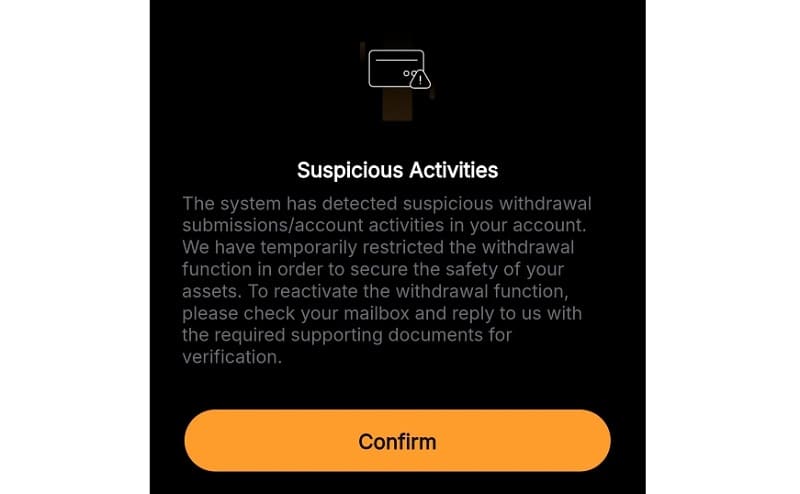
Why Exchanges Restrict Access to Assets
Before assuming wrongdoing, it is important to understand the regulatory environment facing major trading platforms.
Over the last several years, authorities worldwide have increased pressure on crypto businesses to strengthen anti-money laundering controls, sanctions screening, and transaction monitoring.
As a result, exchanges now routinely investigate activity that may appear unusual.
Potential triggers include:
- large incoming transfers;
- connections to flagged blockchain addresses;
- high-risk jurisdictions;
- suspicious transaction patterns;
- unusual account behavior;
- discrepancies in verification records.
Many of these checks are performed automatically through blockchain analytics tools and risk-scoring systems.
When a transaction exceeds predefined thresholds, internal teams may conduct additional due diligence before approving further activity.
From the exchange's perspective, delaying a transaction is often considered safer than approving one that later attracts regulatory scrutiny.
What Bybit Officially Says
According to the company's Help Center, identity verification is mandatory for platform services, and different verification levels unlock different transaction limits. Additional checks may also be required depending on regional regulations, product usage, or specific circumstances.
Official documentation further notes that outgoing transactions can be affected by:
- KYC requirements;
- security-related account changes;
- daily or monthly limits;
- verification requests;
- Travel Rule obligations;
- platform security measures.
The company also maintains dedicated procedures for submitting additional verification materials when requested.
On paper, these policies are relatively standard within the industry. The controversy begins when customers believe the process extends beyond what they consider reasonable.
Also Read: What Makes a Crypto Exchange “Trustworthy”? A Beginner’s Checklist
When Security Procedures Become a Customer-Risk Issue
Most traders accept that compliance checks are necessary. The concern emerges when there is little visibility into what happens next.
Across Reddit, Trustpilot, Forex Peace Army, and other public forums, affected users frequently describe similar experiences:
- generic support responses;
- unclear progress updates;
- repeated requests for information;
- expired timelines;
- difficulty obtaining specific answers.
One Trustpilot reviewer claimed that more than 30 days passed after the original investigation period expired. Another user described over 25 days of cooperation without receiving a clear explanation regarding the status of the case.
A Forex Peace Army discussion from 2025 described a situation where a customer reported 21 days without meaningful communication despite repeated follow-ups.
Again, these are user allegations rather than verified findings. Yet the consistency of the complaints is noteworthy. The recurring theme is not necessarily the restriction itself. It is the perceived lack of transparency surrounding the process.

The Rise of Automated Risk Scoring
One factor often overlooked by traders is the growing role of automation.
Modern exchanges increasingly rely on systems that analyze:
- blockchain activity;
- transaction history;
- wallet relationships;
- behavioral patterns;
- geographic exposure.
These systems assign risk scores designed to identify potential compliance concerns before problems emerge.
While such tools improve regulatory compliance, they also create the possibility of false positives. A legitimate transaction may occasionally resemble activity associated with higher-risk behavior. When that happens, a user can become subject to additional scrutiny despite having no intention of violating platform rules.
This trend affects the entire industry, not just one exchange.
A Broader Industry Problem
The reality is that similar complaints appear across many major trading venues.
Binance, OKX, MEXC, KuCoin, and other large platforms have all faced criticism regarding prolonged investigations, source-of-funds requests, or delayed access to balances.
The reason is largely structural.
Regulators increasingly expect exchanges to identify:
- money laundering;
- sanctions evasion;
- fraud proceeds;
- stolen assets;
- suspicious transaction chains.
Failure to do so can expose companies to substantial legal and financial risks. As a result, many platforms now prioritize caution over convenience.
The unintended consequence is that legitimate users sometimes become caught inside systems designed to minimize regulatory exposure.
Also Read: Is OKX Safer Than Binance in 2026?

How Long Should Enhanced Verification Take?
There is no universal answer.
Duration depends on:
- transaction complexity;
- source-of-funds documentation;
- jurisdictional requirements;
- blockchain tracing results;
- internal workload.
Typical Timeframes
| Process | Common Duration |
|---|---|
| Standard KYC | Hours to several days |
| Security verification | 1–7 days |
| Source-of-funds assessment | Several weeks |
| Enhanced due diligence | Multiple weeks |
| Complex investigation | Several months |
The problem is that customer expectations often differ dramatically from operational realities. Many users assume that once documents are submitted, access will quickly return. In practice, some investigations may continue far longer.
Who Actually Controls Your Crypto?
Perhaps the most important lesson from these cases has little to do with Bybit specifically. It concerns custody.
Many traders view exchange balances as if they were personal holdings under their direct control. Technically, that is not entirely accurate.
When assets remain on a centralized platform:
- private keys are controlled by the exchange;
- transfers require platform approval;
- internal policies can affect accessibility;
- compliance procedures can temporarily limit activity.
This explains why the phrase "Not your keys, not your coins" continues to resonate throughout the crypto industry.
Exchange Custody vs Self-Custody
| Factor | Centralized Exchange | Self-Custody |
|---|---|---|
| Private key ownership | Platform | User |
| Transaction approval | Platform controlled | User controlled |
| Regulatory restrictions | Possible | Limited |
| Recovery responsibility | Shared | User |
| Counterparty risk | Higher | Lower |
What Users Should Do If Access Is Restricted
When encountering a prolonged verification process, emotional reactions rarely help.
More productive steps include:
- preserving all correspondence;
- documenting every submission;
- maintaining transaction records;
- preparing source-of-funds evidence;
- responding promptly to requests;
- keeping copies of identification documents used during verification.
Clear documentation often becomes extremely valuable if questions arise later.

Conclusion
The available evidence does not prove that Bybit is uniquely problematic. Official documentation clearly outlines identity verification requirements, transaction limits, and additional security procedures that may apply under certain circumstances.
At the same time, public complaints reveal a recurring concern shared by many users. The issue is not simply that investigations occur. The issue is uncertainty.
When customers cannot determine why restrictions remain active, what stage the process has reached, or when a resolution may arrive, confidence begins to erode regardless of the underlying reason.
Ultimately, the larger lesson extends beyond a single platform. The real debate is not whether one exchange is better than another. It is whether traders fully understand the tradeoff they make when convenience and custody are placed in someone else's hands.
FAQ
Why does Bybit restrict outgoing transactions?
Common reasons include KYC requirements, risk controls, AML obligations, source-of-funds verification, and security-related investigations.
Can completed KYC remove restrictions immediately?
Not always. Additional due diligence may still be required depending on the circumstances.
How long can enhanced verification last?
Simple cases may take days, while complex investigations can extend for weeks or months.
Are these issues unique to Bybit?
No. Similar complaints appear across many major crypto exchanges.
What documents are commonly requested?
Identity documents, proof of address, transaction history, and source-of-funds records.
Can automated systems trigger false positives?
Yes. Risk-scoring systems sometimes flag legitimate activity for further examination.
Is self-custody safer?
It removes counterparty risk but requires users to manage security themselves.
Should large balances remain on exchanges?
Many security experts recommend limiting long-term exposure to custodial platforms whenever possible.
Sources
Get professional help with your case.