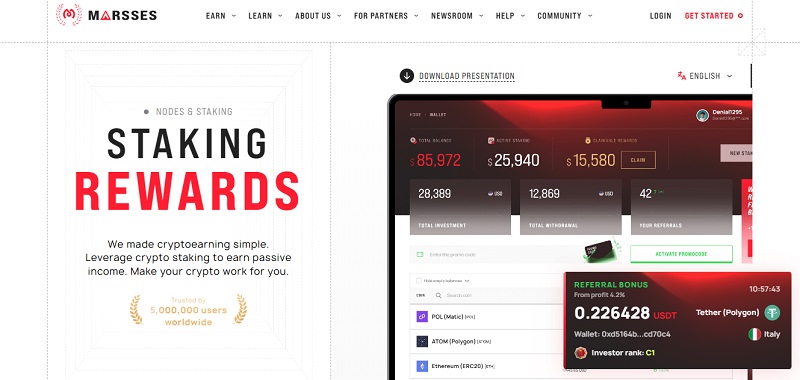
The investment project Marsses markets itself as an ecosystem offering node delegation, liquid staking, token swaps, a crypto card, and a BTC Farm. Operational copy advertises daily yields reaching 0.85% on select pools, alongside cumulative returns up to 271% over fixed terms.
The Marsses HYIP highlights a substantial operational footprint, citing over 11,000 validator nodes and 5.5 million users. However, corporate registry data confirms that its operating firm was incorporated in September 2025. This gap between the claimed scale and the recent legal setup requires careful evaluation.
Corporate Parameters:
Official Website: marsses.com
Legal Entity: MARSSES NODEES LIMITED
Company Number: 16687080
Incorporation Date: September 1, 2025
Registered Address: 83 Victoria Street, London, England
Standard Industrial Classification (SIC): 70221 — Financial management
Executive Leadership: Ethan Walker (CEO, Sole Director)
Licensing Status: Unregulated / No statutory financial authorization verified
While the corporate entity exists, business incorporation is distinct from financial authorization. A standard private limited company registration does not grant regulatory approval to manage retail capital or execute regulated trading strategies.
Marsses Domain Records and Operational Timeline
The supplied DomainTools data shows:
This timeline creates a notable discrepancy: the primary domain predates the incorporation of MARSSES NODEES LIMITED by more than three years. While domain re-registration or asset acquisition is common, domain age alone does not confirm that the current legal entity has operated continuously since 2022. marsses.com metrics — such as 11,455 validator nodes and $243 million in staked capital — remain unverified by independent on-chain audits.
Node Staking Options and Payout Ratios at Marsses
The primary offer centers on node delegation, where client assets are supposedly directed to network validators with automated rebalancing. The Marsses investment company asserts that operations function without smart-contract exposure. However, the advertised yields diverge significantly from standard protocol rewards.
| Staking Tier | Minimum Allocation | Stated Daily Return | Duration | Total Stated Yield | Protocol Fee |
|---|
| AI | $25 | 0.48%–0.54% | ~386 days | Up to 197% | 2% of yield |
| POLIS | $10,000 | 0.52%–0.58% | ~378 days | Up to 208% | 3% of yield |
| SPE | $50,000 | 0.56%–0.67% | ~357 days | Up to 220% | 5% of yield |
| ZENO | $100,000 | 0.80%–0.85% | ~303 days | Up to 250% | 5% of yield |
| FIPO | $15,000 | 230% APR | 365 days | 130% (in decks) | 5% of yield |
Native Proof-of-Stake yields depend on network issuance and validator performance, rarely exceeding single-digit or low double-digit annual percentages. Promising fixed daily payouts near 0.85% indicates that returns rely on external trading strategies or capital allocation rather than base protocol rewards. Discrepancies also exist between site tables and PDF decks regarding the FIPO tier's net yields.
Liquid Staking Infrastructure of Marsses
The Marsses investment project provides liquid allocation pools across several major crypto assets with fixed delegation periods:
ETH: Entry from 32 ETH; daily payout of 0.83%–0.88% over roughly 300 days, with a 4% fee.
BNB: 175 BNB minimum, offering 0.82%–0.89% per day for about 295 days; fee: 3%.
POL: Allocation stated at 212,000 POL (370,000 on site), with 0.84%–0.87% daily for approximately 316 days and a 5% fee.
SOL: Requires at least 590 SOL; the stated daily rate is 0.81%–0.86%, with a duration of around 305 days and a 5% fee.
Liquid contracts require locked terms, preventing early capital retrieval before the delegation cycle ends.
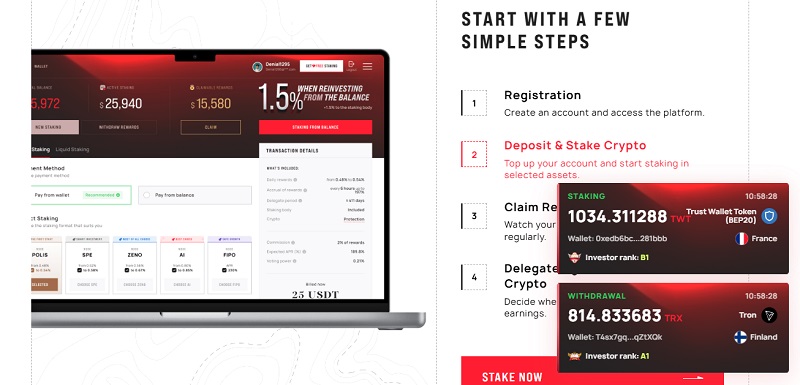
Personal Account, Funding and Withdrawing Money from Marsses
Managing allocations and balance tracking occurs through the Marsses personal account.
Published Payout Parameters:
Minimum Allocation: $25
Minimum Withdrawal: $5 for most assets
Node Allocation Withdrawals: Described as flexible
Liquid Staking Payouts: Locked for the contract duration
While the portal claims users retain full custody without smart-contract risk, transferring funds into platform-controlled wallets shifts control to the venue's internal management systems.
Marsses Auxiliary Products: Crypto Card and BTC Farm
The Marsses investment company advertises additional retail services:
Marsses Crypto Card: Offers fiat/crypto spending with reported limits up to €10,000 monthly for cash withdrawals and €120,000 for account refills. Card cashback is promoted at 2% to 5%.
BTC Farm: Asserts daily rewards up to 0.003 BTC without hardware operation.
Offering card issuance and fiat gateway limits increases the need for formal regulatory supervision, which is currently unverified.
Customer Support and Marsses Corporate Address
Official communication relies on web inquiry forms and internal portal tickets:
No verified corporate telephone lines are published on the official website marsses.com.
Public Sentiment and External Marsses Reviews
The project profile on Trustpilot shows a small set of user entries (13 reviews), with mixed ratings (77% five-star, 15% one-star).
A critical notice on Trustpilot indicates that platform moderators previously removed fake reviews linked to the page. While positive Marsses reviews describe functional reward accruals, critical reviews cite payout delays. The removal of artificial entries reduces the reliability of early positive ratings, making external comments an inconclusive gauge of long-term solvency.
Risk Assessment and Final Verdict on Marsses
| Evaluation Criterion | Assessment |
|---|
| Corporate Status | Registered UK entity (MARSSES NODEES LIMITED, No. 16687080) |
| Regulatory Oversight | None verified; lacks FCA financial authorization |
| Yield Realism | Highly aggressive (up to 0.85% daily) compared to native staking |
| Platform Transparency | Moderate corporate disclosures, but unverified operational data |
| Domain & Legal Timeline | Domain created in 2022; UK firm incorporated in September 2025 |
| External Feedback | Limited sample; fake reviews removed by Trustpilot |
| Overall Risk Rating | High |
Final Assessment:
The Marsses investment project presents a High Risk profile. Although the presence of a registered UK legal entity offers more corporate identity than completely anonymous platforms, the absence of financial licensing and the use of aggressive yield metrics warrant caution.
User Suitability:
Unsuitable For: Conservative investors, retail users seeking regulated asset management, or participants relying on predictable yields.
Potentially Suitable For: Speculative participants who understand smart-contract and counterparty risks, and are prepared for potential capital loss.
Recommendation: Verify all legal documents and test small transactions before allocating capital into a client area. Exercise caution when withdrawing money from Marsses.


