


Withdrawals get delayed as soon as you ask for your profit back
2
Charles Bickerton
The decentralized platform Altura operates as an automated yield engine built on HyperEVM. Capital committed in USDT enters a unified vault, which automatically distributes funds across several market-neutral strategies. According to technical documentation, these mechanisms comprise:
market making;
funding-rate arbitrage;
basis trading;
real-world asset (RWA) allocations.
The system focuses on passive returns through smart-contract execution rather than manual asset trading.
Unlike typical high-yield programs promising fixed daily rates, the Altura Trade ecosystem does not guarantee daily ROI. Instead, users hold vault shares whose valuation fluctuates with the protocol's Price Per Share (PPS).
Nevertheless, potential investors should exercise caution: public details concerning corporate ownership, jurisdiction, and regulatory licensing remain sparse.
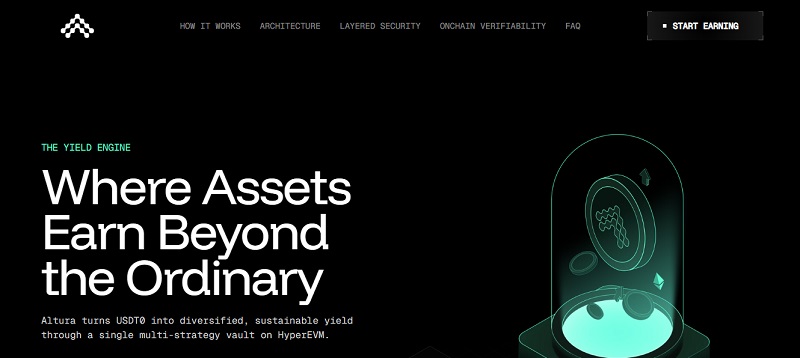
Architecturally, Altura platform functions natively on HyperEVM while incorporating LayerZero for cross-chain capital transfers. The documentation specifies that all accounting, strategy execution, and PPS tracking happen directly on-chain.
Core operational features include:
exclusive support for USDT;
automated strategy distribution;
share-based accounting;
standard and instant asset redemptions.
However, during this evaluation, no corporate entity, certificate of incorporation, business registration number, or official address was identified across the website altura.trade or documentation. Furthermore, no regulatory authorization or financial license was cited.
The Altura Trade platform also omits corporate email addresses, phone lines, or verifiable management profiles. Direct communication takes place primarily via protocol interfaces and community channels rather than formal customer support.
Analytical observation:
While the service explains its technical architecture in considerable detail, legal disclosure remains minimal. Identifying who holds legal control over deposited assets is just as critical for risk assessment as evaluating automated trading execution.
| Parameter | Information |
|---|---|
| Project Name | Altura |
| Website | altura.trade |
| Platform Type | DeFi yield protocol |
| Blockchain | HyperEVM |
| Supported Deposit Asset | USDT |
| Legal Entity | Not publicly disclosed |
| Registered Address | Not listed |
| Company Registration | Not availabe |
| Financial License | Not disclosed |
| Public Contact Information | Not clearly published |
| Domain Registration | 1 November 2025 |
| WHOIS | Domains By Proxy, LLC |
Source: DomainTools
Rather than selling structured plans with fixed payouts, the Altura protocol employs a pooled vault framework.
Upon depositing USDT:
participants receive vault shares;
liquidity distributes automatically across active strategies;
returns accumulate on-chain;
share value (PPS) increases over time;
holdings are redeemed upon exit.
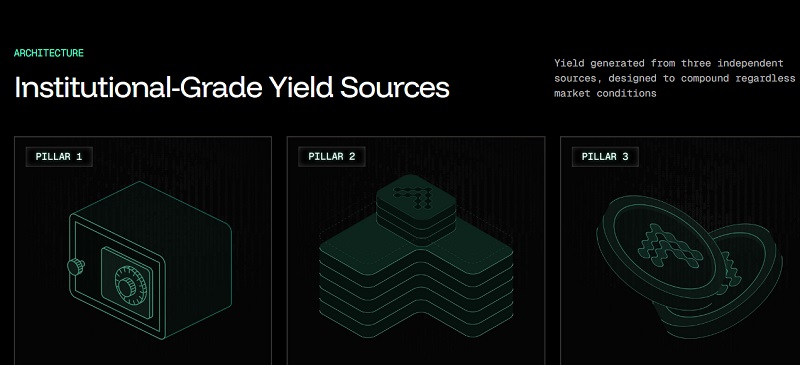
According to protocol specifications, yield comes from three core activities:
Market Making & Liquidity Provision;
Funding Rate and Basis Arbitrage;
Real-World Asset (RWA) allocations.
These approaches are engineered as non-directional, meaning performance depends on capturing market inefficiencies rather than forecasting token prices.
Analytical observation:
Compared with platforms promising fixed rates like "5% daily," Altura Trade protocol models its approach closer to quantitative digital-asset asset management. However, the service currently lacks independently audited performance data or verified track records to validate strategy efficiency.
| Feature | Published Information |
|---|---|
| Deposit Asset | USDT |
| Strategy Type | Multi-strategy yield vault |
| Market Making | Supported |
| Funding/Basis Arbitrage | Supported |
| RWA Allocation | Supported |
| Performance Metric | Price Per Share (PPS) |
| Guaranteed Yield | Not stated |
| Independent Performance Audit | Not identified |
Onboarding involves connecting a Web3 wallet and committing stablecoins.
The Altura personal account functions as a decentralized dashboard rather than a traditional trading interface.
Through the client area, users can:
track share balances;
monitor PPS trajectory;
initiate redemption requests;
review deposited capital;
inspect overall system activity.
Because operations rely on smart contracts, the dashboard acts primarily as a portal for blockchain interactions rather than a centralized database.
At present, funding is limited exclusively to USDT.
Capital redemptions follow two distinct paths:
Standard Withdrawal: processed within 72 hours with no protocol fees.
Instant Payout: executed immediately (subject to available pool liquidity) with a 0.10% fee.
Unlike many high-yield sites, Altura Trade platform explicitly separates free delayed redemptions from fee-based liquidity payouts.
| Feature | Published Information |
|---|---|
| Deposit Asset | USDT |
| Blockchain | HyperEVM |
| Standard Withdrawal | Within 72 hours |
| Standard Payout Fee | None |
| Instant Withdrawal | Available |
| Instant Payout Fee | 0.10% |
While the workflow for withdrawing money from Altura is documented clearly, the stated payout intervals remain self-reported and lack external statistical verification.
No Trustpilot page directly linked to altura.trade was located at the time of analysis. Reviews addressing separate entities named "Altura" (such as apparel brands or software providers) were excluded to maintain accuracy.
Given the scarcity of verified user testimonials, current Altura reviews reflect preliminary technical checks rather than long-term user experience.
The review highlights several positive design aspects:
comprehensive technical documentation;
transparent explanation of capital routing;
clearly defined exit mechanics;
absence of unrealistic daily rate claims.
Conversely, critical verification gaps remain:
undisclosed corporate entity and address;
missing commercial registration details;
lack of regulatory oversight;
no third-party audit of historical returns;
anonymous WHOIS records;
limited operating track record.
| Criteria | Assessment |
|---|---|
| Corporate Transparency | Moderate |
| Technical Documentation | Good |
| Financial Regulation | Not disclosed |
| Performance Verification | Not independently audited |
| Withdrawal Transparency | Good |
| Independent Reputation | Limited |
| Overall Risk Level | Medium-High |
Risk Rating: Medium-High
The Altura Trade protocol outlines a vault-based yield model driven by market making, arbitrage, and RWA exposure. The technical documentation is structured, and exit procedures are explicitly defined.
However, key due-diligence questions persist. No verifiable corporate entity, physical office, or regulatory authorization was found during research. Furthermore, trading performance lacks independent verification.
Potentially suitable for:
experienced Web3 users;
investors familiar with automated yield vaults;
participants comfortable with smart-contract and liquidity risks.
Not recommended for:
conservative investors;
capital seeking regulated fund management;
individuals requiring legal investor protections;
users unwilling to accept code-level risks.
Summary:
While the Altura platform presents a more sophisticated architecture than typical yield platforms, its legal and regulatory transparency remains low. Prospective users should independently audit contract code, governance controls, and on-chain metrics before committing capital.
Almost 98% of investment service providers are scammers. To avoid falling into a fraud scheme, it is essential to carefully choose the platform for investments. When evaluating a company, pay attention to its registration and licensing, as well as its experience and reputation among clients. You can also use specialized services available online.
To avoid making a mistake in your choice, it is better to trust the verification of the investment project to specialists . They will conduct a comprehensive analysis of the intermediary's activities, which will help provide an objective picture of the benefits of the offered services.
Comments about the company are one of the indicators of its performance that should be considered when assessing service quality. However, reviews are not always a reliable source of information. This is because fraudulent projects use paid materials to enhance their reputation in the eyes of potential investors.
If opinions about the company's services are formulaic and lack substance, they are likely written by fake individuals. Another sign of inflated reviews is their excessively emotional tone and regular calls for cooperation. An abundance of reviews on a single portal or forum is also evidence of paid comments.
In this case, it is crucial to cease any forms of interaction with the project. Scammers manipulate clients with demands for additional payments, profiting from them, which leads to even greater financial losses.
When faced with the inability to withdraw funds, it is advisable to seek help from experts . They will assess the situation and suggest the best solution to the problem.
Closure of access to personal accounts and assets is a common occurrence among unscrupulous service providers. This way, fraudsters deprive investors of the ability to manage their accounts and funds. They may also make unfounded accusations, such as suspicions of fraud, violation of internal system rules, illegal earnings, etc.
When encountering such issues, it is better to consult with relevant specialists. They will explain what measures should be taken to unblock the account and help restore access to investments.
The reasons may include technical issues such as unstable server performance, cyberattacks, or hosting problems. The project portal may also be down due to the cessation of its activities or a lack of demand for investment products.
In the case of scammers, the shutdown of the website serves as a reason to deny clients access to their investment portfolios and accounts. In such situations, it is a dvisable to consult experts . They can help determine the true cause of the website's inactivity and find an effective solution.
To recover funds, you should terminate the contract by submitting a corresponding request to the management company. If this cannot be done independently, it means the client has encountered fraud.
To facilitate the return of capital, it is better to use the services of specialists. With the help of chargebacks, they can assist in processing refund payments, returning the funds in full. Only timely initiation of this procedure and adherence to established requirements will yield positive results.