The digital exchange Xevtra presents itself as a cryptocurrency execution venue providing a browser-accessible environment along with asset tracking tools. The official website xevtra.com promotes an interface designed to let market participants track crypto markets and manage active positions via a customizable interface.
DomainTools metadata:
Domain Creation Date: May 8, 2026
Domain Last Updated: July 30, 2026
Server Infrastructure: Cloudflare Inc. (San Jose, California, USA)
WHOIS Ownership: Redacted for privacy reasons
The recent creation date of the domain highlights that this digital venue has only recently launched into the public sphere.

Supported Markets on Xevtra
Publicly available resources indicate that the Xevtra exchange concentrates primarily on digital asset transactions.
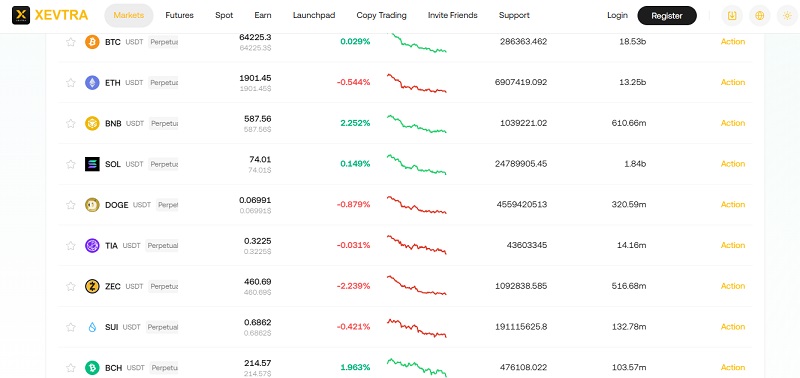
The web portal advertises access to:
real-time cryptocurrency market feeds;
historical price data archives;
trend charting and monitoring tools;
a dedicated digital asset execution interface.
Services Offered by Xevtra
According to public promotional materials, the Xevtra exchange highlights the following capabilities:
web-based cryptocurrency execution;
customizable workspace layouts;
digital asset market analysis;
interactive price history charts;
real-time asset tracking.
The Google Play storefront listing for the XEVTRA application further notes that users can:
monitor live cryptocurrency market shifts;
review past market trends;
evaluate digital token movements directly within the mobile app.
Operational Perspective:
Most public descriptions center on front-end user experience and tracking utilities. Independent technical documentation outlining the provider engine, matching system, or liquidity providers has not been disclosed.
Trading Fees of Xevtra
During this evaluation, no public fee schedule could be identified for the Xevtra exchange.
The portal omits public disclosures regarding:
Likewise, documentation clarifying the cost structure of the marketplace remains inaccessible to unregistered visitors.
| Fee Category | Public Availability Status |
|---|
| Spot Trading Fee | Not disclosed |
| Deposit Fee | Not disclosed |
| Withdrawal Fee | Not disclosed |
| Margin Fee | Not disclosed |
| Official Fee Schedule | Not identified |
Analytical Observation:
The absence of a transparent pricing matrix hinders prospective clients from comparing trading costs on the Xevtra exchange against established crypto venues prior to registration.
Registration on Website xevtra.com
Accessing the live interface requires visitors to complete a user registration workflow to create a Xevtra personal account.
Once registered, a client area unlocks access to:
an execution dashboard;
real-time market monitoring tools;
price movement analytics;
balance and portfolio management features.
However, no public documentation clarifies key operational protocols such as:
mandatory identity verification (KYC) steps;
account security architecture (e.g., 2FA enforcement);
withdrawal authorization controls;
Proof-of-Reserves (PoR) verification.
Security Interpretation:
Limited operational disclosure prior to registration makes it difficult to evaluate the account-level security standards implemented by the Xevtra exchange.
Deposits and Withdrawing Money from Xevtra
Public documentation regarding funding channels remains sparse. This evaluation found no detailed guidelines detailing:
supported fiat or crypto deposit channels;
minimum funding thresholds;
withdrawal caps or limits;
transaction settlement timeframes;
compliance verification procedures.
Consequently, withdrawing money from Xevtra cannot be independently audited using public resources because operational mechanics are omitted from the main website.
Operational Impact:
Restricted transparency regarding deposits and payouts makes it challenging for traders to evaluate transaction timelines before establishing a user profile on the provider.
Company Registration and Regulatory Status of Xevtra
No verifiable evidence was located confirming official corporate disclosures for the Xevtra exchange, such as:
a certificate of incorporation;
a state business registration number;
a physical registered office address;
an identifiable operating legal entity.
Similarly, this assessment found no evidence of authorization or licensing from major global regulators, including:
FCA (Financial Conduct Authority, UK)
ASIC (Australian Securities and Investments Commission)
CySEC (Cyprus Securities and Exchange Commission)
BaFin (Federal Financial Supervisory Authority, Germany)
Analytical Conclusion:
Although the Xevtra exchange presents itself as a digital asset venue, publicly accessible data regarding legal ownership and oversight remains undisclosed. Consequently, the legal status of the project cannot be verified at this time.
Customer Support of Xevtra
Before registration, the Xevtra exchange maintains a minimal support infrastructure.
The sole publicly identifiable contact channel during this review was:
The web portal omits standard communication options, such as:
dedicated support emails;
telephone helplines;
a public ticketing desk;
a corporate contacts page;
registered office details.
Operational Interpretation:
Compared with established crypto venues that offer multi-channel helpdesk coverage, the Xevtra exchange provides relatively restricted support channels for pre-registration inquiries.
Xevtra Reviews and Independent Reputation
No Trustpilot profile associated with xevtra.com was identified during this analysis. Feedback belonging to unrelated businesses or similar brand names has been excluded to avoid misattribution.
Market Observation:
The combination of a newly created domain and the absence of established user reviews of Xevtra makes it difficult to gauge the long-term reliability of this marketplace.
The Xevtra exchange is currently absent from the BrokerChooser database.
Several factors explain this status:
the venue entered the market only recently;
it falls outside BrokerChooser's current editorial scope;
public data regarding legal structure and regulatory status is insufficient for a review.
Therefore, its absence from BrokerChooser represents an omission of coverage rather than a negative operational rating.
Risk Assessment and Expert Conclusion on Xevtra Exchange
| Criterion | Analytical Findings |
|---|
| Domain Registration | Created May 2026 |
| Company Registration | Not verified |
| Registered Address | Undisclosed |
| Regulatory Supervision | Unlicensed / Unverified |
| Fee Transparency | Low |
| Corporate Transparency | Very Low |
| Public Support Channels | Live Chat only |
| Trustpilot Profile | Not identified for xevtra.com |
| BrokerChooser Coverage | Not listed |
| Overall Risk Profile | High |
Final Evaluation of Xevtra
The Xevtra exchange discloses limited verifiable corporate and operational data on its public portal.
Summary of Key Findings:
Operational domain registered in May 2026.
Absence of an official incorporation certificate or legal business details.
No published corporate address or operational headquarters.
Lack of verifiable licensing from recognized financial authorities.
Trading fees, funding conditions, and payout rules are unlisted prior to registration.
Customer assistance before registration is limited to live web chat.
No verified Trustpilot or BrokerChooser profiles associated with xevtra.com.
These findings do not constitute definitive evidence of wrongdoing. However, the combination of a short digital history, hidden corporate ownership, and unverified regulatory status reduces overall transparency.
Financial research confirms that recently established digital asset platforms lacking public corporate documentation warrant thorough independent due diligence before participants transfer funds or connect personal wallets to the Xevtra exchange.


