The global online broker TrustedOptimum demonstrates a high-risk profile based on structural inconsistencies, lack of verifiable regulation, and a non-standard trading model. The company is not listed on BrokerChooser, which may indicate either a newly launched entity, failure to meet industry standards, or potential scam characteristics. Combined with unrealistic return claims, this significantly weakens its credibility.
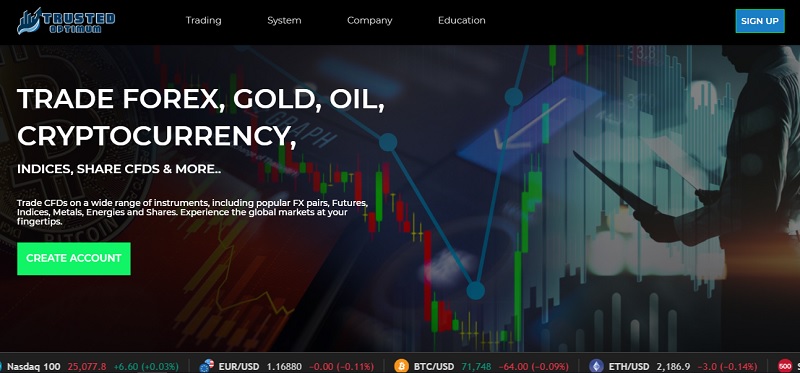
TrustedOptimum Overview
Trusted Optimum broker presents itself as a multi-asset platform offering access to cryptocurrencies, Forex, shares, indices, and ETFs. However, the platform provides no verifiable trading infrastructure details, such as liquidity providers, execution model, or contract specifications.
The official website trustedoptimum.com positions the company as a reputable brokerage, claiming broad market access and ease of profit generation.
This creates a gap between marketing claims and verifiable data, which is a key concern when evaluating any broker.
Is TrustedOptimum Broker Safe to Use?
From a risk analysis perspective, TrustedOptimum broker raises several structural concerns:
Absence from BrokerChooser listings
No verifiable license data on the website trustedoptimum.com
Use of fixed return models instead of market-based trading
When a broker is not listed on BrokerChooser, it typically means:
The company is new and untested
It does not meet transparency standards
It may fall into a potential risk category not yet fully classified
Regulation and Legal status of TrustedOptimum
Trusted Optimum broker provides conflicting and partially disclosed information about its legal structure.
According to available claims, the company states that:
TrustedOptimum is registered in Seychelles under the Financial Services Authority (FSA)
The broker is also presented as a tradename of another entity with registration number HE 19818009, described as a Cyprus Investment Firm (CIF) regulated under CySEC and MiFID II
However, these claims raise multiple concerns.
To evaluate the regulatory transparency of TrustedOptimum broker:
| Regulatory Element | Status |
|---|
| Cyprus Entity (CIF) | Claimed (HE 19818009) |
| CySEC License Proof | Not provided |
| Seychelles Registration (FSA) | Claimed (709718501) |
| Official Verification | Not available |
| Legal Transparency | Inconsistent |
The key issue is not the presence of claims, but the lack of verifiable evidence.
No license numbers are displayed on the official website trustedoptimum.com
No links to CySEC or FSA registries
No confirmation that the Cyprus entity is actually connected to TrustedOptimum broker
The trading provider claims Tier-1 regulation (CySEC), but provides zero verifiable proof.
Trading Conditions at Trusted Optimum
TrustedOptimum broker does not disclose core trading parameters expected from a CFD intermediary.
Instead of standard conditions, the platform lacks:
spreads
commissions
leverage details
execution model
The absence of these parameters indicates that Trusted Optimum broker does not follow a traditional brokerage model. This can be summarized as follows:
| Feature | Status |
|---|
| Account Types | Non-standard (investment plans) |
| Spreads | Not disclosed |
| Commissions | Not disclosed |
| Leverage | Not specified |
| Execution Model | Not specified |
Account Types at TrustedOptimum
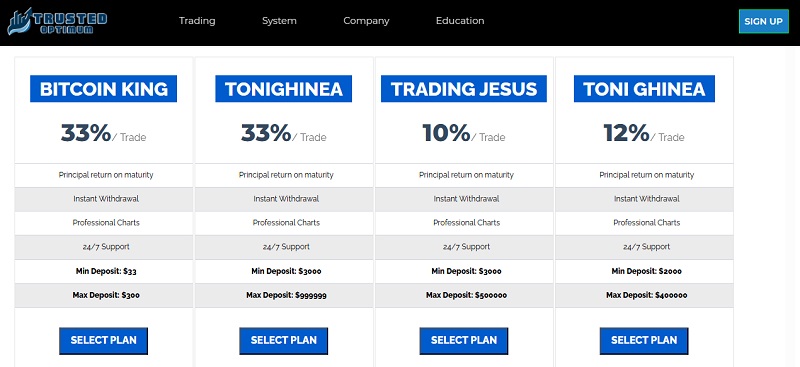
TrustedOptimum broker replaces standard accounts with predefined investment plans offering fixed returns:
| Plan | Min Deposit | Max Deposit | Return per Trade |
|---|
| Bitcoin King | $33 | $300 | 33% |
| ToniGhinea | $3000 | $999999 | 33% |
| Trading Jesus | $3000 | $500000 | 10% |
| Toni Ghinea | $2000 | $400000 | 12% |
| Dmc | $6000 | $300000 | 12% |
Fixed returns of 10–33% per trade are not aligned with real market behavior, where outcomes are variable and risk-dependent.
This structure resembles high-yield investment schemes rather than brokerage accounts.
Opening a personal account with TrustedOptimum involves significant uncertainty due to a lack of regulatory clarity, transparent trading conditions, and investor protection mechanisms.
A second major concern is the inability to verify:
Fees and Transparency at TrustedOptimum
Trusted Optimum broker provides no detailed fee structure.
Missing elements include:
spread ranges
commission per lot
overnight swaps
inactivity fees
In regulated environments, fee transparency is mandatory. Its absence significantly increases operational risk.
Domain History and Server Location of TrustedOptimum
Technical infrastructure analysis provides additional insight. A newly registered domain combined with hidden ownership is a common pattern among short-term or high-risk financial platforms. This combination limits transparency and makes it difficult to identify or verify the entity behind the service. As a result, users face increased uncertainty when assessing the platform’s legitimacy.
| Parameter | Details |
|---|
| Domain Registration Date | September 19, 2025 |
| Last Update | September 19, 2025 |
| Server Location | Arizona, USA |
| Ownership Transparency | Hidden |
Source: DomainTools
Deposits and Withdrawing Money from TrustedOptimum
The broker does not clearly disclose:
The platform claims “instant withdrawals of funds from TrustedOptimum,” but provides no supporting documentation or independent verification. In many high-risk cases, such claims are used as marketing triggers rather than operational guarantees.
Platform and Tools at Trusted Optimum
TrustedOptimum broker advertises:
However, critical details are missing:
no platform specifications
no latency or execution data
no API or infrastructure transparency
This makes it impossible to evaluate real trading performance.
TrustedOptimum Broker Reviews
Available TrustedOptimum reviews are extremely limited and are mostly found on aggregator sites. Some sources directly link the project to fraudulent schemes.
This pattern is typical for:
Final Verdict on TrustedOptimum
The broker demonstrates multiple high-risk indicators:
| Criteria | Assessment |
|---|
| Regulation | Not verified |
| Transparency | Low |
| Domain Age | Very recent (2025) |
| Trading Model | Non-standard (fixed returns) |
| User Feedback | Limited / negative signals |
| Overall Risk | High |
TrustedOptimum broker is not recommended for trading or investment.
The combination of unverifiable regulatory claims, unrealistic fixed returns, lack of transparency and recent domain registration places the brokerage in a high-risk category commonly associated with potential scam platforms.


