The global broker TradeStation is one of the oldest technology-oriented brokerage platforms in the United States, focused primarily on active traders, futures participants, and professional stock market users. Unlike many modern retail CFD brands, the company developed from trading software infrastructure into a fully regulated brokerage ecosystem with direct access to U.S. financial markets.
Collected company information
Official websites:
Foundation timeline:
Trade Station roots trace back to 1982 through Omega Research
The platform launched in 1991
TradeStation broker structure expanded significantly in the early 2000s
DomainTools data:
Domain created: January 16, 1997
Updated: March 9, 2026
Registrant organization: TradeStation Technologies, Inc.
IP location: Portland, Oregon, United States
Main regulated entity:
Regulatory memberships and registrations:
SEC registered broker-dealer
CFTC registered futures commission merchant
FINRA / NFA / SIPC member
Exchange memberships include:
NYSE
Nasdaq
CME Group
CBOT
COMEX
NYMEX
ICE Futures U.S.
Cboe exchanges
Investor protection:
SIPC protection up to $500,000
Including $250,000 cash protection
Contact methods:
Online chat
Email support
Phone: 800 822 0512
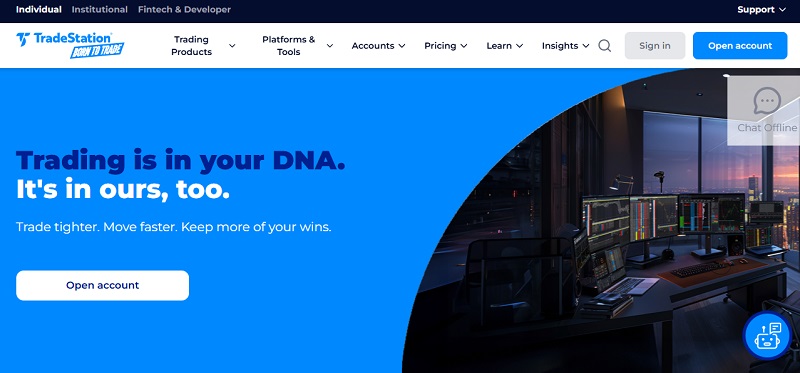
TradeStation Regulatory Structure and Corporate Background
The TradeStation broker operates under one of the strongest regulatory environments available to retail traders in the United States.
Unlike offshore CFD platforms, the company is supervised by:
This places the broker in a substantially different category compared to lightly regulated forex-only brokers.
An important detail is that TradeStation Securities maintains relationships with major U.S. exchanges and clearing institutions, while additional transaction clearing support is performed through Wedbush Securities for specific markets.
TradeStation Group also became part of Japan-based Monex Group after its acquisition in 2011, adding another layer of institutional ownership and corporate transparency.
| Criteria | Assessment |
|---|
| Primary regulation | SEC, FINRA, CFTC, NFA |
| Investor protection | SIPC coverage up to $500,000 |
| Corporate ownership | Owned by Monex Group |
| Transparency level | High |
| Overall legal reliability | Strong |
TradeStation Markets and Supported Instruments
The TradeStation broker primarily focuses on:
One major distinction is that the trading provider does not specialize in retail forex trading like many MetaTrader-focused brokerages. Forex access is limited compared to multi-asset CFD competitors.
The TradeStation broker is more oriented toward:
The company supports:
Platforms and Trading Technology at TradeStation
The TradeStation broker is especially known for its proprietary trading infrastructure.
Main platform ecosystem:
The desktop platform is considered the flagship environment for professional traders.
Key platform capabilities:
advanced charting,
automated strategy testing,
EasyLanguage scripting,
market scanning,
backtesting,
algorithmic trading support,
custom indicators,
and professional-level analytics.
The TradeStation personal account integrates:
portfolio management,
funding operations,
market data,
research,
and strategy deployment.
Unlike simplified beginner-focused apps, the brokerage infrastructure is built for users who actively analyze markets and execute higher-frequency trading strategies.
TradeStation Account Types and Pricing Structure
The TradeStation broker offers several account structures depending on trading style and region.
Main account categories include:
Publicly available conditions indicate:
commission-free U.S. stocks and ETFs under certain limits,
options commissions depending on volume,
futures commissions,
and separate crypto fee models.
The TradeStation personal account is particularly designed for experienced users rather than casual investors seeking simplified mobile investing only.
| Feature | Available Information |
|---|
| Stock & ETF commissions | Commission-free under selected conditions |
| Minimum deposit | Varies by account type |
| Platform access | Desktop, web, mobile, crypto |
| Algorithmic trading | Supported via EasyLanguage |
| Demo account | Available |
Deposits and Withdrawing Money from TradeStation
Funding methods supported by the TradeStation broker include:
BrokerChooser highlights that:
ACH withdrawals are free,
deposits generally have no fees,
but international wire withdrawals may become expensive.
Processing times:
Important limitations:
no widespread card funding infrastructure,
no simplified instant wallet ecosystem,
and less flexibility compared to fintech-oriented brokers.
This is one of the most common criticisms in external user feedback.
When evaluating withdrawing money from TradeStation, users should understand that the brokerage follows traditional U.S. financial compliance procedures rather than instant crypto-style transfers.
The phone number 800 822 0512 is also referenced in broker support materials for funding and account assistance.
TradeStation Reviews and Market Reputation
Most TradeStation reviews describe the broker as:
Frequently praised aspects include:
BrokerChooser specifically highlights:
At the same time, common criticisms include:
complicated fee structure for beginners,
weaker customer support responsiveness,
inconvenient withdrawal system,
and a learning curve that may overwhelm inexperienced traders.
Unlike many modern beginner-focused brokers, the TradeStation broker is clearly optimized for active traders rather than passive investors.
TradeStation Broker Infrastructure and Operational History
The TradeStation broker has one of the longest operational histories among online trading technology firms.
Important infrastructure observations:
domain history since 1997,
roots tracing back to 1982,
long-term SEC registration,
institutional exchange memberships,
and established market presence.
The company survived multiple market cycles, including:
Compared to newly launched brokerage startups, the TradeStation broker demonstrates significantly higher operational maturity.
| Criteria | Assessment |
|---|
| Platform sophistication | Very high |
| Investor protection | Strong SIPC-backed structure |
| Ease of use | Moderate to difficult for beginners |
| Withdrawal convenience | Average |
| Overall project risk | Low to medium |
Final Assessment of TradeStation
The TradeStation broker occupies a unique niche in the online brokerage industry as a technology-heavy platform tailored toward active and professional traders.
Key strengths:
strong U.S. regulation,
SEC and FINRA oversight,
SIPC protection,
advanced desktop platform,
professional analytics,
deep futures and options infrastructure,
long operational history.
Potential drawbacks:
complicated interface for beginners,
relatively inconvenient banking system,
limited forex orientation,
and less beginner-friendly onboarding compared to app-based brokers.
BrokerChooser’s final assessment positions the TradeStation broker as particularly suitable for:
Project characterization
Risk level: Low to medium
Suitable for: experienced traders, active market participants, futures and options traders, algorithmic strategy developers
Not suitable for: beginners seeking simplified investing apps or instant fintech-style withdrawals
From an analytical perspective, the TradeStation broker represents a mature, highly regulated, institution-grade trading environment rather than a speculative offshore brokerage model.


