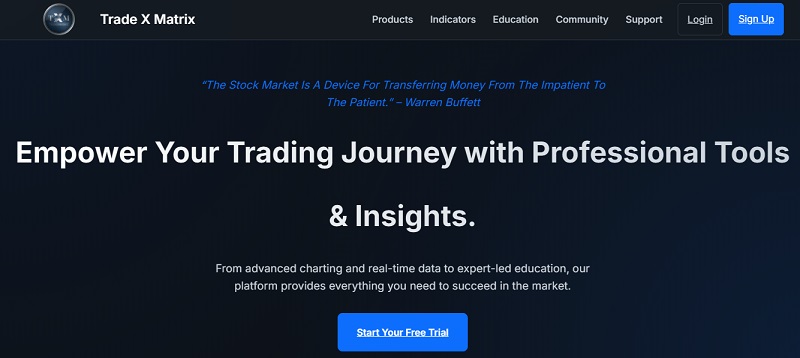
The project Trade X Matrix presents itself as an educational trading ecosystem focused on technical analysis tools, trend indicators, market structure analytics, and private strategy communities. Unlike a traditional regulated brokerage, the platform currently operates more as a closed-access trading service and analytical environment with partially hidden operational conditions.
Official website: tradexmatrix.com
Publicly disclosed company data:
No registration number
No legal entity disclosed
No licensing information
No physical address
No regulatory references
No published company ownership structure
No launch date officially confirmed
Support infrastructure:
Registration required for most interactions
No public phone number
No public live support information
No clearly disclosed operational jurisdiction
The TradeXMatrix project heavily restricts access to operational details before registration. No publicly available evidence was identified regarding:
trading conditions,
pricing,
account structure,
payment rules,
risk disclosures,
withdrawal procedures.
This lack of transparency significantly complicates independent due diligence.
Trade X Matrix Legal Transparency and Regulatory Status
The Trade X Matrix project currently provides almost no verifiable legal disclosures.
The platform does not publicly publish:
brokerage licenses,
financial registrations,
incorporation certificates,
investor protection details,
AML policies,
or regulator references.
From a compliance perspective, this is a major limitation because users cannot independently verify:
who operates the platform,
which jurisdiction governs disputes,
or whether client protection mechanisms exist.
The official website tradexmatrix.com also avoids publicly describing:
The project is additionally absent from BrokerChooser and other major regulated-broker databases. Analytically, this may suggest:
the project is extremely new,
its structure does not fit regulated brokerage standards,
or the operation remains outside recognized financial oversight frameworks.
TradeXMatrix Educational Trading Tools and Market Analytics
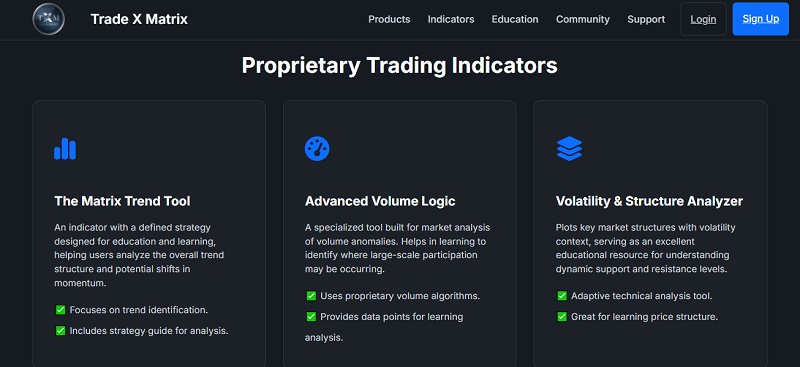
The TradeXMatrix platform promotes several proprietary analytical products aimed at traders interested in technical analysis and market structure interpretation.
Publicly promoted tools include:
According to the project’s own descriptions, these systems focus on:
The Trade X Matrix project repeatedly positions these tools as:
However, important operational information remains undisclosed:
whether signals are automated,
how strategies are tested,
win-rate statistics,
or historical audited performance.
The TradeXMatrix platform also references “proprietary volume algorithms,” but does not provide technical methodology documentation.
| Feature | Available Information |
|---|
| Trend analysis tools | Available |
| Volume anomaly analysis | Claimed proprietary algorithms |
| Trading signals transparency | Limited |
| Performance reporting | Not publicly verified |
| Educational positioning | Strongly emphasized |
Investment Services and Managed Participation Model of Trade X Matrix
One of the more notable sections of the Trade X Matrix platform is its “Discreet Account Management” offering.
The project states that users may:
invest between $500 and $5,000,
receive monthly status reports,
and participate without trading independently.
However, the TradeXMatrix project does not explain:
who manages funds,
whether trading is discretionary,
how risk is handled,
whether losses are possible,
or how profits are distributed.
No publicly available information exists regarding:
This is especially important because account management services typically require:
The Trade X Matrix project also promotes strategy collaboration, idea sharing, and private community participation, but access appears restricted behind registration walls.
Trade X Matrix Platform Access and User Environment
The TradeXMatrix ecosystem currently functions as a partially closed-access environment.
Most operational sections require:
Publicly unavailable information includes:
The Trade X Matrix project also does not clearly explain whether users trade through:
This significantly reduces transparency compared to established brokerage or exchange platforms.
Deposits and Withdrawals of Funds from Trade X Matrix
The website tradexmatrix.com currently provides no detailed public information regarding:
No information is publicly disclosed regarding:
This is one of the largest due diligence gaps surrounding the Trade X Matrix project.
Because operational financial mechanics remain hidden until registration, independent evaluation of capital accessibility, withdrawal reliability, and fund custody is currently impossible.
Trade X Matrix Domain Infrastructure and Website Lifecycle
DomainTools information for the Trade X Matrix project:
Domain created: September 6, 2025
Expiration: September 6, 2026
Infrastructure location: United States, California, San Francisco
Hosting provider: GitHub Inc.
Ownership masking: Withheld for Privacy ehf
The very recent domain registration is an important analytical factor.
Compared to established financial platforms with long operational histories, regulatory track records, and public corporate disclosures, the TradeXMatrix project currently demonstrates an extremely short public lifecycle.
The platform infrastructure additionally appears lightweight and startup-oriented, using GitHub-hosted web deployment architecture rather than enterprise-grade institutional infrastructure.
| Domain Factor | Observation |
|---|
| Domain age | Very recent (2025) |
| Corporate disclosure | Extremely limited |
| Regulatory visibility | None publicly verified |
| Operational transparency | Low |
| Infrastructure maturity | Early-stage / unverified |
TradeXMatrix Reputation and External Trust Signals
At the moment, independent Trade X Matrix reviews remain extremely limited.
This is likely connected to:
the project’s recent launch,
limited public visibility,
and partially closed ecosystem structure.
No verified institutional reviews currently confirm:
The lack of public leadership disclosures additionally increases uncertainty surrounding:
accountability,
operational governance,
and dispute resolution.
Final Assessment of Trade X Matrix
The TradeXMatrix project appears to combine:
educational trading tools,
market analysis systems,
community-based strategy discussions,
and semi-private investment participation services.
However, the platform currently operates with extremely limited transparency regarding:
Key observations:
no published licenses,
no disclosed company ownership,
no verifiable registration records,
hidden operational conditions,
very recent domain registration,
and gated access to most critical details.
Project characterization
Risk level: Very High
Suitable for: experienced speculative users comfortable evaluating unregulated analytical ecosystems independently
Not suitable for: conservative investors, beginners, or users requiring regulated financial protections and institutional transparency
From a due diligence perspective, the Trade X Matrix project currently resembles an early-stage unregulated trading-analysis ecosystem rather than a fully transparent and institutionally verified financial platform.


