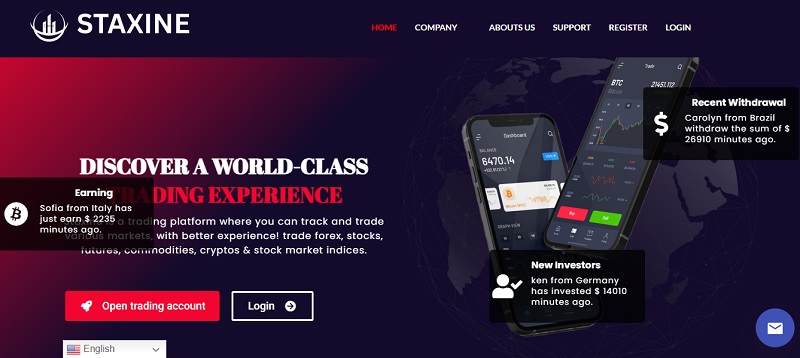
The global broker Staxine presents itself as a multi-asset online trading platform offering forex, crypto, futures, stock indices, and CFD-style trading services through MetaTrader infrastructure.
At first glance, the project attempts to resemble a classic offshore CFD brokerage, but deeper analysis shows that many important transparency elements remain either undisclosed or incomplete.
Collected company information:
Official website: staxine.com
Client portal: acct.staxine.com
Declared trading platforms: MT4 and MT5
Support channels: email, online chat, contact form
Foundation date, headquarters, regulatory status, corporate registration: not disclosed
Unlike regulated intermediaries that usually provide legal entity names, licensing numbers, corporate filings, and investor protection details, the Staxine broker leaves most of these sections empty or unavailable publicly.
The company is also absent from BrokerChooser databases and rankings. From an analytical perspective, this can mean several things:
the project is still relatively new,
it may not meet the transparency standards used by brokerage-review platforms,
it may simply operate outside recognized regulatory ecosystems.
In higher-risk cases, absence from major broker-review databases may also indicate a platform that has not yet undergone serious public due diligence scrutiny.
Staxine Broker Legal Transparency and Regulatory Concerns
One of the most notable issues surrounding the Staxine broker is the absence of verifiable legal disclosures.
The website staxine.com currently does not publicly provide:
The Staxine broker also does not disclose:
This creates a major transparency gap compared to trading providers operating under:
Although the platform promotes “transparent and fair” trading, multilingual support, and professional services, there is currently no independent regulatory evidence confirming supervision by a recognized financial authority.
For traders evaluating operational safety, the lack of licensing data significantly increases counterparty risk.
Markets and Tradable Instruments Offered by Staxine
The Staxine broker promotes access to multiple financial markets through leveraged trading products.
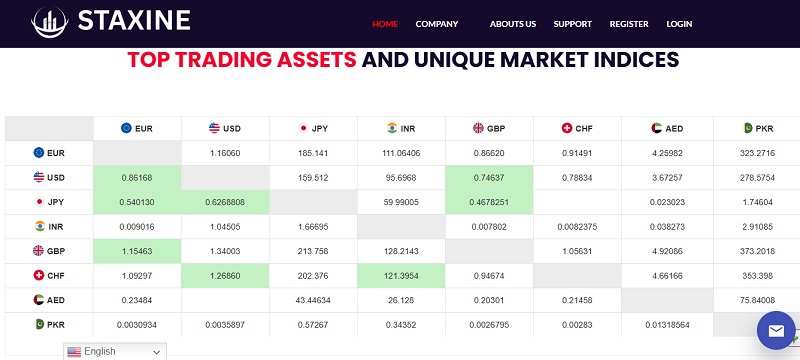
Advertised markets include:
Forex
Stocks
Futures
Commodities
Cryptocurrencies
Stock market indices
However, detailed specifications remain unavailable publicly.
The platform does not clearly disclose:
leverage limits,
spread tables,
swap structures,
liquidity providers,
or execution policies.
This means traders cannot independently verify:
The Staxine broker additionally promotes:
However, operational details remain vague.
| Feature | Available Information |
|---|
| Tradable markets | Forex, crypto, futures, commodities, stocks, indices |
| Trading specifications | Mostly undisclosed |
| Account types | Not publicly explained |
| Leverage and swaps | No detailed public data |
| Copy/social trading | Promoted on website |
Staxine Platforms and Trading Environment
The Staxine broker states that it supports:
MetaTrader 4,
MetaTrader 5.
The company also claims compatibility across:
desktop,
mobile,
and tablet devices.
However, the platform provides very little technical documentation regarding:
The Staxine personal account is used for:
The client area additionally appears to function as a crypto-wallet-style balance system connected to trading operations.
While MT4 and MT5 are legitimate and widely used trading terminals globally, the existence of MetaTrader support alone does not confirm brokerage reliability or regulatory legitimacy.
Deposits and Withdrawals of Money from Staxine
The Staxine broker appears heavily crypto-oriented regarding payments.
According to publicly available platform information:
users deposit cryptocurrency directly into wallet addresses,
and balances are credited after blockchain confirmations.
The Staxine broker states:
KYC verification is mandatory before withdrawals,
crypto withdrawals require a minimum of $2,000,
bank transfer withdrawals require at least $20,000.
Advertised withdrawal speed:
The unusually high minimum thresholds for withdrawing money from Staxine may create operational limitations for smaller traders and beginners.
The platform does not clearly disclose:
This lack of transparency creates uncertainty regarding:
| Payment Feature | Published Information |
|---|
| Deposit method | Cryptocurrency wallet transfers |
| Crypto withdrawal minimum | $2,000 |
| Bank transfer withdrawal minimum | $20,000 |
| KYC requirement | Mandatory before withdrawal |
| Withdrawal processing time | 2–5 hours (claimed by platform) |
Staxine Reviews and Reputation Analysis
Available Staxine reviews remain limited because the platform appears relatively new within the public trading ecosystem.
The website staxine.com itself displays highly positive testimonials referencing:
At the same time:
independent external review coverage remains very small,
large regulator-linked review platforms barely reference the broker,
and there is no significant institutional broker-ranking presence.
This creates a situation where evaluating Staxine reviews objectively becomes difficult due to the lack of long-term public trading history.
The combination of anonymous ownership, undisclosed licensing, and incomplete corporate information usually increases due diligence concerns among experienced traders.
Staxine Broker Domain and Infrastructure Review
DomainTools data for the Staxine broker:
Domain created: October 3, 2025
Last updated: October 3, 2025
IP location: Paris, France
Hosting provider: Hostinger FR
The domain age is extremely recent compared to long-established brokerage firms.
This matters because many short-lifecycle offshore platforms:
operate for limited periods,
aggressively market high-return opportunities,
and disappear before building a verifiable compliance history.
The Staxine broker currently lacks:
long operational infrastructure history,
independently audited public presence,
or institutional recognition.
A newly created domain combined with missing regulatory information materially increases operational uncertainty.
| Criteria | Assessment |
|---|
| Regulation | No verified license disclosed |
| Corporate transparency | Very low |
| Operational history | Very recent domain registration |
| Withdrawal transparency | Limited public clarity |
| Overall risk | High |
Final Assessment of Staxine Broker
The Staxine broker positions itself as a modern crypto-oriented multi-market trading platform using MetaTrader infrastructure and social-trading-style marketing.
Positive observations include:
However, the platform also shows multiple major risk indicators:
no disclosed licenses,
no verified legal entity,
no public headquarters,
incomplete trading specifications,
and extremely recent domain registration.
Additionally:
account conditions remain vague,
withdrawal thresholds are unusually high,
and independent reputation coverage is still minimal.
Project characterization
Risk level: High
Suitable for: speculative traders comfortable with elevated offshore-platform risk
Not suitable for: conservative investors, beginners, or users seeking strong regulatory safeguards and transparent brokerage operations
From a due diligence perspective, the Staxine broker currently resembles a high-risk offshore trading environment with limited independently verifiable operational transparency.


