Short verdict: StakeTradeWay broker presents itself as a global multi-asset trading provider, but the combination of unverified licenses, inconsistent corporate claims, and high-yield investment plans places it firmly in the high-risk category.
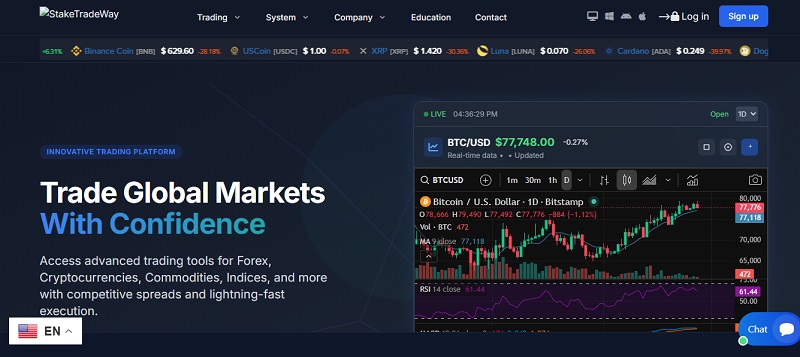
StakeTradeWay Background and Legal Claims
Stake Trade Way broker states the following corporate details:
Head office: 11 Grace Avenue, Ste 108, Great Neck, New York, USA
Phone: 702-706-4466
Claims UK registration: #08683932
Claims Seychelles entity: registration 709718501 (FSA)
Claims Cyprus CIF entity: HE 19818009 (CySEC)
However, there are critical inconsistencies:
No official certificates or registry extracts are provided on the official website staketradeway.com
The same registration numbers are reused across unrelated projects
No verifiable listing in official regulator databases
Additionally, regulators such as the Financial Conduct Authority explicitly warn that firms operating without authorization offer no investor protection or compensation coverage.
Conclusion: StakeTradeWay broker’s legal structure is declared but not substantiated, which is a major red flag.
StakeTradeWay Global Presence Claims vs Verification
Stake Trade Way broker advertises offices in:
North America: New York, San Francisco, Toronto
Europe: London, Frankfurt, Zurich
Asia-Pacific: Singapore, Hong Kong, Tokyo
There is no documentary or operational evidence supporting these locations (no licenses, no local registrations, no regulatory filings).
This pattern is typical of platforms trying to simulate institutional scale without operational substance.
Stake Trade Way Trading Conditions and Markets
StakeTradeWay broker lists access to:
Forex
Cryptocurrencies
Shares
Indices
However:
No contract specifications
No spreads, swaps, or commissions
No execution model (ECN/STP/MM)
No liquidity provider disclosure
This absence of core trading parameters means users cannot assess actual trading costs or risks, which is not consistent with regulated brokerage standards. This lack of transparency is also reflected in how the StakeTradeWay personal account is structured, with no visibility into actual trading mechanics.
StakeTradeWay Account Structure
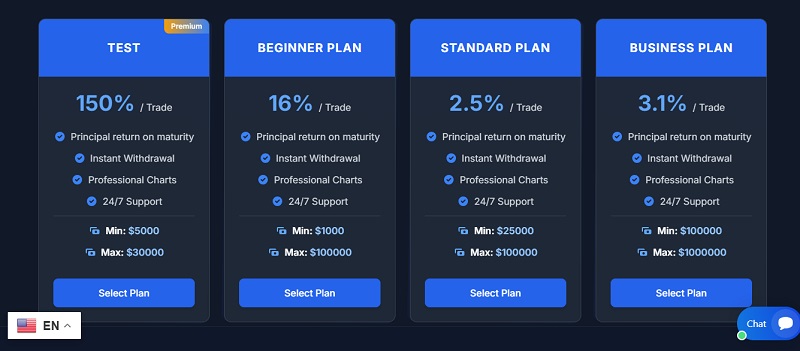
The platform does not offer classic trading accounts. Instead, Stake Trade Way broker promotes fixed-return investment plans, which is structurally different from real brokerage services.
| Plan | Return | Deposit Range | Key Features |
|---|
| Test | 150% per trade | $5,000 – $30,000 | Instant withdrawal, high yield |
| Beginner | 16% per trade | $1,000 – $100,000 | Principal return, 24/7 support |
| Standard | 2.5% per trade | $25,000 – $100,000 | Moderate yield |
| Business | 3.1% per trade | $100,000 – $1,000,000 | High capital tier |
| Basic | 25% per trade | $30,000 – $229,000 | Aggressive ROI model |
Analytical note:
This aligns more with HYIP mechanics than legitimate brokerage.
StakeTradeWay Deposit and Withdrawal Mechanics
Supported payment methods:
Key financial parameters:
Minimum deposit: from $10 equivalent
Maximum deposit: up to $75,000+ equivalent
Minimum withdrawal of money from StakeTradeWay: from $0.1 (depending on currency)
Processing: claimed instant payouts
Risk interpretation:
Instant withdrawals are marketing claims, not guarantees
Crypto-only focus increases irreversibility risk
No banking transparency or custody details
At the same time, users interacting through the Stake Trade Way personal account are not provided with clear transaction tracking or withdrawal verification mechanisms, which further increases financial risk. More information can be requested by phone 702-706-4466.
Stake Trade Way Technical Infrastructure and Domain Data
This indicates:
No long-term operational history
No established reputation cycle
High probability of short lifecycle model
Source: DomainTools
StakeTradeWay Reviews and External Risk Signals
Independent monitoring sources classify StakeTradeWay brokers among unregulated or scam-flagged trading providers.
Additionally, there is no presence on BrokerChooser. A typical interpretations include:
The platform is very new and not yet reviewed
It does not meet transparency or regulatory standards
It operates in a high-risk or suspicious segment
Given the available data, scenarios 2 and 3 are more consistent.
StakeTradeWay Broker Risk Assessment
| Criteria | Assessment |
|---|
| Regulation | Unverified / inconsistent |
| Business model | High-yield investment scheme |
| Transparency | Low |
| Domain age | Very recent |
| Overall risk | Extremely high |
Final Conclusion on StakeTradeWay
StakeTradeWay broker combines multiple high-risk indicators:
Conflicting and unverifiable regulatory claims
Unrealistic fixed ROI structures
Lack of trading transparency
Newly registered domain
No independent verification or credible industry presence
Bottom line: the brokerage does not exhibit the characteristics of a regulated entity. Instead, its structure is consistent with high-risk investment schemes where capital preservation is uncertain.


