The online broker Pepperstone is an established international forex and CFD provider founded in Melbourne in 2010.
The project operates several official web addresses:
pepperstone.com — main corporate and trading website;
secure.pepperstone.com, auth.pepperstone.com — secure client authentication and account access gateways.
The group now operates through several regulated entities, while the Kenyan business operates as Pepperstone Markets Kenya Limited under supervision of the Capital Markets Authority (CMA).
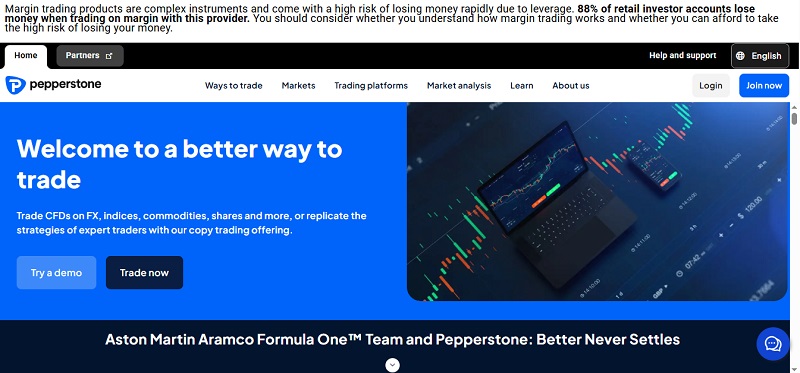
Registration on Website pepperstone.com
Opening a Pepperstone personal account is handled digitally. Onboarding begins with an online application, followed by suitability checks, identity verification and funding. A demo setup is also accessible prior to committing live capital.
The registration sequence involves:
Creating a profile using a primary email address;
Completing required suitability and risk assessments;
Submitting requested identification and verification documents;
Awaiting formal validation;
Depositing initial capital into the chosen workspace;
Commencing trading through the selected software.
A second Pepperstone personal account reference concerns the secure user dashboard itself. Following onboarding, clients manage deposits, withdrawals, settings and sub-accounts through this online portal or via the mobile application.
Pepperstone Markets and Trading Platforms
The Pepperstone broker currently advertises more than 1,350 execution instruments across major global asset classes. Official breakdowns list:
93 FX currency pairs
26 stock market indices
40 hard and soft commodities
1,400+ share CFDs (on selected terminals)
31 cryptocurrency CFDs
95 exchange-traded fund (ETF) CFDs
The available technology extends well beyond basic trading tools. The service supports:
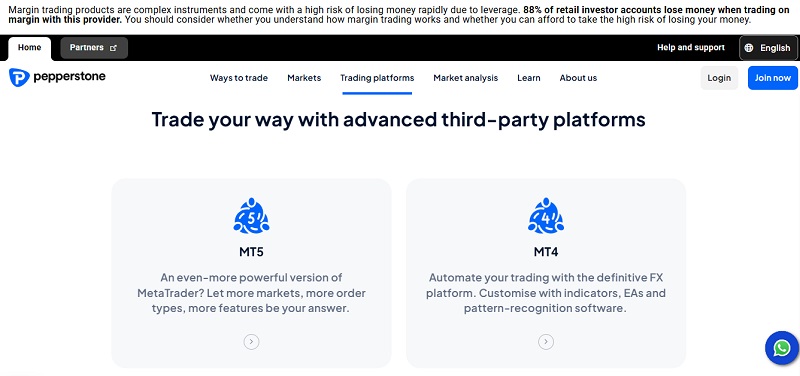
MetaTrader 4 & MetaTrader 5
cTrader & TradingView
Proprietary web software & mobile app
Integrated CopyTrading & cTrader Copy
Custom API connections, algorithmic execution tools, and VPS hosting
TradingView access depends on routing and geographic jurisdiction. Kenyan disclosures confirm this broad software selection, though comparisons note that TradingView integration may not apply to every Standard account profile.
The provider also promotes social investment through its proprietary CopyTrading service alongside cTrader Copy, enabling users to mirror strategies from experienced market participants.
Pepperstone Trading Accounts and Costs
The Pepperstone broker offers two principal CFD account models for the Kenyan market: Standard and Razor. Both configurations grant access to the same market universe, with margin requirements dictated by instrument class and regulatory caps.
| Pricing Parameter | Standard Account | Razor Account |
|---|
| FX Spreads | From raw pricing + 1 pip markup | From 0.0 pips |
| FX Commission | No separate commission on most FX CFDs | From $3.50 per lot per side |
| Spot Gold Spreads | Markup-based pricing | From 0.08 |
| Spot Gold Commission | Included in spread-based pricing | Charged under the raw-spread model |
| Share & ETF CFD Commission | Charged separately | Billed separately |
| Overnight Swap / Financing | Depends on the instrument | Market-based |
| Account Maintenance Fee | None | Not specified separately |
| Inactivity Fee | None | Not separately stated |
For equity and ETF CFDs, current Kenyan fee schedules specify commissions ranging between 0.07% and 0.20% per side depending on underlying exchanges.
No inactivity penalties are assessed, though overnight financing charges (swaps) apply to open leveraged positions held past market roll.
Leverage Available through Pepperstone
Published terms for the Kenyan entity detail maximum retail leverage allocations across asset categories:
Major Currency Pairs: Up to 1:400
Gold & Silver: Up to 1:400
Major Indices: Up to 1:200
Minor & Currency Indices: Up to 1:100
Shares / Equities: Up to 1:20
Commodities (excl. Gold/Silver): Up to 1:50
Energies & Crude Oil: Up to 1:33 to 1:100
High leverage substantially amplifies both potential gains and capital losses. Statutory disclosures note that approximately 86% of retail investor balances experience financial losses when trading margin instruments with this provider.
Deposits and Withdrawing Funds from Pepperstone
The CFD operator provides several funding methods, although the exact selection depends on the client's jurisdiction.
For the Kenyan service, published options include:
Most listed deposit avenues incur no internal processing charges. Minimum transaction thresholds for electronic channels start at $10, while domestic wire transfers carry no minimum obligation.
Payout timelines vary depending on the chosen route and corporate division. Official withdrawal terms state:
Cards & Mobile Wallets (Apple/Google Pay): Processed same day to 1 business day;
Domestic Wire Transfers: 1 to 3 business days;
International Wire Transfers: Potentially longer due to intermediary clearing;
Third-party banking partners or payment processors may assess independent processing costs.
Certain regional operating units charge fees on outbound wire transfers. Specifically, Kenyan disclosures highlight a $25/£15 fee for international wire withdrawals, whereas other global branches maintain different schedules.
Outbound transfers are initiated directly within the portal:
Log into the workspace;
Navigate to the Funds tab;
Select the target sub-account;
Click Withdraw Funds;
Specify the transfer amount and destination details;
Confirm authorization via email verification or 2FA.
Therefore, when evaluating withdrawing money from Pepperstone, traders should check the exact legal entity and routing method involved rather than relying on generalized global fee sheets.
Pepperstone Company History, Registration and Regulation
The Pepperstone broker was founded in Melbourne, Australia, in 2010 by a team of traders seeking to enhance execution speeds, tight pricing, and technical support across the online trading sector.
For Kenyan residents, operational details comprise:
Full Legal Title: Pepperstone Markets Kenya Limited
Company Registration: PVT-PJU7Q8K
Supervisory Body: Capital Markets Authority (CMA) of Kenya
Official Licence: No. 128
Physical Address: The Oval, Ring Road Parklands, Nairobi, Kenya
The CMA's public registry independently verifies the entity under licence 128, explicitly linking the authorization to the official domain.
Rather than relying purely on self-declared compliance claims, regulatory status in Kenya is backed by verifiable state register records.
Pepperstone Global Regulatory Structure
At the group level, disclosures highlight oversight across multiple global jurisdictions:
While current group materials reference regulation across eight authorities, these licences belong to distinct legal entities and are not interchangeable. Applicable investor protections depend strictly on which subsidiary onboarded the user.
Client capital is segregated in Tier-1 banking institutions away from operational company funds.
Pepperstone Domain History and Infrastructure
DomainTools data records:
Creation Date: January 20, 2002
Last Update: May 15, 2026
IP Server Location: Portland, Oregon, USA
Network Host: Amazon Web Services (AWS) / c/o whoisproxy.com
The domain creation predates the company's 2010 founding date, which is typical when acquiring an existing web address.
Key domain characteristics:
Long-standing web footprint;
Infrastructure routed through Amazon cloud services;
Registrant identity secured via privacy proxies;
Domain registration data alone does not indicate which regional entity contracts a user.
Definitive verification rests on official corporate registry entries and financial authority databases rather than WHOIS lookup records.
Pepperstone Contact Channels and Client Support
The Kenyan branch provides multiple communication channels:
Email assistance
Interactive live web chat
Online inquiry form
Direct telephone support (+254 20389 3547/8/9)
Regional office client desk
WhatsApp messaging (where enabled)
Client support operates 24/5 during market hours, supplemented by limited weekend coverage depending on the desk.
Public Pepperstone Reviews
The Pepperstone reviews footprint is extensive, reflecting over a decade of continuous operation in retail finance.
An official Trustpilot profile maintains a 4.2 / 5 TrustScore across more than 3,500 user submissions:
The overall review landscape presents a well-documented operating track record:
High volume of verifiable feedback;
Frequent praise for customer service and terminal integration;
Active discussions on funding channels and execution speeds;
Critical posts primarily cover routine support response times;
The review profile is tied directly to the main domain pepperstone.com.
This offers a significantly larger body of independent user data than is typical for recently launched trading sites.
Pepperstone Assessment by BrokerChooser
BrokerChooser maintains a dedicated review of the Pepperstone broker, awarding it a highly favorable overall rating.
Key advantages highlighted in their analysis:
Competitive forex and CFD transaction costs;
Total absence of inactivity or maintenance fees;
Broad selection of tradable asset classes;
Access to advanced trading software (MT4, MT5, cTrader, TradingView);
Streamlined digital onboarding;
Varied deposit and withdrawal channels;
Strong suitability for active currency and CFD traders.
BrokerChooser classifies the Pepperstone broker as well-regulated due to oversight from Tier-1 authorities like the UK FCA and Australian ASIC. However, the analysis notes specific limitations:
No banking licence is held;
The parent company is not publicly traded;
Detailed financial statements are not published publicly;
Overnight swap costs on certain instruments are less competitive;
Specific withdrawal routes incur international bank fees.
BrokerChooser summarizes the provider as a legitimate choice for currency and CFD traders, while emphasizing that investor protections vary depending on regional account placement.
Pepperstone Broker Risk Assessment and Expert Conclusion
The provider demonstrates high corporate transparency, backed by verifiable regulatory filings across multiple jurisdictions.
| Criterion | Assessment |
|---|
| Foundation | 2010, Melbourne, Australia |
| Kenyan Legal Entity | Pepperstone Markets Kenya Limited |
| Registration Number | PVT-PJU7Q8K |
| Kenyan Regulator | Capital Markets Authority (CMA) |
| Licence Identifier | No. 128 |
| Registered Address | The Oval, Ring Road Parklands, Nairobi, Kenya |
| Global Regulation | ASIC, SCB, SCA, FCA, DFSA, CMA, BaFin, CySEC |
| Execution Terminals | Pepperstone Platform, MT4, MT5, cTrader, TradingView |
| Market Scope | Forex, Shares, Indices, Commodities, Crypto, ETFs |
| Instrument Count | 1,350+ worldwide |
| Account Models | Standard & Razor |
| Minimum Deposit | $10 for most channels; no mandatory account minimum |
| Deposit Costs | Generally free |
| Withdrawal Fees | Mostly free; international bank wires may incur costs |
| Inactivity Penalty | None |
| Trustpilot Status | Established profile (4.2/5 based on 3,500+ reviews) |
| BrokerChooser | Verified dedicated review available |
| Overall Assessment | Low regulatory risk; high market/trading risk |
Final Pepperstone Characterization
Risk Level: Low Regulatory Risk / Moderate Operational Risk / High Trading Risk.
Suitable for: Experienced currency traders, CFD strategists, active algorithmic users requiring MT4/MT5/cTrader/TradingView access, and clients seeking multi-regulated providers with diverse instrument coverage.
Less suitable for: Investors seeking physical stock ownership, risk-averse individuals, traders unfamiliar with margin mechanics, beginners unable to manage high leverage, and clients requiring a publicly listed banking institution.
Expert Conclusion: The regulatory credentials for the Kenyan subsidiary are solid: the CMA independently indexes Pepperstone Markets Kenya Limited under licence 128, supported by additional Tier-1 group authorizations worldwide.
The primary exposure for clients stems not from corporate legitimacy, but from the high market risk inherent in leveraged financial derivatives. As official disclosures state, most retail margin accounts experience losses, highlighting the distinction between operational safety and market risk.


