


Neoster kept showing “analyst online” 24/7, yet every reply looked copied and pasted. Don’t fall for it.
1
Mrs
The international broker Neoster presents itself as a compliance-oriented digital asset platform focused on cryptocurrency trading, futures, and options infrastructure. The company promotes a “security-first” image and repeatedly references regulatory compliance, although many important operational details remain unavailable before registration.
Collected company information:
Official website: neoster.com
Additional domain: neoster-global.help
Declared business focus: cryptocurrency trading
Support channels: email support, contact form
Claimed jurisdiction: United States-based operation
Claimed compliance status: FinCEN MSB referenced
Public licenses displayed on website: none
The Neoster Global broker does not disclose:
legal entity documentation,
company registration certificates,
financial statements,
executive team structure,
or detailed operational jurisdiction data.
The platform is also absent from BrokerChooser databases and major regulated-brokerage listings. From an analytical perspective, such absence may indicate:
a relatively underdeveloped institutional footprint,
incomplete regulatory verification,
or a recently expanded offshore-oriented operation that has not passed broader industry due diligence standards.
In higher-risk scenarios, platforms missing from established broker-review ecosystems may also represent projects operating ahead of formal compliance maturity.
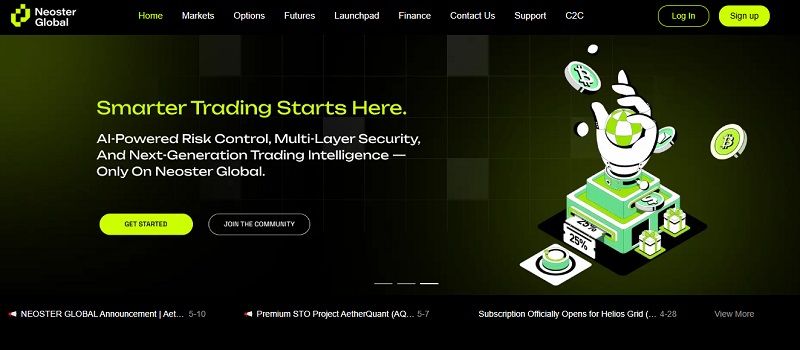
The Neoster broker states that it is a “U.S.-based digital asset trading platform” focused on security and compliance-driven operations. However, the website neoster.com does not publish:
incorporation documents,
state registration records,
or regulator-issued certificates.
The platform claims to have “obtained the US FinCEN MSB license,” but no direct registration number or verification link is publicly displayed.
It is important to distinguish between FinCEN MSB registration and full financial licensing.
FinCEN MSB registration is primarily a federal reporting and AML compliance framework rather than a complete investment brokerage authorization.
For crypto-related businesses in the United States, additional state-level licensing requirements may apply depending on custody and money transmission activities.
The Neoster Global broker does not clarify:
whether it holds state money transmitter licenses,
whether client funds are segregated,
or whether independent audits exist.
This creates uncertainty regarding the true scope of its regulatory standing.
| Regulatory Element | Neoster Disclosure |
|---|---|
| FinCEN MSB claim | Mentioned but not publicly verified |
| Tier-1 financial regulation | Not disclosed |
| Public company certificates | Unavailable |
| State-level licensing data | Not provided |
| Investor protection scheme | Not mentioned |
The Neoster broker appears to focus almost entirely on crypto-related markets.
Publicly referenced trading categories include:
cryptocurrencies,
crypto futures and options.
No evidence of forex, stock CFDs, commodities, or traditional securities was identified during public review.
The Neoster Global broker also keeps most operational conditions hidden behind registration barriers. Before opening an account, users cannot fully verify:
available leverage,
trading commissions,
liquidity depth,
spread models,
or order execution methodology.
This restricted-access model reduces transparency for prospective clients conducting pre-registration due diligence.
The Neoster broker additionally references
institutional-grade security,
compliance-oriented architecture,
and wallet protection mechanisms.
However, technical implementation details remain limited.
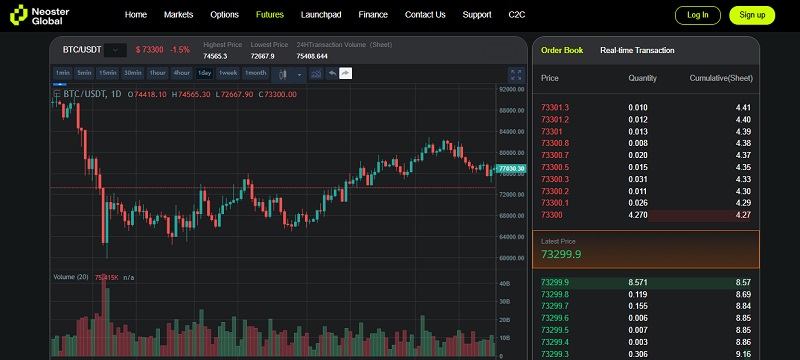
The Neoster personal account acts as the central gateway for all platform functions.
Based on public descriptions, the client area includes:
KYC verification,
wallet management,
deposit and withdrawal tools,
and access to trading products.
However, the Neoster Global broker provides almost no detailed public walkthroughs explaining:
interface functionality,
supported order types,
risk-management tools,
or platform analytics.
The majority of platform mechanics only become visible after registration.
This partially closed operational structure is often seen among newer crypto exchanges attempting to control user onboarding internally before exposing trading infrastructure.
The Neoster broker publicly acknowledges that users are responsible for:
trading fees,
withdrawal and deposit fees,
other service-related charges.
However, no fixed public fee schedule is visible.
The company states that:
fees may change periodically,
updated charges will appear within the platform,
and users are responsible for verifying wallet addresses and blockchain networks correctly.
The absence of transparent public fee tables makes it difficult to compare the Neoster Global broker costs against established cryptocurrency exchanges.
| Trading Component | Public Information Availability |
|---|---|
| Spot crypto trading | Mentioned |
| Options trading | Mentioned |
| Futures trading | Mentioned |
| Public spread information | Not disclosed |
| Public commission schedule | Not disclosed |
The Neoster Global broker states that deposit and withdrawal operations are subject to:
wallet verification,
blockchain network compatibility,
and internal fee structures.
The platform warns users that they are fully responsible for selecting:
correct blockchain networks,
valid wallet addresses.
No exact information is publicly disclosed regarding:
minimum deposits and withdrawals,
withdrawal limits,
processing times,
or supported payment providers.
Additionally, there is no detailed explanation regarding:
fiat currency support,
banking relationships,
or stablecoin custody arrangements.
This limited transparency complicates evaluation of operational reliability before registration.
When analyzing withdrawing money from Neoster, users should carefully consider the absence of independently verified processing statistics and the lack of public operational disclosures regarding payment infrastructure.
Public Neoster reviews remain relatively scarce.
This may indicate:
a still-developing user base,
low institutional visibility,
or a platform operating primarily through private onboarding channels.
The Neoster Global broker heavily emphasizes compliance, transparency, and operational security in its own marketing narrative.
At the same time, the absence of regulator databases, institutional reviews, and broader independent auditing makes external verification difficult.
The lack of BrokerChooser coverage further limits independent benchmarking against regulated exchanges and brokerage firms.
In analytical terms, this does not automatically confirm fraudulent activity, but it does increase informational uncertainty for prospective users.
DomainTools data for the Neoster broker:
Domain created: December 31, 2016
Last updated: November 17, 2025
The older domain age differs from many short-lived crypto platforms launched within the last 1–2 years. A longer domain history can sometimes indicate operational persistence.
However, domain age alone does not confirm:
regulatory legitimacy,
solvency,
or client fund safety.
The Neoster Global broker still demonstrates several transparency gaps despite the older infrastructure footprint.
| Criteria | Assessment |
|---|---|
| Regulatory transparency | Limited |
| Public fee disclosure | Incomplete |
| Corporate visibility | Low |
| Platform transparency | Restricted before registration |
| Overall risk | Medium to High |
The Neoster broker markets itself as a compliance-oriented cryptocurrency trading platform with access to futures and options products. The company attempts to position itself closer to institutional crypto infrastructure rather than retail CFD brokerage models.
Positive observations include:
relatively mature domain history,
crypto-focused specialization,
and references to compliance procedures and KYC frameworks.
At the same time, several important concerns remain:
lack of publicly verifiable licenses,
incomplete fee transparency,
hidden trading conditions before registration,
and absence from major broker-review ecosystems such as BrokerChooser.
Risk level: Medium to High
Suitable for: experienced crypto traders comfortable evaluating partially transparent offshore-style platforms
Not suitable for: conservative investors, beginners, or users requiring strong regulator-backed investor protection frameworks
From a due diligence perspective, the Neoster Global broker currently provides insufficient public transparency to be evaluated on the same trust level as fully licensed major crypto exchanges or regulated brokerage institutions.
The overwhelming majority of brokers are scammers. Traders can identify illegitimate ones by using free online resources. It is essential to verify the company's registration, the licensing of its services, and its operational history. It is also important to assess the completeness and authenticity of contact information and the transparency of trading conditions.
You can consult specialists who can help evaluate the broker and identify signs of fraud, and if necessary, assist in opening an account with a reliable service provider. A knowledgeable and comprehensive approach will help avoid negative trading experiences.
First and foremost, pay attention to the content of the comments. Excessively emotional opinions without specifics may indicate paid content. Additionally, a broker's positive reputation may be indicated by mass activity on a single online portal or forum. Another sign of fake reviews is their formulaic nature. Such comments are filled with general phrases and advertising slogans. Fraudulent projects use paid content to confuse traders and lure them into cooperation.
It is important not to fall for the tricks of company representatives. This can lead to additional financial losses. With legitimate brokers, withdrawing funds is a free service that is not subject to any fees such as insurance, taxes, commissions, etc.
If you need assistance in withdrawing capital, it is advisable to consult specialists. Timely consultation with experts can help achieve positive results and withdraw funds from the brokerage account.
In the case of scam brokers, account blocking may be related to a simple refusal to withdraw funds. Clients are accused of violating agreements, money laundering, technical work on the platform, etc. Such manipulations are aimed at depriving traders of the ability to withdraw capital.
When a brokerage account or personal account is blocked, it is better to use the services of professionals . Depending on the reason for the blockage, experts can find the optimal solution to the problem.
The reasons for the inactivity of a brokerage company's presentation portal can vary widely. Blocking due to numerous complaints, cessation of project activities, inclusion in the blacklist of trading platforms — all of this can lead to access issues to the broker's site. Additionally, unstable internet connection and browser restrictions can cause improper functioning of the resource.
If the official broker's website does not open, seek help from experts. They will advise on any questions and provide recommendations for further actions.
First and foremost, it is important to ensure that there are no assets in the account and no debts to the broker. If there are instruments in the investment portfolio, they should be sold, and you should wait for the settlements to be completed. After that, you can submit a request for the withdrawal of funds and the closure of the brokerage account.
If the broker refuses to fulfill requests, it is better to consult experts. They can assist in closing the brokerage account and recovering funds through chargebacks . When preparing to dispute transactions, it is necessary to gather all available evidence of cooperation with the project. This will help increase the chances of successfully initiating refunds.