The online broker Grand Markets positions itself as a versatile international financial intermediary catering to self-directed retail clients. The operator promotes multi-terminal execution options, micro-lot trading models, virtual practice accounts, and leverage parameters reaching up to 1:1000.
However, an independent analysis of the legal background surrounding the GrandMarkets broker reveals notable structural risks. While marketing collateral cites an international clearing house status, the firm operates under an offshore registration in the Autonomous Island of Anjouan (Union of Comoros). This regulatory framework falls outside tier-1 financial supervision, leaving client deposits without statutory investor compensation protections.
Collected company information:
Official portal: grandmarkets.com
User management area: my.grandmarkets.com
Operating corporate entity: Grand Markets Limited
Regulatory license & jurisdiction: Licensed by Anjouan Offshore Finance Authority (Licence Number L15998/GML)
Registered physical address: Hamchaku, Mutsamudu, Autonomous Island of Anjouan, Union of Comoros
Regulatory standing: Offshore regulated (unlicensed by tier-1 regulators like FCA, CySEC, ASIC, or CFTC)
Client communication channels: On-site web chat, contact form, Email
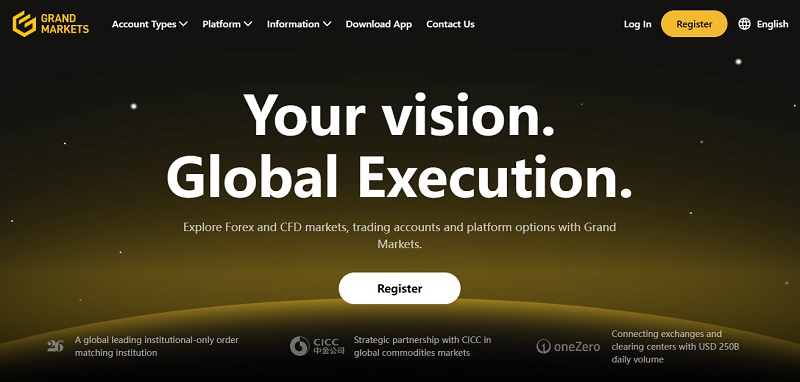
Client Onboarding and Profile Verification via grandmarkets.com
Registering a Grand Markets personal account is initiated online through my.grandmarkets.com. Prospective profile holders complete standard contact submissions, set up password security settings, and proceed through identity validation workflows.
To satisfy basic Know Your Customer and Anti-Money Laundering standards, users must upload government-issued photo identification cards alongside proof-of-address records.
Following identity clearance, the GrandMarkets personal account acts as the primary management panel for initiating balance transfers, configuring trading terminal credentials, adjusting leverage settings, and accessing virtual demo accounts. However, public documentation on the portal omits explicit details regarding compulsory secondary security layers, such as mandatory two-factor authentication.
Software Infrastructure and Execution Portals of GrandMarkets Broker
The Grand Markets broker bases its execution setup on well-established, third-party trading suites alongside charting integrations. Rather than relying on closed proprietary web applications, the company offers multiple cross-platform client options:
Through MT4 and MT5, traders gain access to:
interactive technical indicators,
multi-timeframe charting,
automated trading capabilities via Expert Advisors (EAs),
custom script execution.
Despite offering established platforms, the GrandMarkets broker provides limited public data regarding server hosting locations, trade execution speeds, or independent order-routing audits.
Account Categories and Trading Parameters Offered by Grand Markets
Clients accessing markets via the Grand Markets broker can trade a selection of global financial instruments, primarily focused on foreign exchange currency pairs.
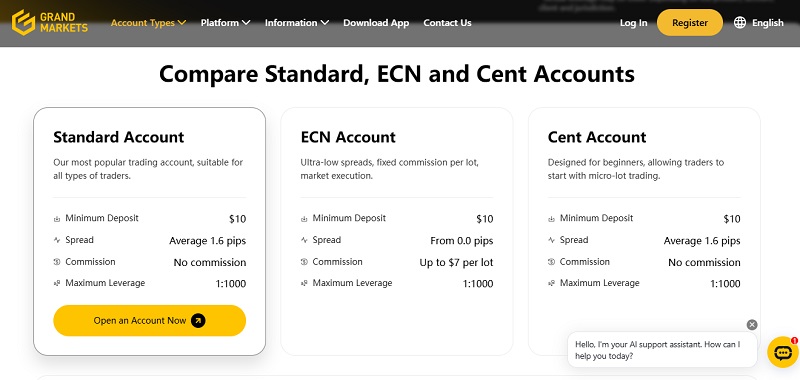
The intermediary structures its live offerings into three distinct account tiers alongside free virtual demo environments:
| Account Tier | Minimum Deposit | Spread Starting Point | Commission Model | Maximum Leverage | Target Audience |
|---|
| Standard Account | $10 | Average 1.6 pips | $0 (No commission) | 1:1000 | General retail traders |
| ECN Account | $10 | From 0.0 pips | Up to $7 per lot | 1:1000 | Active & spread-sensitive traders |
| Cent Account | $10 | Average 1.6 pips | $0 (No commission) | 1:1000 | Beginners & micro-lot testing |
All live account models feature low entry barriers starting at $10, flexible margin limits up to 1:1000, and defined stop-out levels for currency positions. While the Cent account allows risk-controlled micro-lot execution, trading with maximum leverage of 1:1000 significantly increases capital depletion risks during periods of high market volatility.
Funding Protocols and Withdrawing Money from Grand Markets
Account funding operations with the GrandMarkets broker require an entry minimum of $10 across supported account types. The platform supports:
standard electronic payment channels,
credit/debit card processors,
wire transfer rails.
When withdrawing money from Grand Markets, payout requests are managed directly through the online client dashboard. Payment destinations must strictly match the verified identity of the account holder under standard anti-money laundering protocols.
However, the GrandMarkets broker lacks a published legal schedule outlining explicit payout turnaround times, daily transfer caps, or potential intermediary bank wire surcharges.
Corporate Standing, License Verification, and Domain Info for Grand Markets
DomainTools data:
From a legal perspective, the Grand Markets broker maintains an active operational history dating back to its domain registration in 2015. The operating firm holds an offshore license (L15998/GML) in the Autonomous Island of Anjouan, Union of Comoros (registered at Hamchaku, Mutsamudu).
While an offshore license provides a legal framework for international operations, Anjouan oversight lacks the strict capital adequacy requirements, mandatory client compensation insurance schemes (such as FSCS or ICF), and independent dispute resolution mechanisms enforced by tier-1 regulators.
Client Feedback, Public Standing, and Grand Markets Reviews
Public user feedback for the GrandMarkets broker is currently sparse across independent consumer aggregators.
An analysis of the company's Trustpilot profile reveals an unclaimed status with a neutral score of 3.4/5 based on a very small sample size of user comments:
positive Grand Markets reviews mention platform stability,
isolated negative feedback points to customer support delays and verification processing times.
The trading provider is currently absent from BrokerChooser.
Absence from BrokerChooser’s index is legally neutral and does not constitute a judgment on the brokerage's operational integrity. Common non-adversarial factors include:
the entity's brief operating history,
non-alignment with listing benchmarks,
or a temporary deficit in publicly verifiable regulatory filings.
Risk Assessment and Expert Summary for Grand Markets Broker
Evaluating the structural framework of the GrandMarkets broker highlights key trade-offs between low entry thresholds and offshore regulatory risks.
| Risk Parameter | Observed Finding | Impact Level |
|---|
| Regulatory Jurisdiction | Offshore license in Anjouan, Comoros; no tier-1 regulatory oversight | High |
| Trading Infrastructure | Official MT4, MT5, and TradingView support | Low |
| Corporate Transparency | Discloses company registration details and physical address in Comoros | Medium |
| Leverage & Cost Structure | High maximum leverage (1:1000); competitive $10 deposit minimums | Medium |
| Public Sentiment | Sparse user feedback (3.4/5 on Trustpilot across limited entries) | Medium |
The Grand Markets broker provides access to MetaTrader 4, MetaTrader 5, and TradingView platforms, supported by accessible $10 deposit thresholds, cent accounts, and zero-commission models.
However, these features are counterbalanced by offshore regulation in the Union of Comoros, extreme leverage availability, and an absence of statutory deposit protection funds.
Project Risk Characterization: High Risk.
Suitable For: Experienced retail traders seeking MT4/MT5/TradingView access, high leverage, and cent account setups who fully comprehend offshore operating risks.
Less Suitable For: Conservative investors, beginners, or traders requiring tier-1 regulatory supervision and statutory investor protection schemes (such as FSCS or CySEC coverage).


