The global broker Bitpanda is one of the largest European crypto investment platforms operating in the digital asset sector today. Founded in Vienna in 2014, the company gradually evolved from a cryptocurrency exchange into a broader fintech ecosystem offering crypto trading, stocks, ETFs, metals, staking products, and payment services.
Unlike many offshore CFD projects, the Bitpanda broker openly references European licensing frameworks and operates under multiple regulatory registrations across the EU. The platform has positioned itself as a regulated crypto-financial infrastructure provider rather than a classic forex brokerage.
Collected company information:
Official website: bitpanda.com
Client area: account.bitpanda.com
Founded: 2014
Executive Chairman: Eric Demuth
Main products: cryptocurrencies, ETFs, stocks, metals, staking
Regulatory framework references: MiFID II, PSD2, EMI, AML5, MiCAR
Corporate address: Stella-Klein-Löw-Weg 17, Vienna, Austria
The Bitpanda broker also states that it currently holds 16 European licences and registrations across different jurisdictions.
One notable detail: the company is absent from BrokerChooser’s classic brokerage ranking system. In this case, the explanation is likely structural rather than reputational.
BrokerChooser primarily focuses on forex and CFD intermediaries, while Bitpanda broker operates closer to a regulated crypto investment ecosystem. Still, the absence means users cannot rely on BrokerChooser’s traditional trading provider scoring methodology for evaluating the platform.

Bitpanda Regulation and European Licensing Structure
The Bitpanda broker emphasizes regulatory compliance as one of its core competitive advantages. According to company disclosures, the platform operates under multiple European registrations and licenses tied to financial services and crypto-asset operations.
The company publicly references:
MiFID II investment licensing
PSD2 payment authorization
Electronic Money Institution (EMI) permissions
AML5 compliance
MiCAR authorization framework
In 2025, Bitpanda broker announced that it became one of the first major crypto firms to secure a MiCAR licence through Germany’s BaFin regulator.
The project also publicly states that it maintains VASP registrations in several European countries including:
Austria
Germany
France
Italy
Spain
Sweden
Czech Republic
This level of regulatory disclosure is substantially stronger than what is typically seen among offshore CFD brokerages.
At the same time, crypto regulation remains an evolving field. Even fully regulated crypto platforms still operate within a sector exposed to elevated volatility and technological risks.
Markets and Investment Products of Bitpanda
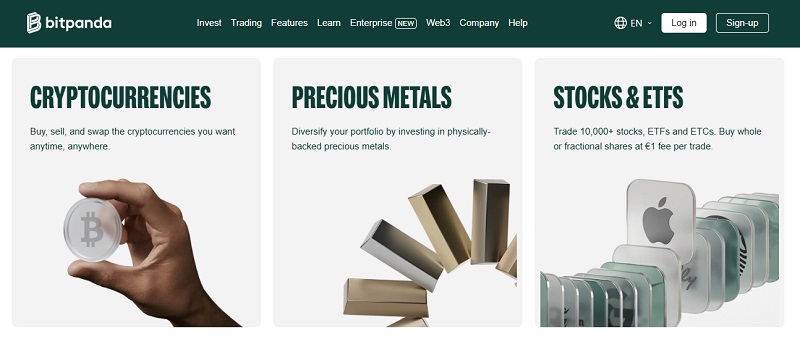
The Bitpanda broker no longer focuses solely on cryptocurrencies. Over time, the platform expanded into multiple investment categories designed for retail European investors.
Available instruments include:
Cryptocurrencies
Crypto indices
Stocks
ETFs
Precious metals
Commodities
Staking products
Savings plans
The platform positions itself as an all-in-one investment application rather than a traditional leveraged trading terminal.
| Asset Category | Bitpanda Broker Offering |
|---|
| Cryptocurrencies | Hundreds of digital assets |
| Stocks | Fractional investing available |
| ETFs | Available |
| Precious metals | Gold, silver and platinum supported |
| Crypto indices | Supported |
The Bitpanda broker appears more investment-oriented than speculation-oriented, especially compared to high-leverage forex platforms.
Bitpanda Trading Environment and Platform Infrastructure
The Bitpanda broker does not rely on MetaTrader infrastructure. Instead, it uses a proprietary ecosystem optimized for mobile and web investing.
Available interfaces include:
The Bitpanda personal account allows users to:
The client area is structured more like a fintech banking interface than a high-frequency trading terminal.
| Platform Feature | Availability |
|---|
| Web platform | Available |
| Mobile applications | iOS and Android |
| Crypto wallet | Integrated |
| Savings plans | Supported |
| Staking services | Available |
Unlike many offshore intermediaries, the Bitpanda broker publicly discusses custody, compliance, and payment licensing rather than focusing primarily on leverage marketing.
Deposits and Withdrawals of Money From Bitpanda
The Bitpanda broker supports multiple payment systems depending on the client’s country and verification level.
Common funding methods include:
SEPA transfers
Bank cards
Cryptocurrency transfers
Online payment services
The company advertises fee-free deposits for many payment channels.
When analyzing withdrawing money from Bitpanda, the overall reputation appears stronger than among many offshore crypto brokers. The platform operates under stricter AML and KYC obligations, which can occasionally slow verification procedures but also improve compliance credibility.
Withdrawal speed may depend on:
bank processing times,
blockchain congestion,
verification status,
regional restrictions.
The Bitpanda broker generally emphasizes transparency regarding payment operations and identity verification.
Bitpanda Reviews and Reputation Analysis
Public Bitpanda reviews across fintech and crypto communities are relatively balanced compared to the highly polarized reputation often associated with offshore crypto exchanges.
Positive feedback commonly mentions:
intuitive platform design,
strong European compliance framework,
broad asset selection,
simple onboarding process,
institutional partnerships.
Negative feedback usually involves:
verification delays,
higher spreads on instant transactions,
occasional customer support response times during market volatility.
The Bitpanda broker has also developed multiple institutional partnerships and banking integrations in Europe, which strengthens its public credibility profile.
At the same time, users should remember that regulation does not eliminate crypto-market risks.
Domain and Infrastructure Analysis of Bitpanda Broker
DomainTools data for the Bitpanda broker:
Created: June 5, 2014
Updated: May 11, 2026
IP Location: United States, California, San Jose
Infrastructure provider: Cloudflare
Key observations:
Long operational history compared to many crypto startups
Stable domain ownership timeline
Significant international infrastructure footprint
Enterprise-level CDN protection
The Bitpanda broker demonstrates considerably more operational continuity than many recently launched offshore trading projects.
Bitpanda Broker Risk Evaluation
| Criteria | Assessment |
|---|
| Regulatory transparency | High for crypto sector standards |
| Corporate disclosure | Strong |
| Platform maturity | Operational since 2014 |
| Asset risk | Crypto assets remain volatile |
| Overall risk | Medium |
Final Assessment of Bitpanda Broker
The Bitpanda broker stands apart from many offshore CFD brands because of its visible European compliance structure, long-term market presence, and broader fintech orientation.
Key observations:
Founded in Austria in 2014
Operates under multiple European registrations
Publicly references MiFID II, PSD2, EMI, and MiCAR frameworks
Offers diversified investment products beyond crypto speculation
Maintains stronger transparency than many offshore brokers
Potential concerns:
Crypto assets remain inherently volatile
Some services depend on regional availability
Verification procedures may feel strict for retail users
The platform is less suitable for aggressive leveraged forex trading
Project characterization
Risk level: Medium
Suitable for:
European crypto investors,
long-term digital asset holders,
diversified retail investors,
users seeking regulated crypto exposure.
Not suitable for:
high-risk leverage traders,
users looking for MT4/MT5 forex speculation,
traders seeking ultra-fast offshore onboarding with minimal verification.
From an analytical standpoint, the Bitpanda broker appears considerably more transparent and institutionally structured than the majority of offshore crypto trading platforms currently operating in the retail market.


