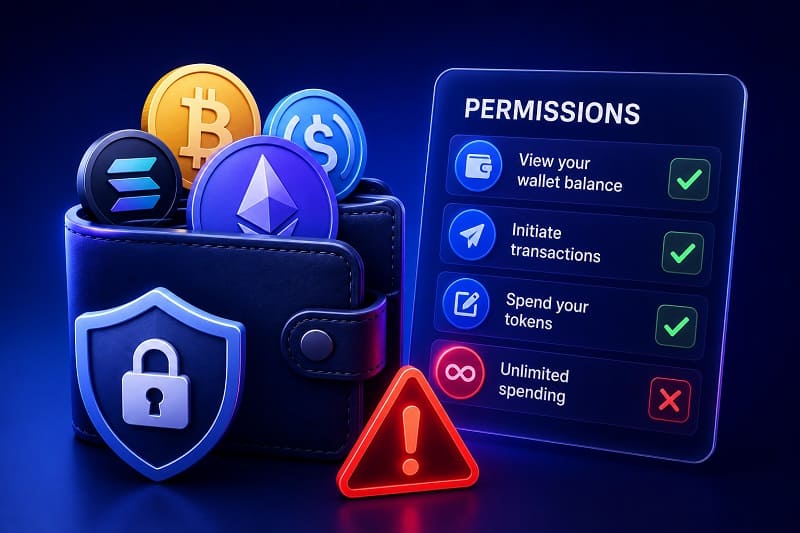
Why Wallet Permissions Become More Dangerous Over Time
- Every New Protocol Leaves Something Behind
- Convenience Today Can Create Risk Years Later
- Forgotten Permissions Are Easy to Overlook
- Not Every Old Permission Is Dangerous — But Every One Deserves Review
- Disconnecting a Wallet Does Not Remove Previous Access
- Forgotten Smart Contracts Can Become Tomorrow's Weakest Link
- Unlimited Approvals Increase Potential Exposure
- Real Incidents Show Why Historical Permissions Matter
- How to Audit Existing Permissions
- When Revoking Makes Sense
- Common Mistakes That Increase Long-Term Risk
- Conclusion
- Frequently Asked Questions
- Sources
For many newcomers, the initial interaction with a decentralized application feels completely routine. A crypto swap, an NFT purchase, or a liquidity deposit usually takes only a few clicks. The confirmation window asks for authorization to spend a particular asset. Most participants approve the request without giving it much thought.
After all, nothing unusual happens immediately afterward. The transaction succeeds, the swap completes, and daily activity continues. What many people fail to realize is that this allowance often remains active long after the original dApp session has ended.
According to the Ethereum Foundation, smart contract approvals do not expire automatically. Unless revoked manually, they may remain valid for months or even years, regardless of whether the underlying application is still being used.
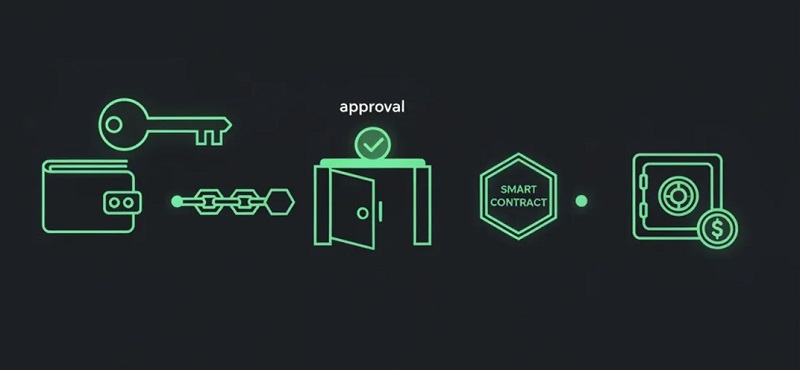
Every New Protocol Leaves Something Behind
Consider how an active Web3 user operates over several years:
- January: Swapping USDC for ETH on Uniswap.
- February: Depositing stablecoins into Aave to earn yield.
- Spring: Minting an NFT on OpenSea.
- Late Summer: Exploring a newly launched yield farm.
- Autumn: Bridging assets across alternative networks.
Each unique interaction requires a fresh spending allowance. Individually, these authorizations serve an immediate purpose. Collectively, they form a sprawling list of granted privileges that users rarely re-examine.
This accumulation is completely natural. Unlike passwords or browser cookies, blockchain access rights reside directly on-chain rather than within a web browser. Closing the website tab or disconnecting a wallet interface does not erase previously granted access.
Key Takeaway: The Ethereum Foundation explicitly notes that disconnecting from a decentralized application is not the same as revoking token permissions. The authorization continues to exist until a dedicated on-chain transaction removes it.
Convenience Today Can Create Risk Years Later
Unlimited spend allowances became popular for a simple reason: they remove friction. Instead of prompting traders to approve every transfer individually, many platforms request spending access only once. Subsequent operations execute faster because additional signature requests are no longer required.
Consider a trader who exchanged USDC on Uniswap back in 2022. The trade executed cleanly, and the user eventually moved on to different DeFi protocols. By 2026, that initial interaction might be completely forgotten, yet the original allowance remains permanently active on-chain if never revoked.
Similarly, an NFT collector who listed artwork on OpenSea years ago may no longer visit the marketplace daily. Nevertheless, historical token permissions tied to that early activity still show up during account audits. Neither scenario represents an immediate security breach, but digital access rights quietly stack up over time.
Forgotten Permissions Are Easy to Overlook
This issue escalates as on-chain activity expands. A user managing three protocol connections can easily track them. A power user interacting with dozens of protocols across multiple EVM chains rarely can.
Typical Multi-Year On-Chain Journey:
- Token swaps
- Participation in liquidity pools
- Using lending platforms
- Trading on NFT marketplaces
- Transferring assets through cross-chain bridges
Eventually, account holders lose track of which access rights remain necessary and which belong to platforms abandoned long ago.
Security researchers frequently highlight this oversight. A landmark academic study on ERC-20 spending approvals revealed that unlimited allowances are overwhelmingly common across the Ethereum ecosystem. Conversely, only a fraction of active participants routinely enforce safety measures like custom spending caps or periodic allowance revocations.
Not Every Old Permission Is Dangerous — But Every One Deserves Review
An older spending allowance does not automatically mean funds are at immediate risk. Many blue-chip smart contracts operate securely for years. However, every active authorization increases the total number of external protocols capable of interacting with held tokens.
If a legacy smart contract suffers an exploit years down the line, or if a malicious approval was signed unwittingly, the financial impact can extend far beyond the initial transaction amount.
| User Activity | Permission That May Remain |
|---|---|
| Swap tokens on Uniswap | ERC-20 spending approval for the selected token. |
| List an NFT on OpenSea | Marketplace authorization for NFT transfers. |
| Deposit assets into Aave | Allowance allowing contract interaction with supplied tokens. |
| Test a newly launched protocol | Authorization granted to an unfamiliar smart contract. |
| Bridge assets between networks | Cross-chain contract approval that may remain after use. |
| Experiment with yield farming | Unlimited token allowance created for convenience. |
A fresh wallet address typically shows only a few active allowances. Following years of exploring decentralized finance, the situation changes drastically. While the total wallet balance might remain steady, the number of external protocols retaining access to specific assets continuously grows behind the scenes.
Also Read: Trust Wallet Scams: How Users Lose Funds and How to Protect Yourself
Disconnecting a Wallet Does Not Remove Previous Access
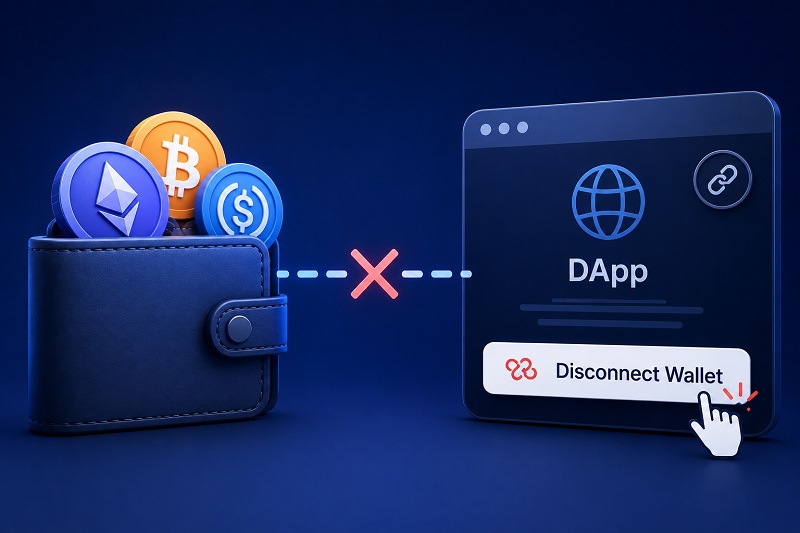
One of the most persistent misconceptions in Web3 is the belief that disconnecting a wallet interface severs all ties with a dApp. Unfortunately, that is not how ERC-20 allowance mechanisms operate.
Removing a website from your wallet’s connected sites list simply blocks that specific web interface from viewing your address during future visits. It has zero effect on existing spending allowances recorded on the blockchain.
Real-World Analogy:
- Disconnecting a Wallet = Leaving a house without taking back the physical key you lent out.
- Revoking an Approval = Changing the locks so the key no longer opens the door.
The Ethereum Foundation constantly reinforces that interface disconnections differ fundamentally from on-chain revocations. Existing authorizations stay live until the address owner broadcasts a specific transaction to invalidate them.
Forgotten Smart Contracts Can Become Tomorrow's Weakest Link
Not every software project maintains active development forever. Some protocols get abandoned, while others upgrade to completely new contract architectures. Occasionally, an older deployment suffers a security exploit years after most users stopped visiting the site.
Consider this timeline:
- 2022: A user tests an experimental yield farming protocol. The transaction succeeds.
- Late 2022: The user withdraws all deposited funds and moves on.
- 2026: The project is entirely forgotten, but the original spending allowance remains active on-chain.
- Exploit Event: An attacker discovers a vulnerability in the legacy 2022 contract and drains approved funds from connected addresses.
A real example occurred during the Dolomite incident. Although the vulnerable contract had been retired years prior, attackers exploited lingering allowances that users had never revoked, draining assets from affected accounts. Similar incidents have impacted users of Socket, ParaSwap, Transit Swap, and numerous other platforms.
The primary vulnerability is rarely the newest dApp — often, it is forgotten legacy code that nobody has monitored for years.
Unlimited Approvals Increase Potential Exposure
Most dApps default to requesting unlimited spending permissions purely for user convenience. Without unlimited allowances, traders would need to execute a separate approval transaction for every single trade—a process that quickly becomes tedious and costly in network fees.
However, this convenience creates severe risk exposure. If a contract holding unlimited spending rights suffers an exploit, the potential loss is far larger than the original transaction size.
- Capped Approval Example: Approving exactly 100 USDC limits maximum theoretical loss to 100 USDC, even if the protocol is later compromised.
- Unlimited Approval Example: Granting an unlimited allowance leaves every compatible token inside that wallet address exposed if the contract is ever breached.
On-chain analytics platforms monitoring approval exploits have documented hundreds of millions of dollars in cumulative losses linked directly to active spending allowances rather than leaked private keys.
Also Read: Crypto Wallet Approval Scams: How Hackers Drain Funds Without Passwords
Real Incidents Show Why Historical Permissions Matter
The threat posed by lingering authorizations is far from theoretical. Over the past several years, numerous high-profile exploits have highlighted how forgotten approvals contribute to sudden financial losses:
- Socket: Users with pre-existing allowances were urged to revoke access immediately following a smart contract breach.
- Dolomite: An unmonitored legacy contract deployed years earlier served as the entry point for exploiting lingering token approvals.
- Transit Swap: Attackers targeted addresses with active spending permissions to extract funds.
- ParaSwap: A contract vulnerability required affected traders to execute emergency revocations even after team interventions.
- Concentric Finance: Compromised contract deployments exposed funds held by addresses with historical spending access.
| Situation | Long-Term Effect |
|---|---|
| One-time token swap | Spending authorization may remain indefinitely. |
| Protocol abandoned years ago | Older contract can still retain previous permissions. |
| Website disconnected | On-chain allowances remain unchanged. |
| Project upgrades its contracts | Legacy approvals may still point to outdated deployments. |
| Security incident discovered later | Previously granted access can increase potential exposure. |
| User forgets earlier activity | Hidden permissions accumulate quietly over time. |
The takeaways are clear: every unnecessary spending authorization expands the attack surface. As time passes and new dApps are tested, this unseen list grows much faster than most users anticipate.
How to Audit Existing Permissions
Reviewing active approvals has become significantly simpler thanks to modern security utilities. Several free tools allow users to inspect which smart contracts currently retain spending rights over their assets across multiple networks.
A standard security audit involves four quick steps:
- Connect Address: Input your public wallet address into a trusted approval manager.
- Identify Inactive Contracts: Spot protocols that are no longer part of your routine.
- Check Allowance Types: Look for lingering unlimited spending permissions.
- Revoke Unnecessary Access: Submit an on-chain transaction to cancel obsolete entries.
Ethereum.org explicitly recommends checking token allowances periodically, especially after testing new protocols or interacting with unfamiliar decentralized applications.
When Revoking Makes Sense
Not every single authorization needs to be erased. Frequently used protocols (e.g., primary DEXs or lending pools) require active permissions to function smoothly. Removing access from those platforms simply forces you to pay gas fees to approve them again during your next trade.
Instead, prioritize removing historical entries that offer no ongoing utility:
- Experimental dApps visited only once.
- Discontinued or migrated NFT marketplaces.
- Abandoned yield aggregators.
- Legacy cross-chain bridges.
- Beta protocols that are no longer maintained.
Expert Recommendation: Revoke.cash advises treating allowance management as routine wallet maintenance rather than an emergency response following a hack. Regular audits keep your attack surface minimal.
Common Mistakes That Increase Long-Term Risk
Most allowance-related losses stem from ordinary habits repeated over long periods. Common pitfalls include:
- Defaulting to unlimited allowances without assessing actual necessity.
- Assuming that disconnecting a wallet clears blockchain permissions.
- Forgetting about dApps tested during past market cycles.
- Continuing to trust legacy contracts that have been replaced by newer versions.
- Failing to audit spending rights after altering investment strategies.
| User Habit | Long-Term Consequence |
|---|---|
| Approve unlimited spending for convenience. | Larger potential exposure if that contract is later exploited. |
| Disconnect from the website. | On-chain authorization remains unchanged. |
| Forget about older protocols. | Unused permissions continue accumulating over time. |
| Never audit historical activity. | Hidden access rights become difficult to track manually. |
| Keep interacting with experimental projects. | The number of trusted contracts steadily increases. |
Another widespread misconception involves zero-balance accounts. Many believe that approvals become harmless once all funds are withdrawn from a protocol. However, if the allowance remains active on-chain, any future deposits of that same token immediately fall back within its scope.
Also Read: Crypto Wallet Trap Scams: Why Scammers Give You Access to Funds

Conclusion
The greatest security threat to an address is rarely the most recent transaction. Instead, hidden risks frequently originate from permissions granted months or even years earlier. Every interaction with a dApp leaves behind a small footprint of trust. Taken together, these allowances create a surprisingly wide network of smart contracts holding access to your assets.
Maintaining healthy wallet hygiene requires more than protecting seed phrases. It demands periodic allowance audits to ensure that only active, trusted applications retain access to your funds.
Frequently Asked Questions
Do token approvals expire automatically?
No. Most ERC-20 spending allowances remain active indefinitely unless manually canceled on-chain or overwritten by a new approval transaction.
Is disconnecting my wallet enough to stay safe?
No. Disconnecting your wallet only terminates the connection with the web interface. Existing blockchain permissions remain completely valid until explicitly revoked via an on-chain transaction.
Should every approval be revoked immediately?
Not necessarily. Highly trusted protocols that you use daily can remain authorized. Obsolete, experimental, or abandoned dApps are the primary candidates for revocation.
Can an old smart contract become dangerous years later?
Yes. Historical incidents (such as the Dolomite breach) demonstrate that legacy, unmonitored contracts can be exploited long after users have moved on, draining funds from connected addresses via lingering approvals.
How often should wallet permissions be audited?
While there is no fixed schedule, conducting a review every few months—or immediately after testing unfamiliar protocols — is considered a best practice by Web3 security professionals.
Sources
- Ethereum.org — How to Revoke Smart Contract Access to Your Crypto Funds
- Revoke.cash — Approval Hacks & Exploits
- Revoke.cash — Frequently Asked Questions
- Penny Wise and Pound Foolish: Quantifying the Risk of Unlimited Approval of ERC20 Tokens on Ethereum (arXiv)
- Resolving the Multiple Withdrawal Attack on ERC20 Tokens (arXiv)
Get professional help with your case.