
Claude AI Trading Bot Scam: How Fake YouTube Tutorials Steal Crypto
- Why "Claude AI" Makes the Scheme Look Credible
- Professional Presentation Shields Malicious Intent
- A Real-World Example
- Why the Comment Section Appears Genuine
- What Really Happens After You Click the Links
- The "Open Source" Delusion
- "Provide Liquidity" Is the Critical Exploit Moment
- Targeting Technically Proficient Users
- Scale of the Threat Infrastructure
- Changing Names, Identical Mechanics
- How to Evaluate Automated Trading Guides
- AI Is the Marketing Hook, Not the Exploit
- Conclusion
- FAQ
- Sources
Artificial intelligence has become one of the most powerful promotional buzzwords across digital asset markets. Almost every week, new online walkthroughs claim that machine learning can automatically discover arbitrage opportunities, execute high-frequency strategies, and generate passive income with minimal effort.
Many of these demonstration guides appear remarkably polished:
- Professional voiceover narration;
- High-quality visual editing;
- Detailed technical breakdowns;
- Links to open-source code repositories;
- Step-by-step deployment instructions.
Some creators even claim that viewers need nothing more than Web3 wallets like MetaMask and 1 ETH to launch an automated execution engine.
Unfortunately, cybersecurity researchers have demonstrated that many guides following this formula are not educational content at all. Instead, they are social-engineering traps designed to persuade users into deploying malicious on-chain logic that immediately routes deposited assets to wallets held by bad actors.

Why "Claude AI" Makes the Scheme Look Credible
One critical detail requires clarification: Anthropic's Claude AI is not responsible for these fraudulent setups. The underlying language model has zero connection to these illicit campaigns.
Instead, deceptive operators exploit the name recognition of leading tech brands to establish unearned trust. Depending on current search trends, titles may feature:
- Claude AI Trading Bot
- ChatGPT Arbitrage Engine
- Gemini Crypto Assistant
- DeepSeek Quantitative Script
- AI MEV Bot
While the featured tech brand shifts, the operational model remains identical. Using recognized names creates the impression that sophisticated neural networks are analyzing market order books behind the scenes — an assumption that retail viewers easily accept as plausible.
Professional Presentation Shields Malicious Intent
These walkthroughs rarely ask users to transfer funds directly to an unknown address. Instead, they encourage viewers to "build and deploy their own automated script."
A standard demonstration follows a predictable sequence:
- Presenter explains AI-generated Solidity code
- Directs viewer to code host (Pastebin) & compiler site
- User compiles contract & connects Web3 wallet
- User deploys contract & deposits "initial liquidity"
- User executes "Start()" function
- Assets routed to attacker
The presenter often emphasizes that the software is completely open-source — a phrase that significantly lowers suspicion because traders associate open code with transparency. The deployment workflow itself mimics standard developer procedures, which is precisely why it succeeds so consistently.
A Real-World Example
A recent community discussion highlights how convincing these instructional videos have become:
- A user discovered multiple YouTube guides claiming that Claude AI could generate automated arbitrage profits. Each video instructed viewers to compile Solidity code through an external interface before deploying the contract. The presenter stressed that the script required at least 1 ETH in operating capital to process transactions.
- The guide appeared fully legitimate: every step was explained clearly, source links were provided, and the comment section contained dozens of positive testimonials.
- Seeking a second opinion before committing capital, the user asked an online forum for verification. Experienced community members quickly warned that no profitable quantitative trading system is distributed freely on social media while requiring users to deposit significant funds into unverified, self-deployed contracts.
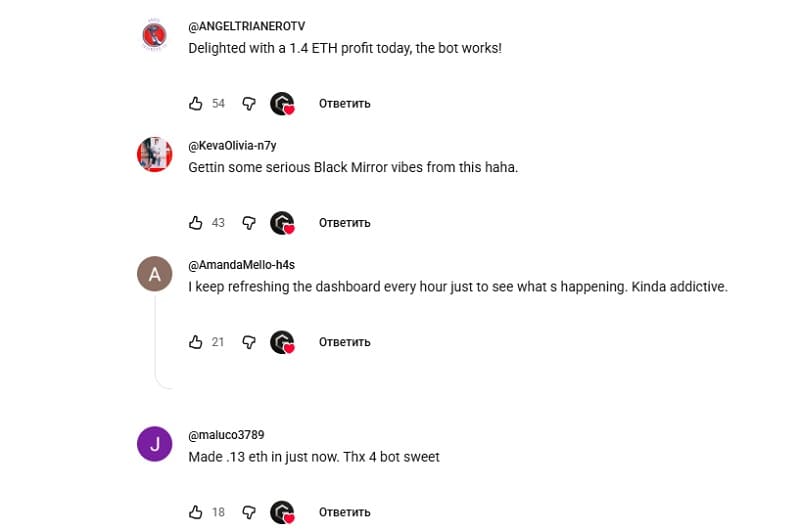
Why the Comment Section Appears Genuine
Many users gauge credibility by checking feedback before watching a full guide. Fraudulent operators exploit this habit. Academic research into automated video scams reveals that campaign managers routinely deploy coordinated bot networks to generate artificial social proof.
Common comment templates include:
- "It started making profits after two hours!"
- "Earned my first ETH today, thank you!"
- "The best AI strategy I've tested so far."
To a viewer encountering the content for the first time, dozens of enthusiastic replies create the impression of a thriving user base. In reality, researchers observed that malicious operators leverage automated accounts, aged channels, and synchronized posting algorithms to make malicious walkthroughs look widely trusted.
During a one-year monitoring period, analysts identified 10,442 deceptive videos uploaded across thousands of distinct accounts.
| What the Viewer Sees | What Security Analysts Observed |
|---|---|
| Professional AI tutorial | A coordinated social-engineering campaign |
| Open-source Solidity code | Programmed backdoors hiding transfer logic |
| Positive comment section | Artificial engagement generated by bot networks |
| External compiler page | Attacker-controlled infrastructure |
| "Provide liquidity" step | Direct deposit into an exploit contract |
| Promises of automated yield | Instant asset draining upon execution |
The primary danger is that these campaigns do not rely on standard phishing sites that harvest passwords. Instead, victims execute every technical step themselves, believing they are initializing a sophisticated algorithm when they are actually triggering an exploit script.
What Really Happens After You Click the Links
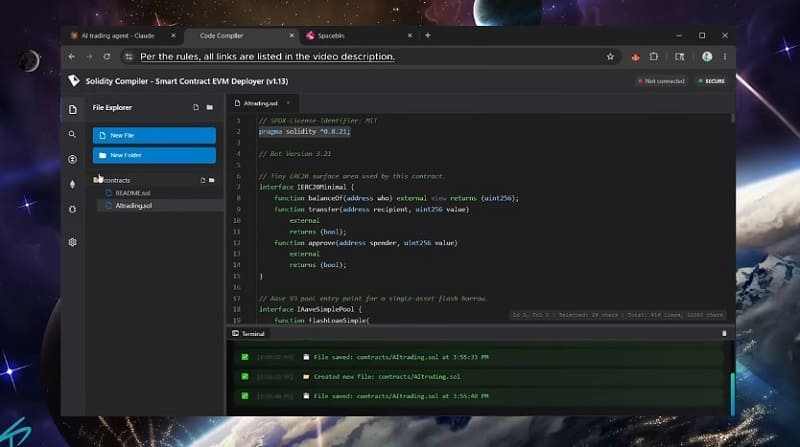
A recurring pattern across these walkthroughs is the choice of compilation tools. Instead of directing viewers to established environments like Remix IDE, creators often point to unfamiliar third-party compiler sites, custom subdomains, or static interfaces imitating official developer portals.
- Standard Remix IDE provides transparent client-side compilation.
- Third-party compilers may modify the generated bytecode or introduce hidden imports, reducing transparency and increasing security risks.
If an untrusted portal controls the compilation pipeline, it can silently:
- Alter the submitted source code before generating bytecode;
- Inject unauthorized transfer logic;
- Return compiled output that differs from the code shown on screen;
- Load remote dependencies that were never reviewed by the user.
Security researchers repeatedly warn that compiling programs through unverified web tools introduces severe supply-chain vulnerabilities, especially when the final bytecode is never audited on a block explorer.

Also Read: Novara, Dexor, Onyx: Inside the Fake Discord Communities Running the “KOL Launch” Rug Pull Scam
The "Open Source" Delusion
Promoting code as "100% open source" provides a false sense of security. Open availability does not inherently guarantee safety. Bad actors utilize several methods to mask malicious functions within visible code:
- Obfuscated variable names (e.g., masking addresses as hex arrays);
- Misleading inline comments describing fake arbitrage functions;
- Convoluted helper functions that mask destination addresses;
- External calls to unverified remote interfaces.
Security audits show that authors rarely hardcode their destination wallet directly into the script. Instead, they construct the target address dynamically across multiple functions or disguise it inside mathematical routines.
"Provide Liquidity" Is the Critical Exploit Moment
Almost every variation of this scheme leads to a single pivotal instruction: providing initial capital. To beginners, this sounds like standard DeFi protocol interaction. In reality, the deposited ETH is the exact asset the hidden code is designed to capture.
- A contract is deployed containing 1.0 ETH of user capital.
- The user executes the Start() function.
- Instead of performing the expected operation, the function triggers a hidden transfer embedded in the contract logic.
- As a result, the entire 1.0 ETH is automatically transferred to the attacker's wallet.
The guide typically instructs the user to invoke a public Start() function to activate the trading engine. Code analysis reveals that calling Start() simply executes a transfer command, sweeping the contract's entire balance directly to the attacker's wallet. The advertised arbitrage engine never existed.
Targeting Technically Proficient Users
While standard phishing attempts target beginners, these campaigns explicitly target technically curious users — individuals comfortable interacting with Web3 interfaces, managing wallets, and deploying Solidity code.
That technical familiarity creates an overconfidence trap: the victim believes they are verifying the entire process independently simply because they are compiling and executing the code themselves.
| What the Guide Claims | Technical Reality |
|---|---|
| Compile open-source code | Bytecode may be manipulated by the compiler interface |
| Deploy your trading engine | A drainer contract is published to the blockchain |
| Provide operating liquidity | Funds become accessible to the embedded backdoor |
| Click Start to begin | Triggers an immediate transaction to the attacker's wallet |
| Monitor automated yields | No trading logic exists within the codebase |
| Maintain full asset control | On-chain execution faithfully transfers ownership away |
Scale of the Threat Infrastructure
Academic research confirms that these tutorials are not isolated incidents, but part of a massive, automated infrastructure. Analysts deployed an automated tracking tool called CryptoScamHunter to evaluate YouTube over a twelve-month period.
CryptoScamHunter findings:
- 10,442 Malicious Videos Identified
- 6,400+ Unique Channels Uploading Content
- 800+ Active Drainer Smart Contracts
- 1,697 Linked Attacker Blockchain Addresses
- 25,000+ Verified Victims Impacted
- $15,000,000+ Total Financial Losses
These metrics demonstrate a persistent ecosystem that continuously rotates branding, domains, and keywords while keeping the core exploit mechanism intact.
Changing Names, Identical Mechanics
As public interest shifts toward new technology trends, malicious operators adapt their marketing terminology:
- Previous Cycles: Flashloan Scripts, MEV Arbitrage Bots, Slippage Exploits
- Current Cycle: Claude AI Trading Bot, ChatGPT Crypto Assistant, Gemini Arbitrage Engine, DeepSeek Trading System
Regardless of the trending title, the workflow remains identical: promise high-yield automated trading, instruct users to compile an unverified script, request capital deposits, and trigger a sweeping function that drains the contract balance.

How to Evaluate Automated Trading Guides
No single indicator proves a video is malicious, but encountering multiple red flags warrants stopping immediately:
- Mandatory Deposit Requirements: The guide insists that a minimum amount of capital is required before the code can run.
- Unfamiliar Compiler Interfaces: The video directs you away from standard tools like Remix toward custom web pages.
- Paste-Bin Code Delivery: Source files are delivered via temporary text-sharing services without version control or audit history.
- Unrealistic Return Guarantees: Claims of consistent daily yields or risk-free market extraction.
- Immediate Activation Demands: Instructions push you to press Start() immediately after funding the address.
| Claim in the Demonstration | Security Verification Standard |
|---|---|
| "AI generated this strategy" | Audit the source code for genuine trading or DEX routing logic. |
| "Open-source code is safe" | Independently verify that compiled bytecode matches the published source code. |
| "Use our custom compiler" | Rely strictly on official, established development environments. |
| "Deposit 1 ETH to activate" | Question why funding is mandatory prior to operational testing. |
| "Hundreds of positive comments" | Treat comment sections as automated engagement, not proof. |
Also Read: Top Resources for Checking Crypto Projects
AI Is the Marketing Hook, Not the Exploit
It is essential to separate genuine artificial intelligence tools from deceptive marketing. Language models like Claude and ChatGPT are valuable resources for writing code, explaining syntax, or debugging scripts. However, bad actors use these brand names as credibility boosters.
The underlying exploit relies on social engineering and backdoor logic — the AI brand simply attracts the target, while the blockchain executes the malicious code as written.
Conclusion
Modern crypto schemes have evolved beyond basic fake exchanges and credential harvesting. Instead of asking for private keys, bad actors persuade users to deploy and fund the exploit infrastructure themselves.
Academic data proves this is a large-scale, automated threat ecosystem. Whether a tutorial references Claude AI, ChatGPT, Gemini, or another emerging tool, the underlying trap remains consistent.
Key Protection Guidelines:
- Approach all promises of effortless automated returns with extreme skepticism;
- Never deploy or fund Solidity code you cannot personally audit line by line;
- Always utilize official developer environments such as Remix IDE;
- Remember that "open source," "AI-generated," and "featured on YouTube" are marketing descriptors, not security guarantees.
FAQ
Is Claude AI involved in these scams?
No. Neither Anthropic nor Claude AI has any connection to these videos. Bad actors misuse popular brand names solely to make their instructional guides appear legitimate.
Why do operators instruct users to deploy the code themselves?
Self-deployment creates a false sense of security and ownership. In reality, public blockchains execute whatever logic is written into the contract — including hidden transfer commands.
Can video comment sections be trusted for verification?
No. Security researchers have confirmed that malicious campaigns use automated bot accounts and synchronized posting schedules to fill comment sections with fake positive reviews.
Is it safe to use custom online compiler sites?
Using unknown compilation portals recommended in video descriptions introduces significant risk. Operators can alter the compilation pipeline to output bytecode that differs from the visible source code.
What is the most obvious warning sign?
Any guide claiming that depositing funds into a newly deployed contract will automatically generate fixed, risk-free returns without verifiable market activity should be treated as an active exploit attempt.
Sources
Get professional help with your case.