Legitimacy of WhiteBIT Exchange: Account Closures, Frozen Funds and User Complaints
- A $10,000 Dispute Following Account Termination
- What Happens When a Compliance Review Locks an Account?
- User Feedback Distribution on Trustpilot
- Positive Reviews
- Severe Customer Grievances
- The Problem of Extended Review Cycles
- Platform Responses and Case Verification
- Evaluating the Operational Contradiction
- URLVoid Scan: Zero Blacklist Flags
- Gridinsoft Assigns a 95/100 Safety Score
- Regulatory Footprint and MiCA Framework Expansion
- Additional European Licenses
- Terms of Service Regarding Account Restrictions
- Evidence Summary
- Final Verdict and Risk Classification
- Frequently Asked Questions
- Sources
A digital asset platform can maintain a long operating history and serve thousands of active traders while still generating complex disputes over restricted balances.
That nuance is essential when evaluating the WhiteBIT ecosystem.
The core debate raised by recent community reports is not merely whether the primary portal is authentic. Rather, it focuses on asset retrieval: can clients reliably recover capital after an account audit, does customer support provide transparent updates, and can users clearly identify the specific corporate entity governing their contractual relationship?
A high-profile case from mid-2026 highlights this operational dynamic.
A $10,000 Dispute Following Account Termination
In July 2026, a Reddit user published an account detailing the aftermath of an internal background check.
According to the post, the customer’s profile was permanently closed, leaving roughly $10,000 in cryptocurrency inaccessible. The account holder described the situation as a total loss, noting that months of outreach to support channels and supervisory bodies had failed to identify which specific corporate branch enforced the termination and retained the remaining balance.
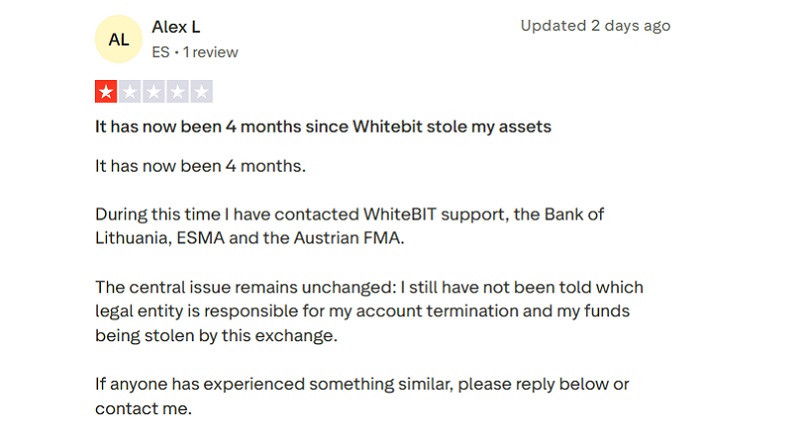
The user noted contacting multiple financial regulators — including the Bank of Lithuania, ESMA, and the Austrian FMA — while seeking clarification regarding entity responsibility. A matching report later appeared on Trustpilot.
This incident should not be taken as definitive proof that the exchange unlawfully retained user property. It remains an unverified claim by an individual client, and public records cannot independently confirm the precise status of the disputed funds.
Nevertheless, the case highlights valid questions regarding account closure protocols and customer communication.
What Happens When a Compliance Review Locks an Account?
Access holds are standard across the centralized crypto industry. A trading venue may restrict activity due to anti-money laundering (AML) protocols, sanctions screening, source-of-funds (SOF) checks, or suspected terms-of-service breaches.
Consequently, a temporary withdrawal hold during an inquiry does not inherently indicate fraudulent behavior.
The primary issue is how post-restriction procedures are managed. Clients reasonably expect clear answers regarding:
- Why access was restricted (where disclosure is legally permitted);
- Which corporate branch is conducting the inquiry;
- What specific identity verification materials are required;
- Whether submitted documents have been received and logged;
- What protocol governs eligible capital following account termination.
In the July Reddit post, the central grievance extended beyond the audit itself: the user specifically questioned which operating branch held legal authority over the closure and the remaining assets.
User Feedback Distribution on Trustpilot
Public review aggregators offer a valuable counterweight to automated domain safety checks.
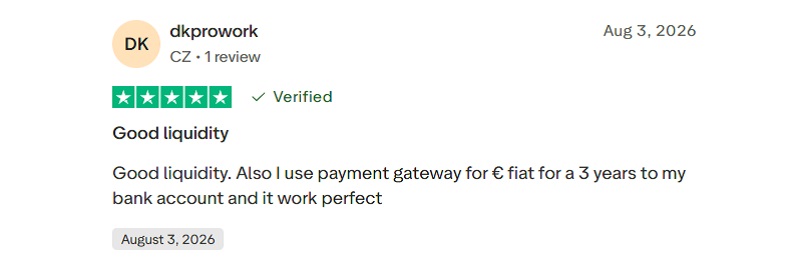
At the time of writing, the portal’s Trustpilot profile showed 446 user entries with an overall TrustScore of 3.2 out of 5. The rating breakdown is unusually polarized: approximately 48% of contributors awarded one star, while around 41% assigned five stars. Only a small fraction selected intermediate ratings.
| Rating | Share of Reviews |
|---|---|
| 5 stars | 41% |
| 4 stars | 7% |
| 3 stars | 3% |
| 2 stars | 1% |
| 1 star | 48% |
This bi-modal distribution is far more informative than the composite score. While a 3.2 rating might look mediocre on the surface, the sharp divide indicates two vastly different user journeys rather than a uniform, middle-of-the-road experience.
Positive Reviews
Favorable submissions highlight standard operational capabilities, including:
- Intuitive interface design;
- Responsive mobile application features;
- Smooth order execution;
- Unhindered deposit and withdrawal processing;
- Timely customer assistance in individual cases.
For instance, verified feedback from May 2026 praised mobile usability, while other 5-star posts expressed satisfaction with routine spot trading. These reports indicate that the exchange is not universally blocking client operations, as a substantial portion of the user base operates without incident.
Also Read: Top 5 Regulated Exchanges for 2026: Where to Trade Safely
Severe Customer Grievances
The 1-star section contains reports that go beyond basic complaints about trading fees or UI preferences.
- Several recent entries describe blocked withdrawals, secondary KYC requests, and prolonged review cycles. One client from Portugal reported trying to withdraw approximately €5,000 before the transaction was flagged, prompting requests for bank statements, video identification, and proof of origin for the deposited funds.
- The reviewer later updated the entry to confirm the issue had been resolved after additional correspondence. The platform's official response noted that the temporary hold was tied to international security standards.
This case is notable because it reached a resolution — unlike the July Reddit report. The restriction was lifted once verification requirements were met, demonstrating that severe withdrawal holds often represent extended compliance checks rather than permanent confiscation.
The Problem of Extended Review Cycles
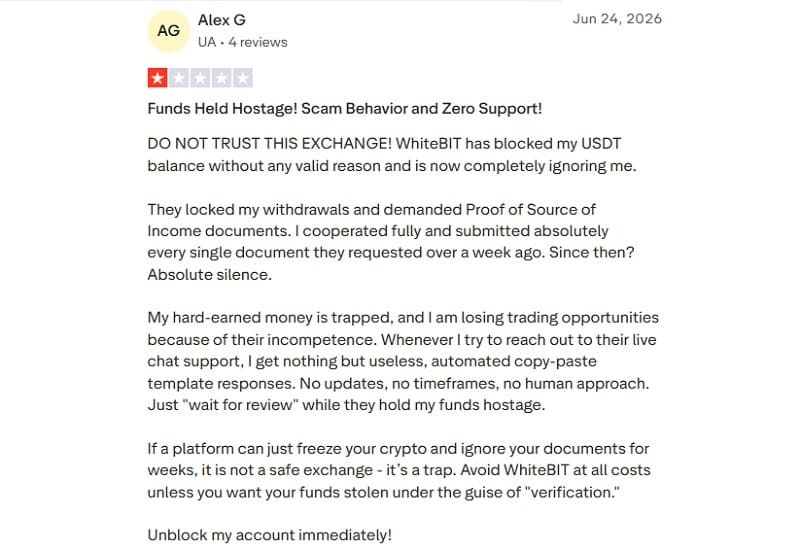
Other feedback highlights a more frustrating pattern: prolonged uncertainty.
A Ukrainian user reported that a USDT balance was locked pending proof-of-income documentation. The reviewer stated that the requested materials were submitted promptly, but subsequent responses from support became slow and repetitive. The platform responded publicly that the file was prioritized and remained under active review.
Another submission alleged that four months had passed since an account closure without receiving clear documentation identifying the responsible operating branch.
While these accounts do not prove illegal asset retention, they point to a recurring operational bottleneck: users undergoing enhanced due diligence often face extended timelines and opaque communication.
Platform Responses and Case Verification
Analyzing public feedback requires reviewing company statements as well.
In response to a reviewer claiming a deposit had disappeared, support noted that the incident could not be traced using the information provided. The representative requested specific identifying data — such as a User ID (UID), support ticket number, or blockchain transaction hash — to investigate further.
Public forum posts reveal only one side of a conflict. Without transaction logs, account records, and blockchain confirmations, it is impossible to determine whether an asset issue stems from an unauthorized transfer, an AML hold, user error, or a technical bug.
Therefore, public reviews should be viewed as documented user experiences rather than established legal facts.
Evaluating the Operational Contradiction
The available evidence presents two distinct narratives:
- User Complaints: Highlight frozen withdrawals, extended AML inquiries, account terminations, communication delays, and unclear entity responsibilities.
- Positive Data: Includes verified 5-star reviews, resolved withdrawal holds, and active company outreach to clear disputed tickets.
This contrast renders simple "scam or legitimate" labels inadequate. To build an accurate picture, one must examine whether the web domain exhibits technical warning signs.
Also Read: How to Spot Fake Crypto Exchanges Before You Lose Money
URLVoid Scan: Zero Blacklist Flags
Domain checking tools evaluate technical safety independently of user sentiment.
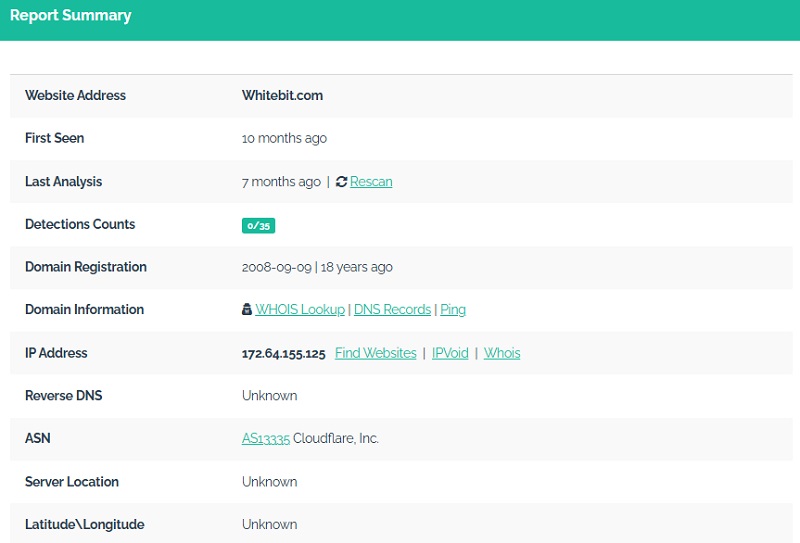
A URLVoid scan for whitebit.com shows a 0/35 detection rate, confirming that the domain is not flagged across 35 major security databases.
This clean result indicates that the portal is not operating as a typical phishing link or malware hub. However, database checks cannot judge whether an internal account closure was fair or whether customer service handled a dispute properly.
A clean security scan simply confirms that whitebit.com lacks known technical threat indicators.
Gridinsoft Assigns a 95/100 Safety Score
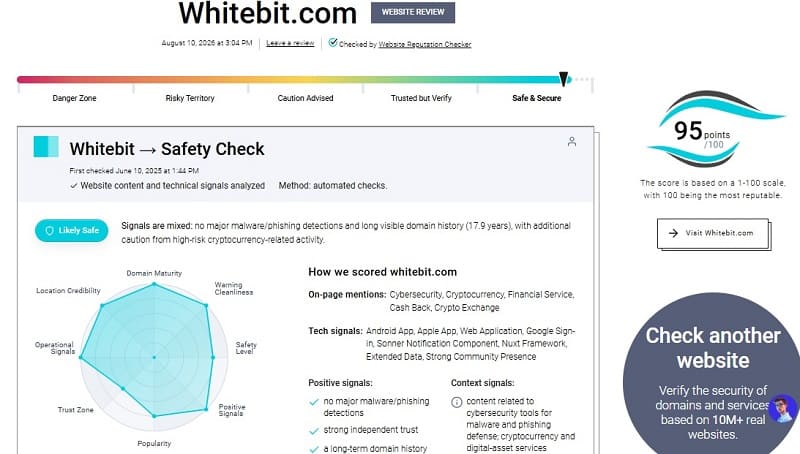
A second automated audit yields a similarly positive result. Gridinsoft assigns whitebit.com a 95/100 trust score, categorizing it as "Safe & Secure."
Key positive indicators include:
- Zero active malware or phishing detections;
- High domain authority;
- Long registration history (~17.9 years);
- Active social channels across X/Twitter, Discord, and YouTube;
- Official mobile app availability and valid SSL encryption.
The service notes mixed public review sentiment as a contextual risk factor, alongside the inherent risks of the cryptocurrency sector.
This breakdown illustrates why a platform can earn high technical safety marks while simultaneously generating significant user complaints regarding account freezes. Automated checkers inspect domain health; review boards capture human friction during compliance audits.
Regulatory Footprint and MiCA Framework Expansion
Corporate structure becomes crucial when analyzing account closure disputes, as a brand name does not always reveal which legal entity executes a specific user contract.
In June 2026, WB-Shield Innovations GmbH (operating under the WhiteBIT EU brand) received authorization as a Crypto-Asset Service Provider (CASP) under the European Union's Markets in Crypto-Assets (MiCA) framework from Austria's Financial Market Authority (FMA).
This is a major regulatory milestone. However, an authorization granted to a European branch does not automatically cover every global user on the main trading portal.
An EEA resident onboarded through WB-Shield Innovations GmbH operates under a different legal framework than an international trader onboarded through a different offshore subsidiary.
Knowing the exact contracting entity determines:
- Which supervisory body has jurisdiction;
- Which terms of service apply;
- What formal dispute resolution paths are available.
Additional European Licenses
The brand's regulatory footprint includes additional European registrations. In April 2026, WHITE TECH received CASP authorization under MiCA from Croatia's Financial Services Supervisory Agency (HANFA) for crypto exchange, transfer, and custody services.
Additionally, the corporate group established WB Technologies AG in Switzerland to align with Swiss AML/CFT frameworks.
While these licenses demonstrate an expanding regulatory structure in Europe, they highlight why users must identify which specific subsidiary holds their account relationship.
Terms of Service Regarding Account Restrictions
The platform’s User Agreement outlines explicit powers regarding compliance holds.
The terms authorize the company to request enhanced KYC documentation, source-of-wealth proof, transaction receipts, and video verification whenever compliance triggers are tripped.
Furthermore, the portal reserves the right to restrict access, freeze funds, or terminate service agreements under specific conditions, including:
- Suspected illicit or fraudulent activity;
- High-risk transaction flags;
- Incomplete compliance documentation;
- Sanctions matching or AML alerts.
This contractual framework explains many of the public grievances found online. A request for source-of-funds paperwork is an exercise of contractual rights rather than evidence of platform misconduct.
The core operational challenge remains the speed and transparency with which these inquiries are conducted.
Also Read: Exchange Account Suspension: When It’s Legitimate — and When It’s Not
Evidence Summary
Comparing technical indicators, regulatory records, and user feedback reveals a multi-layered operational profile:
| Indicator / Source | Finding | Practical Implication |
|---|---|---|
| Domain History | Multi-year established history | Inconsistent with short-lived scam sites. |
| URLVoid | 0/35 security detections | Clean domain safety record. |
| Gridinsoft | 95/100 Trust Score | High technical infrastructure rating. |
| Trustpilot | 3.2/5 (Polarized) | Split between smooth usage and dispute reports. |
| User Agreement | Broad AML / freeze powers | Operational holds are contractually permitted. |
| Austrian FMA | MiCA authorization (WB-Shield) | Verified EU regulated infrastructure. |
Final Verdict and Risk Classification
Based on available technical data, regulatory records, and community feedback, there is no basis to classify WhiteBIT as a fake exchange or scam portal.
The platform operates an established infrastructure, maintains clean domain safety ratings, and includes regulated entities within its European corporate structure (such as MiCA authorizations in Austria and Croatia).
However, public complaints regarding prolonged compliance checks and communication friction cannot be overlooked.
Overall Rating: Medium Risk
This classification reflects operational friction surrounding compliance audits and withdrawal holds rather than domain illegitimacy.
Positive Factors:
- Established operational history and strong domain health;
- Confirmed MiCA regulated subsidiaries in the EU (Austria, Croatia);
- Active mobile ecosystem and high technical safety scores.
Risk Factors:
- Polarized user review ratings;
- Reports of extended account freezes during AML inquiries;
- Complex corporate structure requiring careful entity identification.
Frequently Asked Questions
Is WhiteBIT a legitimate exchange?
Yes. Technical domain checks are clean, the brand has operated for years, and key corporate subsidiaries hold official MiCA authorizations within the European Union.
Why can account withdrawals be restricted?
The User Agreement permits access holds, enhanced document requests, and account suspensions to comply with international AML, CFT, and KYC mandates.
Does a frozen balance mean funds are stolen?
No. A temporary lock typically indicates an ongoing compliance review or document check. Public records confirm that many accounts are fully restored once verification requirements are satisfied.
Is WhiteBIT regulated under MiCA?
Yes, specific corporate subsidiaries within the wider group hold MiCA authorizations in Europe, including WB-Shield Innovations GmbH in Austria and WHITE TECH in Croatia.
What precautions should users take when holding balances?
Traders should verify which specific corporate entity governs their account, keep complete records of deposit receipts and KYC submissions, and avoid holding excess long-term capital on centralized platforms beyond their immediate trading needs.
Sources
Get professional help with your case.