
Is ACEOV a Scam? Inside the High-Yield Crypto Platform Promising “60% Daily Profit”
- What ACEOV Claims to Be
- Reality Check: Why These Returns Are Mathematically Impossible
- Independent Reputation & Technical Risk Analysis
- Trustpilot Reviews: Low Volume, High Risk Signals
- URLVoid Analysis: Malware Database Flagging
- GridinSoft Risk Assessment: Financial Scam Pattern Indicators
- How the ACEOV Scheme Actually Works
- Step 1 — Initial Contact and Trust Building
- Step 2 — Small Entry Deposit
- Step 3 — Simulated Profit Environment
- Step 4 — Escalation and Capital Expansion
- Step 5 — Withdrawal Restrictions and Additional Payments
- Step 6 — Loss of Access
- Real User Experience: Pattern Consistency
- Regulation and Legal Status
- Structural Analysis: Scam Classification
- Why This Scam Model Works
- Risk Assessment of ACEOV
- Final Verdict: Is ACEOV a Scam?
- Conclusion
- FAQ
- Need Help?
At first glance, ACEOV presents itself as a modern cryptocurrency investment platform.
It uses familiar industry language:
- AI-driven trading
- quantitative strategies
- automated profit generation
However, one specific claim defines the entire risk profile of the platform: “returns of up to 60% per day.”
This is not simply aggressive marketing — it is a claim that directly contradicts how financial markets operate. A closer examination reveals a structure that aligns closely with known high-risk and fraudulent investment models.
What ACEOV Claims to Be
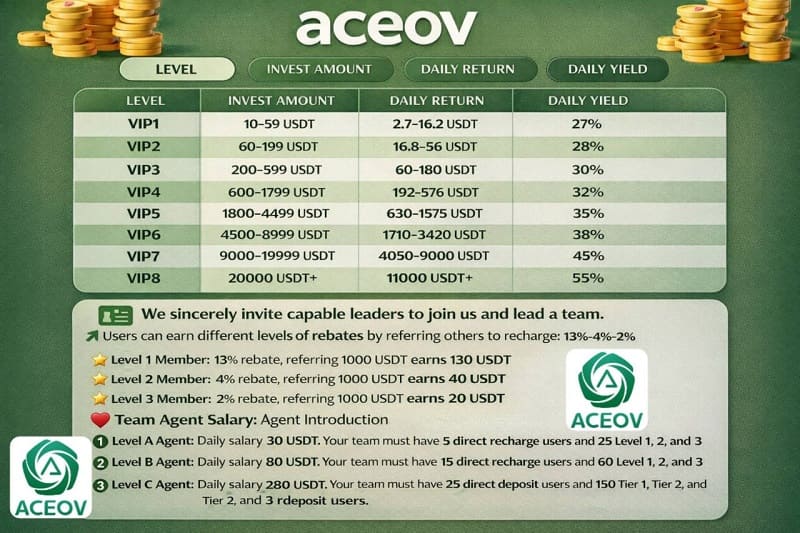
ACEOV positions itself as an AI-powered trading system capable of generating consistent daily returns.
According to its promotional materials:
- users can start with small deposits
- profits are generated automatically
- higher investment tiers unlock higher returns
Examples of advertised yields:
- VIP1 — ~27% daily
- VIP5 — ~35% daily
- VIP8 — up to 55–60% daily
Additionally, the platform includes a multi-level referral system:
- Level 1 — 13%
- Level 2 — 4%
- Level 3 — 2%
At a structural level, this resembles a tiered investment program. However, the numerical assumptions behind these returns are fundamentally unrealistic.
Reality Check: Why These Returns Are Mathematically Impossible
A daily return of 27% implies exponential compounding.
For example:
- $100 compounded at 27% daily exceeds $1,000,000 in approximately 40 days
This is not a theoretical concern — it is a direct consequence of compound growth mathematics.
In comparison:
- top hedge funds typically generate 10–30% annually
- even highly skilled traders rarely achieve consistent above-market returns
Regulatory guidance consistently warns that guaranteed or extreme returns are a primary indicator of fraud.
No legitimate trading system can sustainably generate 20–60% daily returns.
This alone places ACEOV within the category of high-yield investment schemes with impossible economics.
Also Read: QNET Review 2026: Business Opportunity or High-Risk Scheme?
Independent Reputation & Technical Risk Analysis
ACEOV is associated with multiple domains:
- aceov.org
- aceov.com
- ace-ov.com
- aceov.top
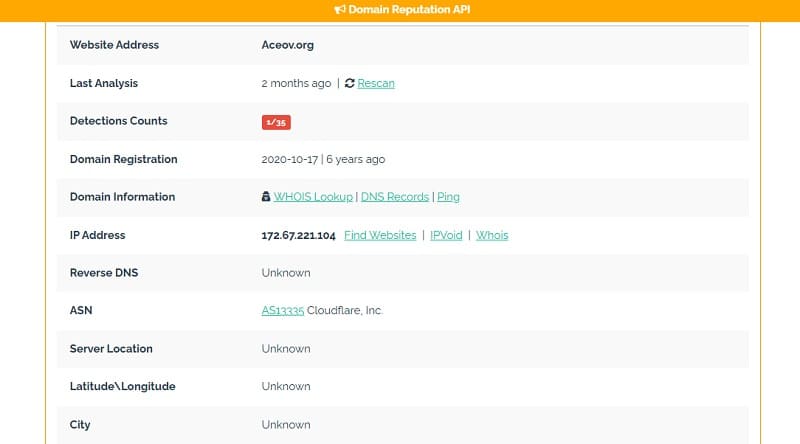
DomainTools data (aceov.org):
- Created: Feb 2026
- Very new domain
- Ownership hidden
- Hosted via Cloudflare
To assess whether ACEOV behaves like a legitimate investment platform or a high-risk scheme, it is critical to examine independent third-party data sources rather than relying on the platform’s own claims.
Below is a structured breakdown based on Trustpilot reviews and technical risk intelligence tools.
Trustpilot Reviews: Low Volume, High Risk Signals
Analysis of Trustpilot data for ACEOV domains reveals a pattern that is highly atypical for legitimate financial services.
Key observations:
- Extremely low number of total reviews
- 100% 1-star ratings in available sample
- Reports explicitly describing:
- fraud scenarios
- social engineering (including romance-based scams)
- pressure to recruit new users
Example patterns from reviews:
- users reporting being “scammed” and losing funds
- mentions of coordinated groups and identity changes
- claims that users are encouraged to bring in new participants
One review explicitly describes a system where early participants profit while later users incur losses — a structure consistent with Ponzi-style dynamics.
Source: Trustpilot
URLVoid Analysis: Malware Database Flagging
Using data from URL intelligence platform URLVoid for aceov.org.
Result:
- Detection count: 1 / 35 security engines
- Flagged by Gridinsoft database
This does not indicate widespread malware detection — but the type of detection matters more than the count.
URLVoid aggregates multiple threat intelligence databases, including:
- malware signatures
- phishing lists
- scam tracking systems
A single detection from a specialized security vendor (like Gridinsoft) often indicates:
- behavioral or financial scam patterns
- not necessarily traditional malware
Source: URLVoid
GridinSoft Risk Assessment: Financial Scam Pattern Indicators
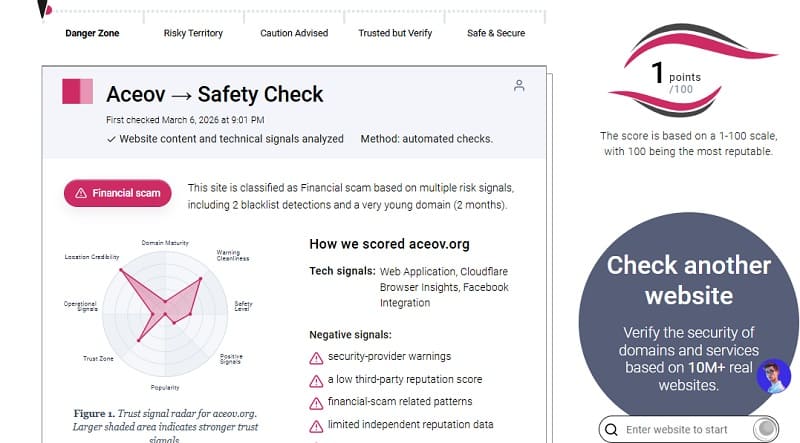
According to analysis from GridinSoft the risk score is 1 / 100 (Danger Zone).
Identified negative signals:
- warnings from security providers
- low reputation across independent sources
- classification linked to financial scam patterns
- very limited external reputation data
- recent domain registration (~2 months)
Source: GridinSoft
How the ACEOV Scheme Actually Works
ACEOV follows a pattern that closely matches documented crypto investment scams.
Step 1 — Initial Contact and Trust Building
Users are typically approached through:
- Telegram or WhatsApp
- social media platforms
- “mentors” or investment advisors
This approach aligns with broader scam patterns where communication begins informally and gradually transitions into financial discussions.
Step 2 — Small Entry Deposit
Users are encouraged to deposit a relatively small amount, often between $50 and $100.
At this stage:
- the platform displays positive returns
- withdrawals of small amounts may be processed
This creates the impression that the system is legitimate and functional.
Step 3 — Simulated Profit Environment
The platform presents:
- increasing balances
- daily profit updates
- incentives to upgrade investment tiers
These figures are not derived from real trading activity. Instead, they are generated within a controlled internal system that simulates profitability without executing actual market transactions.
Step 4 — Escalation and Capital Expansion
Once trust is established, users are encouraged to:
- deposit larger amounts
- upgrade to higher VIP tiers
- recruit new participants
The referral system reinforces this behavior by rewarding expansion.
This structure mirrors Ponzi-like mechanics, where incoming funds from new users sustain the system.
Step 5 — Withdrawal Restrictions and Additional Payments
When users attempt to withdraw significant funds, the process changes. Instead of processing the withdrawal, the platform introduces new requirements, such as:
- “tax” payments
- verification fees
- additional deposits to unlock funds
This is not a procedural delay. It is a deliberate mechanism designed to extract additional payments before the user realizes that withdrawal is not possible.
This pattern is consistent with advance-fee fraud, where victims are repeatedly asked to pay in order to access funds that do not exist.
Step 6 — Loss of Access
In the final stage:
- withdrawals remain unprocessed
- support communication becomes unresponsive
- accounts may be restricted or inaccessible
In some cases, the platform itself disappears or reappears under a new domain. At this point, recovery becomes extremely difficult.
Real User Experience: Pattern Consistency
Reports across multiple sources describe a consistent progression:
- initial success with small withdrawals
- increasing pressure to invest larger amounts
- introduction of withdrawal barriers
- eventual loss of access to funds
This consistency indicates a structured system rather than isolated technical failures.
Also Read: “Elon Musk” Crypto Casino Scam: A Forensic Breakdown of the $2,500 Bonus Trap
Regulation and Legal Status
There is no verifiable evidence that ACEOV is:
- licensed by the Financial Conduct Authority
- registered with the Securities and Exchange Commission
- overseen by any recognized financial authority
Independent analysis confirms the absence of regulatory oversight and verifiable company information. This means user funds are not protected by any formal legal or financial safeguards.
Structural Analysis: Scam Classification
| Component | Present |
|---|---|
| High-yield investment scheme (HYIP) | YES |
| Referral-based expansion | YES |
| Social engineering entry | YES |
| Simulated trading interface | YES |
| Advance-fee extraction | YES |
This is a composite fraud model combining multiple known scam mechanisms.
Why This Scam Model Works
ACEOV leverages three key psychological drivers:
- Perceived Opportunity. High returns create urgency and override skepticism.
- Gradual Trust Formation. Early success (real or simulated) builds confidence.
- Escalation Pressure. Users are encouraged to increase exposure over time.
These elements are widely documented in modern crypto fraud systems.

Risk Assessment of ACEOV
| Factor | Level |
|---|---|
| Transparency | Extremely low |
| Return realism | Impossible |
| Regulatory oversight | None |
| Scam indicators | Critical |
| Overall risk | Very high |
Final Verdict: Is ACEOV a Scam?
Based on:
- mathematically impossible return claims
- multi-domain infrastructure
- lack of regulation
- consistent user complaints
- alignment with known fraud patterns
ACEOV demonstrates all key characteristics of a coordinated crypto investment scam.
This is not a high-risk investment platform, but rather a system designed to extract funds.
Conclusion
ACEOV does not generate profits through trading activity. It generates the appearance of profitability in order to encourage deposits.
Once funds are transferred:
- control is lost
- withdrawal becomes conditional
- recovery becomes unlikely
If a platform promises consistent daily returns of 20–60%, it is not participating in financial markets — it is operating outside them.
FAQ
Is ACEOV legitimate?
There is no verified evidence supporting its legitimacy. Multiple indicators suggest scam behavior.
Can users withdraw funds?
Small withdrawals may be processed early, but larger withdrawals are typically blocked.
Why does the platform appear to work initially?
Because the system is designed to simulate success before increasing user investment.
Can funds be recovered?
In most cases, recovery is difficult and depends on rapid response and external intervention.
Need Help?
If you have lost funds through ACEOV, consider seeking professional assistance. Specialists at Stock View can analyze transaction flows and assess the likelihood of recovering your assets, as well as help prevent further losses.
Get professional help with your case.