
QNET Review 2026: Business Opportunity or High-Risk Scheme?
- What Is QNET? Company Structure and Background
- Important nuance:
- How the QNET Business Model Works
- A Realistic Recruitment Scenario
- Products vs Perceived Value
- The Core Controversy: MLM vs Pyramid Structure
- Legal Status and Regulatory Concerns
- Trustpilot Reviews: A Divided Reputation
- Technical Reputation: Domain and Security Analysis
- Why People Still Join
- Red Flags to Watch
- Can You Actually Make Money With QNET?
- Conclusion
- FAQ
- Sources
- Need Help?
“Someone you trust reaches out. They tell you they’ve started a side business. They’re earning well. Traveling. Buying gifts for family. And they say you can do the same.”
This is how many people first encounter QNET. Not through advertising or financial platforms — but through friends, relatives, or acquaintances. That alone already sets it apart from traditional business models.
In 2026, QNET remains one of the most controversial names in global direct selling. It operates legally in many regions, yet continues to face criticism, investigations, and persistent allegations related to how its business model is implemented on the ground.
So the real question is not just “Is QNET a scam?” — but:
How does the system actually work, and why do so many participants feel misled after joining?
What Is QNET? Company Structure and Background
QNET Ltd. (qnet.net) is part of the QI Group, a multinational conglomerate founded in 1998.
Key corporate details:
- Parent group: QI Group
- Founders: Vijay Eswaran and Joseph Bismark
- Incorporation: Late 1990s (rebranded from GoldQuest to QuestNet and QNET)
- Primary registration: Hong Kong (historically linked corporate structure)
- Operational footprint: Asia, Middle East, Africa
QNET operates through a network of affiliated companies and regional entities, which can make its legal structure difficult to map precisely for the average participant.
Important nuance:
There is no single “global QNET license” — operations are often:
- distributed
- localized
- dependent on regional legal frameworks
This fragmentation is one of the reasons why:
- regulatory treatment differs by country
- enforcement actions often target local distributors rather than the parent entity

How the QNET Business Model Works
At its core, QNET follows a multi-level marketing (MLM) structure.
Participants typically:
- Purchase a product package (often high-value)
- Gain access to a distributor account
- Earn commissions through network expansion
While officially framed as product-based direct selling, many participants report that:
- actual product demand is limited
- earnings depend heavily on recruitment
- commissions are tied to network growth
This creates a structural imbalance.
In a traditional business revenue comes from customers. In many MLM environments revenue often comes from new participants entering the system. This distinction is critical when evaluating sustainability.
A Realistic Recruitment Scenario
A common pattern emerges across user reports. A friend or relative reaches out with an opportunity. They describe:
- financial independence
- fast growth
- a “proven system”
You are invited to meetings — often in hotels, conference rooms, or upscale venues. There, you meet people who present themselves as long-term success stories.
The environment is structured:
- testimonials
- visual proof of success
- emotional motivation
Only later does the financial commitment become clear. Initial participation often requires a significant upfront payment, sometimes framed as a product purchase or business investment.
At this stage, many participants believe they are entering a business. Only afterward do they fully understand that growth depends on bringing others into the same structure.
Also Read: Affiliate and Task Scams Explained

Products vs Perceived Value
QNET sells a range of physical products:
- supplements
- wellness items
- watches
- jewelry
These products are often presented as premium or high-quality. However, a recurring concern in user feedback is the price-to-perceived-value gap.
Participants report that:
- products are difficult to resell
- pricing is significantly higher than comparable market items
- demand outside the network is limited
This raises an important structural issue: if products cannot be sold independently, income becomes dependent on recruitment.
The Core Controversy: MLM vs Pyramid Structure
To understand QNET, it’s essential to distinguish between:
- Multi-Level Marketing (MLM) — legal when based on real product sales
- Pyramid schemes — illegal when based primarily on recruitment
The challenge is that the boundary between the two is not always clear in practice.
Regulators such as the Federal Trade Commission have repeatedly warned that MLM structures become problematic when participants earn more from recruitment than from actual product sales.
This is where QNET faces ongoing scrutiny.
Not necessarily because of its official model — but because of how the model is executed in real-world recruitment environments.

Legal Status and Regulatory Concerns
QNET has faced regulatory attention in multiple countries.
In India, authorities including the Reserve Bank of India and law enforcement agencies have issued warnings about MLM-style operations and unauthorized deposit schemes.
There have also been:
- arrests linked to recruitment networks
- investigations into local operations
- repeated public advisories
Importantly, these actions are often directed at individual distributors or networks, not always the company itself.
However, they reflect a consistent pattern: the model, when executed aggressively, can cross into legally questionable territory.
Trustpilot Reviews: A Divided Reputation
QNET’s reputation on review platforms such as Trustpilot is highly polarized.
Positive Reviews
Many positive reviews:
- describe life-changing income
- praise mentorship and community
- emphasize personal growth
However, a closer look often reveals patterns:
- highly emotional language
- similar phrasing across reviews
- focus on lifestyle rather than product value
In some MLM environments, participants are encouraged to post positive reviews — which can distort perception.
Negative Reviews
Negative feedback tends to be more detailed and specific.
Common complaints include:
- financial losses after joining
- pressure to recruit friends and family
- difficulty selling products
- lack of return on investment
These reviews often describe a gradual realization:
- initial excitement
- followed by confusion
- ending in financial disappointment
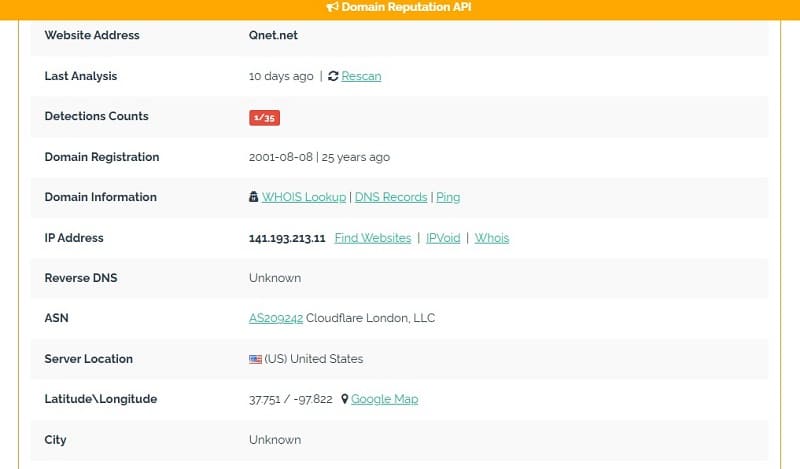
Technical Reputation: Domain and Security Analysis
A domain check through security aggregators shows that the QNET website is not widely blacklisted.
Detection rate
- approximately 1/35 databases
However, it is flagged in at least one system — Gridinsoft. This matters because absence from blacklists does not equal trust — it only means no widespread security flags.
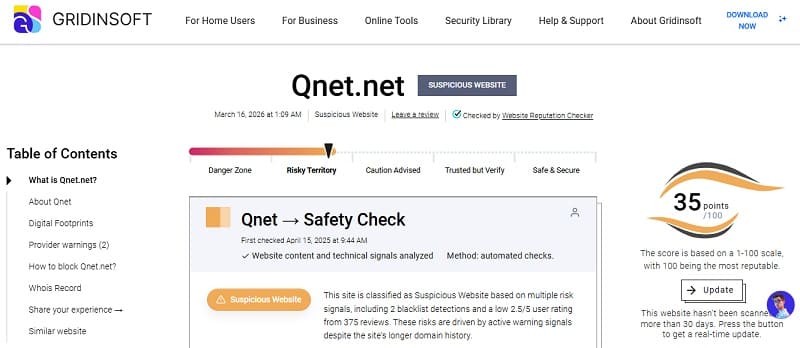
Gridinsoft Analysis
According to Gridinsoft:
- Trust Score: 35/100
- Classification: Risky Territory
Negative signals include:
- low third-party reputation scores
- warnings from security providers
- negative review trends
Positive signals include:
- long domain history (over two decades)
- active SSL certificate
- verified social media presence
- measurable traffic footprint
Gridinsoft blocks the site as “suspicious,” not because of malware — but due to reputation-based risk indicators. This reflects an important nuance. The concern is not technical security — but behavioral and reputational risk.
Why People Still Join
Despite controversy, QNET continues to attract participants.
Key drivers include:
- trust in personal relationships
- emotional storytelling
- visible examples of success
- fear of missing out (FOMO)
For many, the decision is not purely rational. It is influenced by hope, social pressure, and desire for financial change.
Red Flags to Watch
Certain patterns should raise caution:
- strong focus on recruitment over product sales
- upfront payments framed as “investment”
- unrealistic income promises
- pressure to act quickly
- encouragement to borrow money to join
These signals are more important than branding or presentation.
Also Read: The Hidden Danger of WhatsApp/Signal Investment Contact Scams
Can You Actually Make Money With QNET?
Technically, yes.
But in practice:
- success depends heavily on recruitment
- market saturation limits growth
- most participants do not reach sustainable income
This aligns with broader findings from organizations like the Federal Trade Commission, which indicate that a large percentage of MLM participants earn little or no profit.
Conclusion
QNET is not a simple case of “scam” or “legitimate business.” It is something more complex. A structured system where outcomes depend less on products — and more on network expansion.
For some participants, it becomes an opportunity. For many others, it becomes a costly lesson. The key is understanding the structure before entering it — not after.
FAQ
Is QNET a scam?
Not officially classified as one, but it has faced significant criticism and regulatory scrutiny.
Is QNET legal?
It operates legally in some jurisdictions, but local enforcement varies.
How does QNET make money?
Through product sales and distributor network expansion.
Why do people lose money?
Due to reliance on recruitment and limited real product demand.
Can you recover lost money?
Recovery is difficult, especially if funds were transferred voluntarily.
Sources
- Federal Trade Commission
- Reserve Bank of India
- Gridinsoft domain analysis
Need Help?
If you lost money through QNET or similar MLM structures, you can request a free consultation with the Stock View team.
Get professional help with your case.