YepBit Exchange Review: How the BonChat Copy-Paste Trading Scheme Reportedly Collapsed
- How the BonChat Trading System Was Reportedly Designed
- Recruitment Played an Important Role
- Why the System Looked Convincing
- The Mid-Year Gala That Changed Everything
- Why the Withdrawal Freeze Raised Concerns
- A New Platform Instead of Withdrawals
- Early Withdrawals Do Not Always Indicate Legitimacy
- Regulators Identified Additional Warning Signs
- Why So Many Participants Continued Believing
- Why the Migration to AXIOM Deserves Attention
- Browser Warnings Add Another Layer of Concern
- Conclusion
- FAQ
- Sources
- Need Help?
Most fraudulent investment platforms encourage users to trade independently or rely on automated algorithms.
The complaints surrounding YepBit Exchange describe something very different. According to numerous contributor accounts, members did not analyse markets, choose entry points or develop trading strategies. Instead, they simply copied a short code from a messaging application and pasted it into the transaction terminal at scheduled times each day.
The process was presented as a sophisticated investment system capable of generating steady daily returns with almost no technical knowledge.
In July 2026, state financial authorities in Ghana published an official alert regarding YEPBIT Exchange and BONCHAT, cautioning the public that neither entity held valid authorizations to conduct investment activities.

How the BonChat Trading System Was Reportedly Designed
Public discussions describe BonChat as far more than an ordinary group messenger. Subscribers say it functioned as the operational centre of the entire programme.
Several times each day, an individual introduced as Professor Jonathan Brook — sometimes referred to simply as Professor Brook — or other administrators allegedly published short execution codes.
Members were instructed to:
- copy the code;
- open their YepBit account;
- paste the instruction into the trading interface;
- confirm the transaction.
The workflow required minimal market literacy. Success depended almost entirely on following instructions exactly as they appeared.
According to user accounts, beginners initially received access to only a limited number of daily execution windows. Additional sessions became available only after meeting specific network requirements.
This tiering created the impression that higher status unlocked greater earning opportunities rather than requiring enhanced analytical skill.
Recruitment Played an Important Role
Another recurring feature appears throughout user testimonials.
Progress inside the programme was connected not only to account size but also to bringing new investors into the fold. According to multiple accounts, recruiting additional members unlocked extra daily execution cycles and higher status tiers.
Examples included:
- Junior / Intermediate / Senior / Brand Shareholder.
Higher ranks were also described as qualifying for monthly disbursements referred to as "dividends."
This distinction is critical. Rather than relying exclusively on market activity, rank advancement allegedly depended partly on expanding the user network. Financial watchdogs explicitly urge retail investors to remain wary of structures where financial gain hinges on downline recruitment.
Also Read: A Practical Guide to Detecting Clone Crypto Exchange Websites

Why the System Looked Convincing
Many online investment scams promise extraordinary returns without providing a believable process.
The reports concerning YepBit describe the opposite. The routine appeared highly structured:
- Execution windows occurred at fixed times each day.
- Members followed identical instructions.
- Results appeared consistent.
Because everyone completed the same sequence of actions, the process created an impression of professional coordination.
Several contributors also describe receiving successful payouts during the early stages. From their perspective, this appeared to confirm that the business model genuinely worked. That experience encouraged some members to increase their capital balances over time.
The combination of scheduled order execution, visible account growth, and occasional successful withdrawals made the overall system appear considerably more credible than a typical high-yield investment scheme.
| Feature | Operational Details |
|---|---|
| Trading Method | Copying codes from BonChat into YepBit. |
| Daily Schedule | Fixed execution windows at scheduled times. |
| Skill Requirement | No independent market analysis required. |
| Account Progression | Extra trading windows unlocked over time. |
| Network Growth | Referrals unlocked higher daily limits and ranks. |
| Early Withdrawals | Initial payout requests processed successfully. |
Viewed in isolation, each individual feature may appear relatively ordinary.
Taken together, however, the reported structure differs significantly from conventional investing, where performance normally depends on independent research, shifting market dynamics, and individual risk management rather than repeatedly duplicating identical codes distributed through a private communication group.
The Mid-Year Gala That Changed Everything
According to numerous user accounts, the programme continued operating normally for several months:
- Members followed the same daily routine.
- Order executions appeared to generate consistent returns.
- Some users even reported recovering their original capital through earlier withdrawals.
- Confidence remained high.
- That dynamic shifted during what organisers called the Mid-Year Gala.
- Investors were told that yields would temporarily increase from approximately one percent to two percent per execution cycle.
- They were also informed that account balances would effectively double during the promotional campaign.
One important condition accompanied those promises: capital redemptions were suspended until the campaign concluded. For many investors, this restriction appeared reasonable because the event was framed as a limited-time opportunity to maximize yields.
Why the Withdrawal Freeze Raised Concerns
Public accounts describe a dramatic shift immediately after the promotional period ended:
- Many members attempted to withdraw their accumulated balances at roughly the same time.
- Instead of processing requests, operators allegedly explained that servers had become overloaded because hundreds of thousands of users were requesting payouts simultaneously.
- Participants were urged to remain patient.
- According to multiple online discussions, support representatives repeatedly assured users that the backlog was temporary and that normal operations would soon resume.
- Several days later, however, a different announcement appeared.
- Members were informed that YepBit had ceased operations.
- Instead of receiving access to their funds, they were introduced to a new proposal involving another portal.
This sequence — temporary suspension, technical explanations, and eventual platform migration — has been highlighted by numerous investors following the reported shutdown.

A New Platform Instead of Withdrawals
Rather than reopening cashouts, organisers introduced a service called AXIOM:
- Users claim they were told that assets could eventually be recovered through this new environment.
- The proposed solution required a supplementary fee.
- According to several accounts, users were encouraged to deposit approximately two percent of their displayed balances before compensation could begin.
This detail deserves careful attention.
Someone who believed they already owned substantial profits was asked to transfer even more money before receiving any funds back.
Advance-fee requests following the collapse of an investment platform are widely recognized warning signs because they require victims to risk additional capital to recover assets that may never have existed outside the operator's ledger.
Also Read: Why Exchange Mobile Apps Have Become the Main Attack Vector
Early Withdrawals Do Not Always Indicate Legitimacy
One of the most striking aspects of the YepBit reports is that many members openly acknowledge receiving successful payouts during earlier stages. Some recovered their original capital. Others even reported making modest profits before the portal stopped operating.
At first glance, this appears inconsistent with traditional financial fraud.
In reality, consumer protection agencies have repeatedly warned that some fraudulent investment schemes deliberately process limited redemptions during early stages to build trust and encourage larger financial commitments later.
From a psychological perspective, receiving actual cash is far more convincing than seeing numbers on a digital screen. Once investors believe the platform has already paid them successfully, future requests for additional deposits often appear much less risky.
Regulators Identified Additional Warning Signs
The concerns surrounding YepBit extend beyond individual community discussions.
On 15 July 2026, Ghana's Securities and Exchange Commission formally flagged YEPBIT Exchange and BONCHAT as unauthorized market actors operating without statutory licenses.
A week later, enforcement bodies added both brand names to an expanded roster of illicit platforms, confirming active engagement with regional law enforcement to address the matter.
These notices do not determine individual civil or criminal liability. They do, however, provide crucial regulatory context that prospective investors should consider before transferring capital.
| Phase | Key Developments |
|---|---|
| Normal Operation | Daily signal copying with steady account growth. |
| Mid-Year Gala | Promotional daily yield boost paired with frozen payouts. |
| Post-Event Status | Mass withdrawal requests delayed or rejected. |
| Official Explanation | Delays attributed to heavy server traffic. |
| Platform Closure | Complete cessation of operations. |
| Transition Proposal | Account migration to AXIOM requiring extra fee. |
Viewed as individual events, each announcement might appear temporary or administrative.
Taken together, however, the reported sequence represents a significant shift — from routine execution activity to restricted cashouts, followed by the introduction of a completely new platform requiring further financial deposits before any recovery could supposedly begin.

Why So Many Participants Continued Believing
One of the most revealing aspects of the YepBit story is that many members openly acknowledge they trusted the programme until the very end. This was not simply because of promised profits.
Several different mechanisms reinforced confidence over time:
- Some users reported recovering their initial deposits.
- Others described receiving regular redemptions for several months.
- Daily routines created the appearance of operational stability.
- Community leaders answered questions inside BonChat.
- Higher membership tiers rewarded continued participation.
Each individual element reduced suspicion.
Taken together, they created an environment where many users believed temporary disruptions were simply part of scaling a rapidly growing venture.
Why the Migration to AXIOM Deserves Attention
Public reports indicate that the closure of YepBit did not necessarily mark the end of communication with investors. Instead, many users say they were directed to another venue known as AXIOM:
- Rather than processing outstanding payout requests, operators allegedly presented the new site as the remedy.
- According to multiple accounts, users were told they could unlock frozen assets after making an extra payment equal to roughly two percent of their recorded balance.
- From a behavioural perspective, this request follows a familiar pattern.
- An individual who believes a substantial balance exists may be more willing to risk a comparatively smaller sum in the hope of recovering everything.
Consumer protection agencies frequently warn that requests for additional deposits after an investment platform halts operations should be treated with extreme caution, particularly when those transfers are framed as activation fees, recovery deposits, or account restoration charges.
Also Read: Exchange Insurance Funds: What Do They Actually Cover?
Browser Warnings Add Another Layer of Concern
Technical indicators also merit attention.
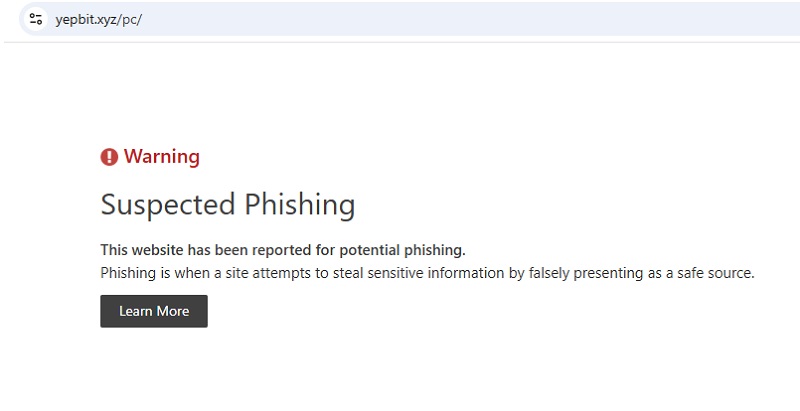
At the time of writing, visitors attempting to access yepbit.xyz may encounter a browser security warning identifying the portal as "Suspected Phishing." Such alerts are generated by web security protocols after reports or automated scans flag deceptive behavior or credential risks.
A browser warning does not determine legal liability on its own. It should, however, prompt users to stop and investigate before entering credentials, transferring cryptocurrency, or submitting personal data. When combined with public regulatory warnings and numerous user grievances, this technical signal becomes difficult to ignore.
| Characteristic | Risk Context |
|---|---|
| Signal Replicating | Replaces genuine analysis with automated code entry. |
| Multi-Level Ranks | Ties profitability directly to downline expansion. |
| Initial Cashouts | Builds trust before larger capital is committed. |
| Payout Locks | Prevents capital removal during promotion peaks. |
| AXIOM Migration | Demands advance recovery fees on frozen balances. |
| Phishing Alert | Triggers browser security warnings on domain. |
Conclusion
The reports surrounding YepBit describe considerably more than an ordinary trading application.
Instead, they outline an ecosystem combining scheduled order executions, code-replication instructions, community messaging, referral incentives, and promotional campaigns designed to encourage sustained participation. According to numerous accounts, the turning point occurred following the Mid-Year Gala, when cashouts were frozen and explanations shifted from temporary server issues to complete operational shutdown.
The subsequent introduction of AXIOM, paired with requests for extra capital transfers before compensation could supposedly begin, has become one of the most heavily criticized aspects of the reported collapse.
Official statements further corroborate participant concerns.
Public advisories confirm that the platform lacked necessary regulatory clearances, serving as a reminder to verify an operator's legal standing whenever encountering high-yield promises combined with mandatory downline expansion.
Anyone encountering a similar operational model — particularly one combining structured referral tiers, fixed daily signal schedules, restricted payouts, and advance-fee requests after technical breakdowns — should thoroughly verify the regulatory status of the operator before committing capital.
FAQ
What was YepBit Exchange?
Public reports describe YepBit as a cryptocurrency portal used alongside BonChat, where users followed signal-based copy-and-paste instructions issued by administrators. Ghana's SEC has confirmed that YepBit Exchange was not authorized to offer investment services.
How did the reported trading system work?
According to user accounts, members copied signal codes from BonChat and pasted them into the YepBit interface during scheduled execution windows rather than making independent market analysis.
Why is recruitment considered a major warning sign?
Regulators specifically caution investors against schemes where income depends primarily on recruiting new users, noting this structure as a key indicator of suspected financial fraud.
Why did users mention AXIOM after YepBit stopped operating?
Several contributors report being advised to migrate to AXIOM and make a supplementary deposit before their frozen balances could supposedly be released. These claims stem from user accounts and require independent verification.
What should I do if I participated in a similar programme?
Cease transferring further funds immediately, preserve transaction receipts and chat logs, check whether the operator holds a valid license with official financial regulators, and file a report with consumer protection authorities if fraud is suspected.
Sources
- Ghana Securities and Exchange Commission — Public Notice: Warning Against YEPBIT Exchange and BONCHAT Platforms – Suspected Fraudulent Investment Schemes
- Ghana Securities and Exchange Commission — List of Entities Operating Without a Licence
- News coverage of the SEC warning (Graphic Online, B&FT, Adom Online)
Need Help?
If you deposited funds on YepBit Exchange — especially if you were attracted by its copy‑trading feature, promising to mirror the trades of "successful" investors — and are now facing withdrawal freezes, account restrictions, or complete platform silence following its reported collapse, you can request a free consultation with StockView specialists.
An expert review can help determine whether your case follows the same pattern as the BonChat copy‑trading scheme and realistically assess your chances of recovering lost funds through chargebacks, crypto tracing, exchange intervention, or legal follow‑up against the operators behind this suspected clone platform.
Get professional help with your case.