Wallet Backup Mistakes That Still Cost Crypto Users Millions
- Why Technical Exploits Pale in Comparison to User Error
- The Hidden Trap of Photos and Screen Captures
- The Illusion of Secure Cloud Drives
- Instant Messengers and "Self-Chat" Exploits
- The Myth of the Secure Document
- Fortifying Your Physical Defenses
- Summary
- FAQ
- Sources
For many cryptocurrency enthusiasts, the ultimate nightmare is a hacker breaching their software. In reality, a staggering volume of financial losses originates much earlier—at the very moment recovery mnemonics are generated and archived.
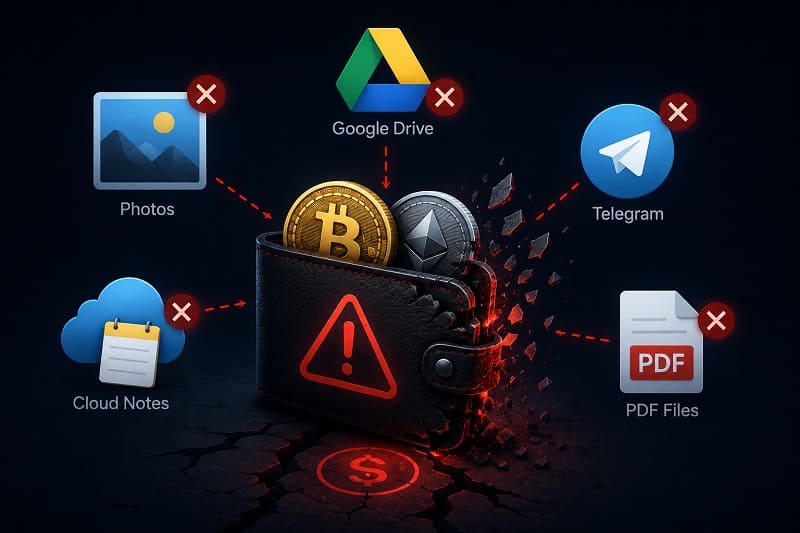
Cybersecurity investigators and hardware wallet manufacturers continuously document the same frustrating pattern: assets are rarely stolen because an app itself was compromised. Instead, funds vanish because sensitive credentials were left in digital environments that modern drainers routinely scour.
Synchronized camera rolls, smartphone screen captures, and automated operating system backups all feed this epidemic of avoidable theft. Leading developers persistently urge users to anchor their keys entirely in the physical world rather than trusting mainstream consumer clouds.

Why Technical Exploits Pale in Comparison to User Error
Hollywood-style operations dominate media headlines, but everyday capital drain looks remarkably mundane. Most security compromises stem from deeply ingrained digital habits.
When configuring a new crypto account, users instinctively turn to familiar productivity tools:
- Built-in smartphone cameras;
- Public cloud hosting;
- Native note-taking applications;
- Instant messaging ecosystems;
- Standard desktop clipboards.
The primary appeal of these utilities — instant cross-device synchronization — is precisely what broadens the attack surface.
A seed phrase saved electronically rarely stays confined to a single machine. Unbeknownst to its owner, a digital copy frequently propagates across synchronization nodes, cached image thumbnails, legacy hardware profiles, and local system restoration archives.
Consequently, a single compromised email account or an automated data restoration onto a replacement phone can expose keys that were meant to remain completely confidential. This cross-contamination explains why hardware wallet teams explicitly condemn any electronic duplication of critical keys.
Crucially, this vulnerability is not restricted to newcomers; even blockchain-savvy veterans routinely fall victim because they underestimate the access model of their own smartphones and cloud hostings.
The Hidden Trap of Photos and Screen Captures
Snapping a quick picture of a backup card feels efficient, accurate, and safe from transcription errors. Ironically, those exact properties make it an exceptionally high-risk habit.
Modern mobile platforms rarely isolate images locally. Depending on default configurations, snapshots instantly migrate to networks like iCloud, Google Photos, or manufacturer-specific data servers. Once that upload occurs, private keys exist simultaneously on remote servers and interconnected hardware.
Furthermore, simply moving an image to the trash bin does not guarantee its destruction. The file often persists in hidden partitions:
[Camera Roll] ──> [Cloud Archive] ──> [Trash Bin (30-Day Cache)] ──> [Hidden System Thumbnails]
Residual metadata, temporary cache folders, and synchronized tablet libraries can preserve the graphic long after the user believes it was erased. For this reason, security engineers advocate for a complete ban on imaging credentials.
Screenshots introduce identical liabilities, exacerbated by optical character recognition (OCR). Modern operating systems index text within images to make them searchable. While convenient for tracking receipts, this utility means an intruder with basic access can type "mnemonic" or "recovery" into a search bar and instantly pinpoint the target data.
The hazard is far from theoretical. In early 2026, South Korea's National Tax Service inadvertently included a visible mnemonic card alongside a hardware wallet in an official press release photograph. Before the agency could retract the image, automated monitoring tools extracted the phrase, and external actors emptied the associated addresses of millions of dollars. The incident proved that a single exposed frame completely invalidates any underlying device security.
| Setup Method | Primary Vulnerability | Status |
|---|---|---|
| Smartphone snapshot | Automated cloud mirroring and persistent system cache. | Strictly Avoid |
| OS Screen Capture | Automated text indexing and searchable image galleries. | Strictly Avoid |
| Isolated local image | Vulnerable to mobile malware, physical theft, or future updates. | Strictly Avoid |
| Handwritten paper | Susceptible to fire, liquid, or accidental disposal. | Recommended (with protection) |
| Engraved metal | High resistance to physical destruction and environmental wear. | Highly Recommended |
| Dual offline locations | Minimizes the risk of total loss from a single localized incident. | Critical Practice |

The Illusion of Secure Cloud Drives
Shared network directories have become foundational to daily life. Documents, files, and personal archives flow seamlessly between computers without a second thought. However, this fluid data movement makes commercial servers an incredibly dangerous repository for wallet recovery information.
The core issue is not that platforms like Dropbox, OneDrive, or Google Drive lack encryption; it is that they expand the ecosystem of vulnerability. A text file or unencrypted PDF containing secret phrases becomes exposed to:
- Session hijacking on trusted computers;
- Stealthy malware running background processes;
- Shared folder permissions inadvertently granted to third parties;
- Outdated, forgotten devices that remain authorized on the account.
Even when protected by complex passwords and two-factor tokens, cloud environments are permanently connected to the web. If an entry point is compromised, an intruder gains immediate access to archived items that should have remained offline.
Additionally, cloud service providers aggressively index documents to optimize user search functions. If unauthorized access occurs, finding a text-based seed phrase takes seconds.
Also Read: Best Practices for Using Multisig and Cold Storage
Instant Messengers and "Self-Chat" Exploits
Messaging platforms introduce a unique behavioral risk. Many individuals treat chat features like Telegram’s "Saved Messages" or WhatsApp's self-chats as a universal notepad. While intended for temporary convenience, these notes often become permanent fixtures.
Such text strings remain synchronized across web interfaces, desktop software, and legacy hardware for years. Deleting a chat locally does not guarantee its complete purge from server backups or interconnected clients. Recognizing this trend, Telegram's own security guidance for its DeFi wallet explicitly warns users never to store recovery phrases in messaging applications or screenshots, emphasizing that keys must remain strictly offline.
An account takeover via SIM-swapping or session-jacking gives an attacker immediate access to historical chat data. In these scenarios, the messaging client—not the crypto app — becomes the fatal vulnerability.

The Myth of the Secure Document
Users who avoid photos often fall into a different trap: creating a digital file. Whether it is an Apple Note, a Microsoft Word document, an unencrypted text file, or a Notion workspace, the underlying danger is identical.
Digital text is routinely indexed by local search engines, swept into automated system images, and exposed to specific malware variants configured to scan hard drives for wallet-related keywords. Research published by the Association for Computing Machinery (ACM) highlighted this behavioral paradox: many crypto owners choose electronic storage simply because physical cards are annoying to manage, openly acknowledging that they are trading safety for convenience.
Converting a raw note into a PDF does not change this equation. Unless the file is wrapped in specialized, localized encryption, a PDF is just another readable document that automated scrapers can easily digest, index, and duplicate.
| Digital Medium | Primary Vector of Exposure | Recommendation |
|---|---|---|
| Google Drive / Dropbox | Credential stuffing and host environment compromise. | No |
| iCloud / OneDrive | Unintentional background synchronization across legacy gear. | No |
| Telegram Saved Messages | Session hijacking and persistent cloud logging. | No |
| WhatsApp / Email drafts | Local device caching and automated network backups. | No |
| Standard PDF / DOCX | Local malware scanning and operating system indexing. | No |
| Analogue / Offline Plate | Physical damage if unprotected, but immune to digital theft. | Yes |
To accurately assess any preservation method, ask yourself: "Could this specific data string appear on another internet-connected screen without my direct physical intervention?" If the answer is yes, the setup carries a level of exposure that threatens your entire wallet security.
Fortifying Your Physical Defenses
Eliminating digital footprints is merely step one. The next phase requires establishing robust physical redundancy. Security specialists suggest treating crypto keys with the same reverence as rare physical titles or identity deeds: shielded from prying eyes while insulated from environmental decay.
The safest architecture relies on two core pillars:
- Maintain strict offline isolation;
- Limit the total number of duplicate copies.
An analogue record cannot be phished, scraped, or compromised by malware because it lacks an internet protocol address. This shifts the defense paradigm entirely from cybersecurity to physical asset protection.
Paper vs. Metal: Material Engineering for Keys
Handwritten paper remains popular due to zero cost and immediate availability. If kept in a climate-controlled, secure environment, ink on paper can last for decades.
However, paper fails catastrophically in unexpected crises. It is easily destroyed by:
- Fire and extreme heat;
- Water damage and burst pipes;
- High humidity causing ink rot;
- Accidental disposal during house cleanings.
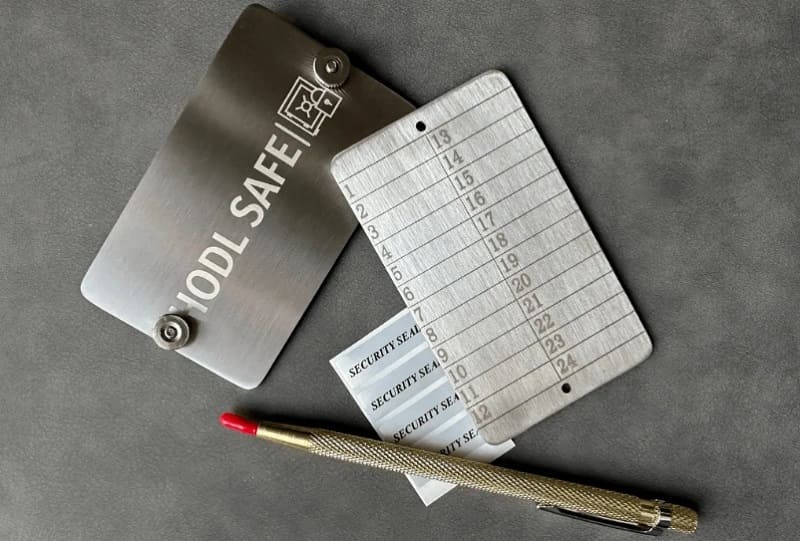
For meaningful capital protection, shifting to engraved stainless steel or titanium plates is highly recommended. These materials withstand structural fires, prolonged submersion, and chemical corrosion. Wallet creators increasingly describe metal plates as a permanent solution that ensures recovery data remains legible through localized physical disasters.
[Paper: Vulnerable to Fire/Water] ──> Upgrade ──> [Metal Plate: Resists Elements]
This doesn't mean a casual user requires premium metallurgy immediately. A modest balance can be adequately protected by a well-hidden paper sheet, whereas life-changing wealth demands investment in durable hardware.
Calibrating Redundancy: How Many Copies?
A common misconception is that proliferating copies inherently scales safety. In reality, every duplicate creates an additional physical location that must be monitored and defended. Too few copies risk permanent loss; too many maximize the chance of discovery by third parties.
The industry standard among wallet developers is to maintain two offline copies distributed across distinct, secure environments. This ensures a localized disaster like a house fire cannot obliterate your entire financial recovery loop.
Optimal distribution looks like this:
- One copy placed in a high-grade home safe;
- A second copy positioned in a separate, trusted physical vault;
- Both locations masked from casual visitors, contractors, or family members.
Avoid concentration risk entirely. Storing a hardware wallet and its single recovery card in the exact same desk drawer completely defeats the purpose of redundancy. If that specific room is compromised, both items vanish simultaneously.
Also Read: Trezor vs Ledger: Why the Debate Is Getting More Aggressive in 2026
Implementing Routine Audits
Preservation is a dynamic process. Ink fades, paper absorbs moisture, and metal plates can be misplaced. Furthermore, subtle spelling mistakes made during the initial setup can sleep silently for years until an emergency occurs.
Conducting a periodic, discreet inspection ensures:
- Every word remains perfectly legible;
- The physical protective seals remain untampered with;
- The storage containers have not suffered environmental decay.
To perform these checks safely, use your hardware wallet’s native "Recovery Check" applications. This allows you to verify the accuracy of your phrases locally on the secure screen without ever typing the words into an internet-connected computer.
| Material Strategy | Advantages | Limitations |
|---|---|---|
| Handwritten Card | Zero cost, completely offline, zero technical friction. | Highly vulnerable to fire, moisture, and tearing. |
| Engraved Metal Plate | Immune to extreme heat, water, and structural collapse. | Requires initial capital and specialized marking tools. |
| Dual Geographies | Prevents total loss from single localized disasters. | Doubles the required physical security footprint. |
| Cloud Hosting | Accessible anywhere globally. | Zero defense against remote server exploits and malware. |
| Desktop Notes Apps | Immediate access for copying/pasting. | Exposed to hard-drive scrapers and automated sync tools. |
Summary
The overwhelming majority of blockchain asset losses do not involve breaking complex cryptographic equations. They are caused by common digital conveniences. A snapshot taken for temporary convenience, a PDF archived on a virtual drive, a phrase typed into a self-chat — each act seems benign in the moment. Together, they multiply the locations where private keys can be compromised.
The most resilient protection strategy relies on old-school principles: isolate data from networks, protect the physical medium from degradation, and implement calculated redundancy without expanding your risk profile. Convenience and absolute security are fundamentally opposed; every digital shortcut you create to make accessing your funds easier makes it equally simple for an intruder to steal them. Hardware wallet manufacturers continue to recommend offline storage because it eliminates entire categories of online risk before they can be exploited.
FAQ
Why is taking a digital photograph of a seed phrase so dangerous?
Modern mobile operating systems automatically sync camera rolls to network hostings. This means a single snapshot creates multiple unencrypted duplicates on remote servers beyond your operational control.
Can I use cloud hostings if the text document is password-protected?
While local encryption helps, security teams advise against keeping key phrases on any machine that connects to the internet, as network access exposes files to advanced keystroke loggers and system memory dumps.
Are mainstream password managers safe for seed words?
Opinions vary, but premier hardware wallet developers recommend completely separating core recovery keys from web-connected password managers to eliminate unified single points of failure.
Is handwritten paper still a valid approach?
Yes. An offline, handwritten card remains highly secure against remote exploits. The challenge is entirely physical, requiring strict protection from environmental elements like water and fire.
How many recovery copies should I create?
Two physical copies stored in distinct geographic locations offer an ideal balance between protecting against physical destruction and minimizing the risk of third-party exposure.
What is the single biggest operational error users commit?
Prioritizing digital convenience. Relying on cloud drives, chat archives, system clipboards, and local notes apps creates invisible electronic footprints that drainers can easily exploit.
Sources
- Ledger Academy — Seed Phrase Storage Best Practices
- MetaMask — How to Store Bitcoin Safely: Self-Custody and Hardware Wallets
- Unchained — Seed Phrase Backups: Paper, Metal and Other Methods
- ACM Digital Library — Research on Cryptocurrency Wallet Backup Practices and User Behaviour
Get professional help with your case.